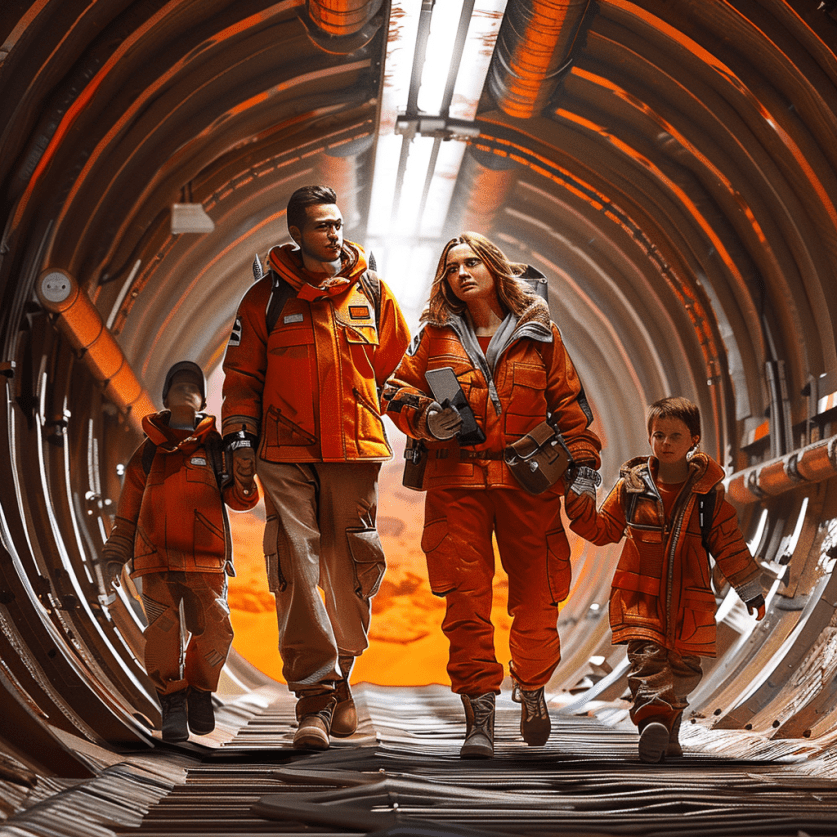
(I might just have to reuse this article title from time to time — it seems so useful.)
Since I’m going to be a bit critical, I’ll try to avoid being explicit about the author/title. My issues are with the work, not the person.
I closed this book with that “what did I just read?” puzzled feeling.
“Why,” you might ask?
Well, I was still waiting for the real story to start, and then the book just ended. I had to write this article to articulate what the issue was.
This SciFi book was a didactic world-building piece, a tale to make a point about a premise, an illustrative essay, with few or no organic “story beats”.
Under the guise of a tale about a family immigrating to Mars, we are taken thru their learning curve of schooling, custom, and background as an ever so slightly masked info-dump.
The particular purpose of this story (made explicit in an afterword) was to explore the implications of a benign singleton AI (and, perhaps, an implied universe of them).
The characters are wet cardboard (like a damp cozy) who exist to provide “what it’s like” walking-around data. No tension, no drama, no stakes, even while demonstrating how populations can come to terms with all-controlling (implied benign) AI rule. No tyranny to evade, no possibility of escape, and little desire to do so. The AI is effectively a deity.
Mind you, I’m not complaining about the choice of situation to explore, but reading it was like trying to get a grip on jello — there was nothing in “story” terms worth the effort. Granted that what readers think about what the characters are doing is part of the story being told, nonetheless there does need to be a story situation for the characters to care about, too, to hold my interest. We identify with people and their goals (for various values of “people”), not situations, and if the people experience no story tension, it’s hard for readers to, either.
The author may have been focused on making subtle essay points (e.g., if there is a godlike benevolent AI, then people will adapt themselves accordingly), but a story needs more than that — it needs characters who care about things, who experience successes and failures, who change from one state to another in the course of their story.
The best this specimen can manage, at the end, is the brief assertion that our main character and his family (personal & extended) will decide to try and make their own space explorations, but since the (benevolent) AI is not expected to stand in the way, it’s hardly an example of catharsis and release for the reader.
So, as a “for instance” example of life under a benevolent godlike AI, this is adequate, but as a story it’s not just boring, but tedious. All the time is spent wandering through “ooh, what is life on Mars like”, but it’s all vanilla — no tension, no conflict, nothing to engage the story-reader. “Sense of wonder” is a fine thing in SFF, but it can’t stand as story all by itself — there also needs to be an actual story.
Now, didactic story-telling doesn’t have to be dull story-telling. For a successful example, I give you: Atlas Shrugged.
Ayn Rand certainly has a didactic point to make, and she periodically erupts into explicit discussions between the characters about it, but she also, by god, has some terrific characters and situations, and we care about the story, whether or not we worship at the altar of Randian Objectivism.
Another spin on the situation is one of the common Horror genre tropes: presenting the horror-machinery by demonstrating it using characters we don’t care much about, so that we can analyze and admire the actual horror mechanism itself. (Cabin in the Woods is a good example of this, as a sort of parody.)
So my point is that riding your particular hobby-horse isn’t necessarily a bad thing, as long as you don’t forget tell a real story, too.
Ever encounter any examples of failures in this area?



 Mad Genius Club
19 responses to “What Did I Just Read?”
Sherri Tepper had a novel where there was some sort of organic AI that guided people to get everything right. IIRC, there was a plot.
As to your question regarding other examples, it’s hard to remember them. One tends to stop reading at a certain point.
This is not, of course, just a modern problem. I was moved recently to reread Swiss Family Robinson (not since adolescence) and found a much longer and more complete version of the original than I’ve ever seen before. To my adult eyes, it’s (shall we say) an overly complete and somewhat boasting account of survival, but in the exemplar Christian style of the period there is no internal conflict among the family members, and (like many survivor stories) it devolves into a sort of engineering tale of competence, with agriculture and hunting standing in for machinery. (Defoe, and even Andy Weir do it much better to the modern taste.)
I expected nothing different, but imagine my horror in the discovery of a final section of the book (new to me) where they encounter more castaways (women, this time) and the whole process starts over again. I assumed this was to provide wives for the original sons, and just couldn’t make myself plow through it to the end, just for the sake of completeness.
The Fun-And-Games of Swiss Family Robinson is that there are several versions of it around.
IE Various writers over the years have “added to it” so it’s hard to know what the “original” version actually was.
Oh, the version I read had the oldest boy finding a shipwrecked woman and the people searching for her rescued the Robinsons.
Note, the parents decide to stay on their island and the boys left the island.
That’s the version I read as well. IIRC, the implication was that now that they were found, they would stay found, and be the head of a new colony once word started getting around.
That’s the version that I have, apparently.
I believe Jules Verne’s The Mysterious Island is also along the engineering lines (definitely without Christian moralizing). I’ve only glanced at it, but one of my brothers really enjoyed, mainly because of the science and engineering.
https://www.gutenberg.org/ebooks/1268
Verne P.S. The original version of 20,000 Leagues Under the Sea is a bit different than the standard English translation and is more explicit that Nemo’s enemy is the English (backstory is that he was an Indian prince or similar – I’d have to dig up my copy to be sure of the exact details)
That’s the background used in “League of Extraordinary Gentlemen”.
From what I understand, Nemo was supposed to be a Pole angry at Russia in Leagues but his editor insisted he make it ambiguous. The Indian backstory was solely for Island. From what I understand.
I know which story you’re talking about – I’m a fan of the author’s work and have read a lot of his books. I thought there was a touch of cosmic horror to the whole thing as the central family and other characters slowly realize how much they are being manipulated, but you’re right, it was extremely underplayed. This author focuses quite a bit on economics and social structures and how they might develop/change under conditions of space travel and new environments. I thought the bit about the colonists’ Friday night meetings, and how they can no longer remember the original reason for them (Shabbat no longer exists?) was interesting.
True, there isn’t all that much at stake, but I enjoyed it.
All true, but the cosmic horror was less on the part of the characters (there was a lot of “shrugging, what can you do”) than on the part of the readers, and I’d rather get my jollies on the story ebbs and flows from the characters. That’s why I think of it as didactic — it’s showing us something the characters don’t seem to feel themselves.
There are horror stories where the characters never quite understand what’s happening, but I find active players far more engaging than puppets. These were nice cozy-ish (ultimately boring without conflict) puppets.
I’m not averse to seeing what else this author has written — they can’t all be essays on the same topic 🙂 and the world building was plausible. Just not enough to carry it, IMHO.
I would expect cosmic horror to still require a conflict to work. The characters are trying to do something, but the sheer weirdness of the environment they are in keeps thwarting them, until the futility of it all either destroys them or drives them mad.
In examining the picture at the top of this article, I noted a curious detail: None of the characters look the least bit happy, or interested. Their expressions range from resignation to disgust.
Seeing that on a cover would not make me want to read the book, lest it leave me wearing a similar expression.
Well, that’s not the actual book cover, of course, just a lazy and unsophisticated use of Midjourney. The actual characters are pleasant, in the “cozy” mode.
The video game Outer Worlds. The plot really just got started and then… the game ended. It literally felt like they got tired of writing.
The problem with stories like this is often that the author is so invested in how wonderful their AI / magic system / world / utopia is, that they want to show off how it goes “if everybody would just…”
To create a story, you have to have conflict. And conflict? Conflict requires acknowledging that everybody will not “just.” It requires looking at the cracks in the system, the failures, the holes, the unintended consequences of “if this goes on…”
It requires stress-testing, and that destroys the perfection that the author is so proud of creating.
You could do a Man vs. Nature plot there. But that’s a trifle limited.
Well, you could have conflict between competing visions, both of which have their pluses and minuses. A cultural example: some cultures emphasize intellectual achievement, while others emphasize family or tribal bonds. So the conflict isn’t between just/unjust, but between competing visions of what is good.
I just gave up on Joe Haldeman’s The Accidental Time Machine for this precise reason. The first third of it was about a man who creates a time machine and has to figure out the rules by which it operates, and then suddenly we were transported into a future that was basically, “Wouldn’t it be horrible if these dumb religious people were in charge” and the story stopped dead to go on and on about how science can only be done by atheists. There were several interesting concepts and one weird mystery set up in the first third, but then he just dropped all that to ride his hobby horse.
I’ve been reading classics that I never got around to, and the one that reminded me of this is Kim Stanley Robinson’s Red Mars. As a geography (areography?) textbook of Mars and how humans try to adapt to it, it was fascinating. Now Robinson does weave character conflict into it, but I had the feeling it was mere window dressing, and I found myself not particularly caring about the characters.
Stories are about people and their conflicts and resolutions. Star Trek TNG baffled their writers at the beginning because Roddenberry had insisted that there is no conflict in his future. After he backed off (or died), the writers didn’t feel so honor-bound to follow that dictate and started writing real stories.