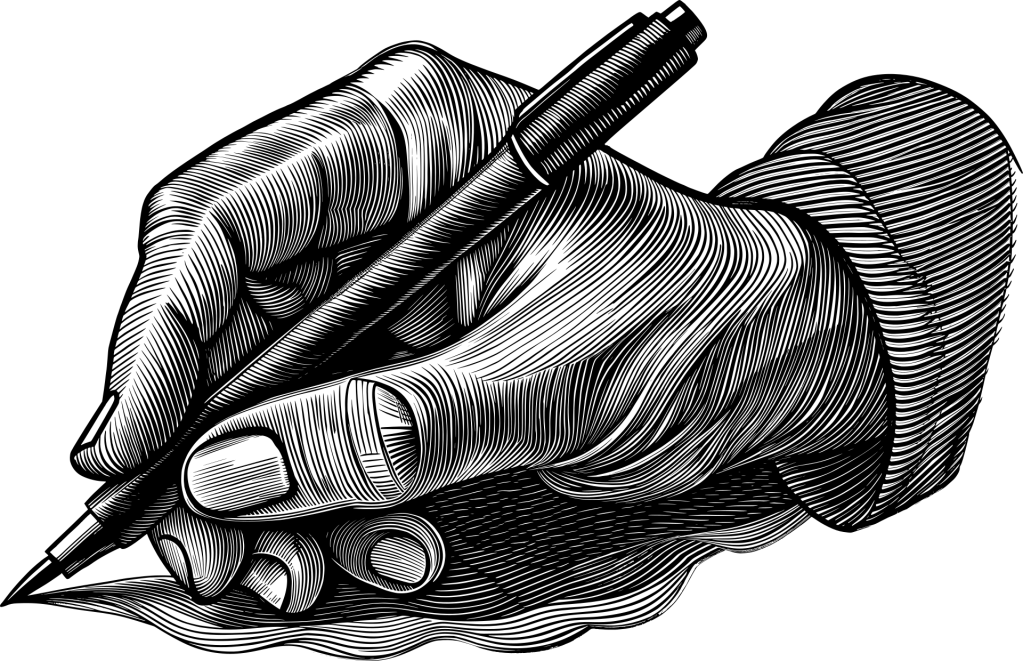
In Praise of Longhand – by Charlie Martin
I always write morning pages more or less right after I get up — I check my blood sugar, I ask Fitbit about my sleep, I weigh myself, then I shower and take my morning fistful of pills and supplements, and sit down with my morning pages notebook and start to write. My first cup of coffee happens in there somewhere, my caffeinated aqua vitae.
As I’ve gotten used to this — which happened long ago, I’ve been writing morning pages for thirty years or more — I started to notice that I actually enjoy writing in longhand. The feel of the paper, the pen in my hand, the unstudied elegance of the words appearing in black ink on the white paper. If I get up in the morning in a bad mood, or feeling the effects of a short night, or if I’m worrying about something, the morning pages let me talk it out. The notebook doesn’t judge — and if you feel like you are being judged, I’ll tell you a secret. It’s you all the way down.
I call that the critic on my shoulder, and over the years I’ve learned how to deal with it. It means well. I’ll write more about it sometime, but for now the short answer is to realize the critic may be harsh, but like a nagging parent, it’s trying to help. Thank it, and keep moving.
Sometimes — it happened today in fact — I find myself wishing the morning pages wouldn’t end. I finished my third page and went upstairs to the office, planning to write something for money … and I just couldn’t. I sat with a file open and waiting, and I fussed with my headphones, I looked for just the right music, I checked comments on my recent posts and articles, and nothing was happening.
Until I finally decided that I would give in to that impulse and go back to writing in longhand. I came back downstairs in the comfy chair, with pen, and clipboard with pad, and just started writing in longhand again.
I didn’t have anything in mind — I certainly wasn’t writing anything for any market or with any purpose of publications — I just started writing, freewriting, finding out what was going on in here.
It turned out, in a perfect postmodern, self-referential moment — I am aware of the status of my discourse — that I was writing about the experience of writing in longhand. The sheer sensual experience. The satisfaction of seeing the paper filling, of seeing the words that I didn’t know were there until seconds ago. The satisfaction of having time to consider the words as they form in my head — like I was able to consider whether I really meant “sensual” or “sensuous” a sentence ago.
When I was in graduate school at Duke, I used to like to visit the Rare Books Room. It was what a library is supposed to be — not endless rows of metal shelves, but a wood-paneled hideaway with writing tables and librarians exuding quiet competence, unassuming confidence, unflappable calm. As well as shelves of old, beautifully-bound books, there were occasional exhibits in protective glass cases. The cases didn’t have the feeling of protecting the contents from pilfering, not like deodorant and mouthwash in an urban Walgreens, but instead a feeling that the contents were important and significant, encased in glass to justly call attention to the artifacts within.
At the time, I had just started writing with the intention of publication, maybe even in a place that would actually pay me for my work. One of the displays was a letter from the poet Walt Whitman — do I even have to say “the poet”? I fear I do — from the poet Walt Whitman to Harper’s Magazine, offering them a poem for the price of $100.
I’m told that room — the Mary Duke Biddle Rare Books Room — is now used as an exhibit space, which is a shame. I’m sure the real collection is now another soulless repository, as aesthetic as a safety deposit box.
It reminded me then, and causes me to recall now, that it’s only in the last century or century-and-a-half that typewriting was even a possibility. Mark Twain was proud to claim that Life on the Mississippi was the first book submitted for publication in typed form.
I’m certainly not going to write everything in longhand in the future, and for all the meditative sense I have writing this, I think I would often miss the way that, on a good day, words seem to flow effortlessly through the keyboard at a thousand words an hour.
Still, for everything gained, something is lost. I think that we have lost a little connection to the page that comes from drawing the words in fluid form as a work of our own hands.

 Mad Genius Club
12 responses to “In Praise of Longhand – by Charlie Martin”
An important subject, expressed elegantly! Thank you.
I feel as though I just had a mini therapy session. Thanks for that too.
Well, I only had about 10 years of talk therapy, so hopefully that gave me a little leverage
Reading the History of the Lord of the Rings right now – now that was a massive project of long hand drafting (typing only done once specific sections were more or less finalized), made worse by wartime paper shortages.
For me, longhand, aka the Boomer/GenX secret code(1), is mostly novel brainstorming or mobile gaming notes, and sometimes real life notes to myself. Journaling, in the “what am I feeling now” sense, doesn’t appeal to me in the least. The space regency occasionally insists on being first drafted in longhand, which I assume is the Jane Austen influence coming through, somehow. When it does that, I read it out loud into a microphone to computerize it, and run it through initial AI cleanup before tweaking it some more.
In my rapid, scratchy handwriting, done oftentimes in homemade notebooks with a series of clicker pens, the latter mostly from a big lot of promotional misprints I bought on ebay, there’s nothing elegant about the process. It is fun, and arguably soothing.
(1) supposedly, the reason the recently released JFK files have not been cross-indexed already by computer guys and their pet softwares, and any interesting nuggets dug out, is because of the FBI’s heavy use of handwritten notes and the difficulty of getting the pet softwares to understand it.
Not to mention the difficulty of humans in understanding handwritten scrawls when they haven’t been taught cursive, affecting both input parameters, and any human verification.
We haven’t quite reached the signature matching scene in Highlander, alas.
I’m really very fond of morning pages as a practice. My longhand is influenced by my doing lots of calligraphy in the SCA decades ago. My old roommate found it suspicious that my handwriting was legible.
5To say nothing of the problem of WHICH type of cursive is used. Takes awhile to get proficient in reading various styles. Other languages do cursive script too. There is even a German Fraktur cursive for those typefaces.
i met a man once who demonstrated writing English phonetically in Cyrillic Cursive handwriting which he told me he does a lot even though Cyrillic Cursive doesn’t fit English very easily plus some of the letters are misleading.
I grew up in the days before computers. We had typewriters…even electric ones…but they were heavy, expensive and uncommon. I actually learned the basics of typing during one semester of High School. We had half manual typewriters and half IBM Selectrics. We had to switch off half way through the semester. Fortunately I started on the manual and switched to electric later. I was amazed how much easier it was to type on an electric typewriter and I felt bad for the people who’d gotten used to that during the first half and had to switch to manuals for the second.
But I digress: my point is that I did a lot of longhand writing in my youth, so it’s not lack of practice…but was never particularly good at it.
Since the proliferation of computers (and even typewriters), I’ve preferred to type because I can do it way faster than I can write by hand and as an added bonus, you can actually read it. When I write by hand, even I often can’t read it later.
I can force myself to slow down and make it legible, but then it looks like the handwriting of your average 8 year old…and takes even longer to write, which reinforces why I type everything.
Even things I’m committing to paper rather than electronic media, I’d rather type them and print them out, than hand write.
I do still write in longhand occasionally just to make sure I still remember how, but I don’t have the artistic talent that God granted to a snail and it shows in my handwriting. I have much admiration for people who write beautifully (my mother is one), but I’ve never formed that sentimental attachment to the act because it’s just not something I’m good at.
Kudos to you for keeping that emotional connection going.
I was given a typewriter for my 14th birthday because it was obvious I’d make my living by words, one way or another, and “It will serve you your entire life.” …. yeah, that.
Oh, yes, the pain. It has always been painful to me.
I laid a curse on longhand writing and threw it out the door just as soon as I got hold of a copy of WordPerfect (I miss it still).
Some things do go on paper – writing into greeting cards (where I use a self-designed “scripty” printing), and grocery lists. For those last, I use a shorthand – such as “shred” for “shredded cheese,” “ground” for “ground beef,” or “roma” for “roma tomatoes.” Just enough to remind me of what I’m supposed to come home with.
Probably a couple dozen words, at the most, in a week actually end up as hand-laid ink on paper.
Ah yes…WordPerfect…the quintessential “word processor” software.
I remember it fondly as well.
Sadly my RSI in my writing arm limits my ability to write sustained longhand. However, I found that the act of physically writing out my first drafts helped my process a lot when I was starting out. The physical act imprints extra neurons in the brain associated with the actual words being written.
Thoughts on whatever I’m writing (and occasionally new projects) occur to me out of the blue, typically but not exclusively in bed, and I have a practice of accumulating the resultant quick notes (using binder clips, 1 per current-series book, and loose notes for the random stuff), unless it’s for the current work-being-written, where they get fed into place directly (the written part or the upcoming parts). Part of the fun of beginning to write a new work is taking its pile of accumulated notes and letting that drive a lot of the outline-ish process at the start.
Some scenes-in-process get so much rumination offline while being produced that ridiculous piles of one-line notes participate in the activity, down to individual word choices.
But longhand? Only for these scribbled notes, never the actual writing.