
As I so often do, I commented that I was having trouble coming up with a post to my husband. Turns out, he had Ideas, so this is his idea, I’m just transcribing today.
He pointed out that many years ago, as a teen in the 1970s, he’d read and enjoyed all the Don Camillo stories. Then I’d picked up a copy in the last decade or so of the collected stories, and he’d started reading and couldn’t finish it. It could be, he pointed out, the difference between a teen reader and a mature adult, but he didn’t think so. He thinks it’s actually the translations. The books he’d read and enjoyed in the 1970s were old then, and probably original translations done in the 1950s. The copy I’d bought was translated sometime after 1980, and is very different than the ones he’d remembered.
He’d been thinking about this, it turns out, because of the recent internet brouhaha over the various translations of the Odyssey, and how the most recent translator as shown in this comparison is pallid and lifeless compared to the scholars whose shoes she was attempting to slip into.
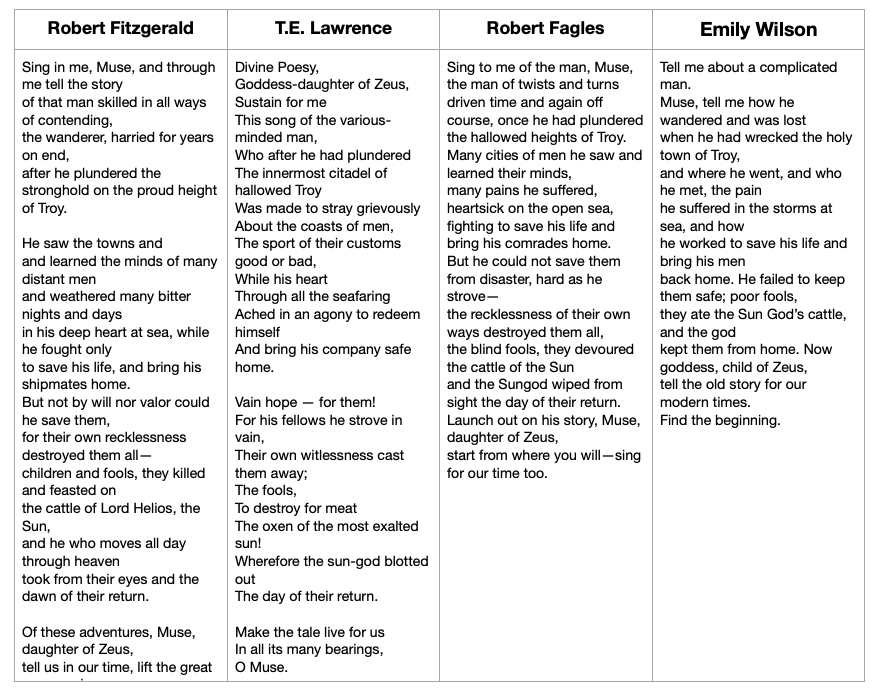
A translator, he pointed out, can be a huge part of taking a story from one language to another successfully, and while I may not be interested in having my work translated, others who read the blog may be, and he wanted to know how they might make sure that their work was translated not just correctly, but in that more difficult manner: engaging and entertaining, in a new language.
So, gentle readers? What do you think about translations, either reading or of your own works?



 Mad Genius Club
30 responses to “Translations”
In school, I had the dubious honor of running into a translator that actually managed to make Dumas boring!
Fiction is more difficult because it isn’t just the technical correctness, but the underlying humor, conveyed meanings that aren’t spelled out, and beauty of construction. None of that is a straight-across language translation.
Also cultural assumptions and customs that are simply presupposed. That’s why anime, whether dubbed or subbed, tend to have fairly hefty liner notes, to convey all those little elements.
Even the same language across enough time can run into these things. Shakespeare is full of these things — why does “I bite my thumb” rile up several characters in the beginning of Romeo and Juliet? And a whole level of interaction in several plays depends on violations of social norms in a language with an active t/v distinction in the second-person pronoun, something that is apt to fly past the average contemporary monolingual reader.
I remember reading of a PG Wodehouse enthusiast for whom English was a second language, who commented that trying to translate Wodehouse was an exceedingly difficult task due to the wordplay and nuances in the text. I would agree with that.
That last translation by Emily Wilson has some sort of ideological problem. She leaves out _entirely_ the point all three of the others make about the ‘man of twists and turns’ and how he was _deliberately_ driven off course and forced to learn about others. “harried for years” “made to stray grievously” etc. Since that is the crux of the story, and she misses it at the beginning, I suspect her translation is really hopeless. Oh, and she misses the part where the hero can’t keep his men safe because of _their own_ reckless witlessness. Two mistakes right off the bat.
I wrote a beginner book about Dante and in the process read parts of ten different translations so I’ve got opinions as a reader though not as an author. A translator has to be sympathetic to what is being translated, or it won’t be any good.
Rex Stout’s Nero Wolfe books were translated into many languages. I’ve seen the covers. They aren’t exactly high literature though I love them. I guess the real thing about translating, um, let’s say Dorothy Grant, would be whether her Polish or Romanian audience needs the translation, or whether they could read English anyway.
I generally dislike light novels and since this is independent of author, it may be due to common genre traits, but I suspect translation has its hand in there.
I honestly think this is why light novel-to-anime or manga and then subbed comes across much better than LN translated to English. Description being translated visually gives the translators more breathing room to come up with the translation that fits the story.
Light novels are messy to translate. My Japanese is good enough to work through them slowly (or was, for a while), and they’re simply not structured like English prose. Even ignoring the extremely colloquial language used, it’s not unusual for a scene to have several pages of unlabeled dialogue with only a few bits of narration sprinkled on top. With the big increase in the number of novels translated, both “pro” and fan translations frequently have awkward, clumsy, or just plain wrong scenes. And then of course there are the woke “localizers” who think they’re better writers than the original authors…
-j
I’ve read translated non-fiction that shades the meanings of the original, and required me to go back to the original in order to make sense of things. Fiction … I tend to prefer older translations of classics, in part because of the more formal language. Some attempts to update older novels into modern English fall very flat. Overall, I will read translated works, especially if the original is in a language I don’t speak or read. MomRed reads lots of translated novels, and enjoys them.
As a translator, I try to stay as close to the author’s tone and apparent intent as possible. This is especially hard with dialect dialogue and poetry. Some things literally do not translate, because there are so many cultural implications or understandings behind them.
Science Fiction, with invented tech and terms . . . could be difficult in a whole new way.
Indeed!
Then there’s the “translators” who want to “tell the story as they want it to be” rather than “tell the story that the original author wanted to tell”. 😒
Oh, but they’re just improving it by taking out those outdated ideas and making it relevant for the Modern Audience! 😛 You know, like the last four or five generations worth of “translators”.
I wonder, after half a dozen or so such ‘reworkings’ of the original story, what’s left?
The internal translation is strain enough—in my side-novel (soon to become the main project) I am having to move between Iphigenian and Korean and present both as English at the appropriate times while throwing language obstacles between them. There are whole social constructions that don’t translate.
That said I admire anyone who can produce a readable translation but how can anyone ever know it is “right”—especially from distant points in the past? I’m reading a Greco-Roman novel right now in two translations and they are similar but different works!
(I wouldn’t trust a modern translation farther than I can throw it.)
To focus solely on the particular example… I studied Homeric Greek (and other dead languages) in college (I blame Tolkien, after I dropped out of Math), and that knowledge lives vividly in the working brain of the translator of something ancient.
Epithets matter. For a single example, the standard epithets for “Saint Nickolas” are “Jolly” and “Old”. They are epithets, not descriptions, the difference being that an epithet “stands in” for the character (that’s a translation of the term “epithet”). You could refer to Santa Claus as “the jolly one” and have a good chance of being understood in the common culture. Epithets are very important as stand-ins for characters in Indo-European formulaic poetry. They function as one-word summaries.
Odysseus’ primary epithet is “polytropos”. He’s the “polytropos guy”. A literal translation would be “with many tropes” (a “trope” being a twist or turn). He’s not just clever, or smart — he’s twisty about it. I would translate the epithet as “wily” (someone with many wiles), which captures both the cleverness as well as the twistiness of the original. This is a relatively rare case of the original word and the translation using similar metaphors as descriptors, and having the right words available to use in the destination language.
Any translator knows this level of detail about what he’s translating (I hope) and what the nearest equivalent (both meaning and flavor) could be in the target language (if he has any flair), and reviews of competing translations of Classical originals are full of wars about this.
But… a lot of the differences in the quoted examples above arise from the goals of the translator:
* Will it be “literal”? what about readers who don’t understand anything in this ancient period and place — should I sprinkle in some clues that the original doesn’t bother with?
* Should it seem contemporary or not? Should I preserve the antique flavor or pander to the low information reader? (Example in a nutshell: “Once upon a time” vs “A long time ago”. Should modern slang in the target language make an appearance?
* If translating from one contemporary language to another, what about all the characteristic details which are unique within the cultures? Should they reflect the relationships within the originals, or the flavors of the destinations?
* What about translator privilege (can’t a translator have some fun)? Writers of early dime Westerns made use of their Classical Greek educations. I guarantee you will be surprised in your Classical Greek class when you realize that Homeric heroes, when they die, literally “take the dust between their teeth” (aka “bite the dust”).
BTW… that latest translation, which uses “complicated” for “polytropos” went (in my opinion) too far. As an amateur linguist, I appreciate the use of the Latinate “many-folded” as a literal rendering of the Greek “many-turns”, but it substitutes one dead-language etymology for another. We understand what “complicated” means, but it doesn’t have much flavor for something that is so essential to Odysseus’s busy mind, which is why I find the rendering of “wily” so superior – more active than simply a characteristic.
If Kipling had made a translation, he’d have called Odysseus stalky. Unfortunately he doesn’t, but he does translate the poem about Regulus in Stalky and Co https://www.kiplingsociety.co.uk/tale/regulus.htm
The linguist in the family tries not to look at the subtitles when we watch MHz Choice, because he says they mess up regularly. I can’t vouch for the one Austrian show we watch (Inspector Rex), but with even my limited French and almost nonexistent Italian I occasionally go, “Gee that’s not a great way of putting that into English” on the shows we watch in those languages. In particular, they botch (or intentionally bury) a lot of references in Murder In and Dom Matteo to Catholic religious concepts, but even just basic relationship and cop talk get kind of fumbled from time to time. At one point, the linguist’s spouse was trying to see if there was some way the linguist could sign up to do translations for MHz, but alas, they do not crowdsource.
My Japanese teacher taught a culture class which included haiku poetry. Since it wasn’t a language class, she needed a book in English, and she wanted it to have plenty of good haiku (she and her husband were professional translators and part of the literary community in Japan).
Reluctantly, she chose Harold Henderson’s “An Introduction To Haiku”. The reluctance was because he’d tortured the translations to make them rhyme.
-j
Surely that’s a shooting offense? Was there no katana on hand?
My favorite novel for many years was The Brothers Karamazov, which I happily first read in the MacAndrew translation. (Fair warning: it’s a quirky translation, and in a few parts, extremely 1960s.) The introduction by the translator compared translation as orchestrating a symphony for strange instruments, which struck me as a reasonably apt comparison.
I tried, twice, to read the translation that brought the novel to English for the first time, by Constance Garnett, who did other translations I quite like. But her Karamazov was bizarre, giving London dialects to Russian peasants, and making choices that did not work for me (a chapter MacAndrew called “Torment” she called “Lacerations”; which one feels stronger, just as a word communicating feeling?).
So, yes, translation matters.
I canrecall two notable translation encounters in my life. The first was when I had to proofread an English translation of a chromatography product manual from a German company. Even in such a dry, very technical situation, the English version missed the spirit of the original German. It’s not just fiction that needs a good translator.
My other encounter was with Beowolf. I don’t recall the translator, but it had the oldest written version of the saga side by side with a version “translated” into 20th century English. Between my (back then) passable German reading ability, and the fact it was written in the precursor to modern English, I just had a feeling that I could almost read the original. Then again, Beoworlf was a spoken saga, so any transcription was itslef a translation. I’d rather not get into translations of translations…
All Indo-European oral-formulaic poetry is spoken/sung, and all of it was written down from speech. It’s like recording the traditional British ballads by listening to a singer, from Homer all the way up. That’s not a matter of translation at the time of recording it — transcriptions are not translations. A transcriber may make a mistake in what he thinks he heard, but they are literal. (The unnamed monks who transcribed an oral version of Beowulf (not their monastery-sanctioned task) were doing their best). Sometimes there are multiple transcriptions (fragments), just as there may be ballad variants that took different paths before transcription. The “formulae” in the name of the form refers to the metrical pre-built vocabulary fragments that allow the poet-of-the-moment to recreate the story for his audience. The story is indeed recreated in performance, not memorized.
These are the same fragments and metrics and uses that give us a broadside ballad (Creeping Jane) where a racehorse does the following: “And then she lifted up her little lily-white hoof / and she flew past them all like a dart.” — Note the ur-English meter and the formulaic “lily-white hand” repurposed for the usage, because its meter fills the need, even if its sense is a bit distorted. This is exactly how oral-formulaic poetry works — a given meter, a known story, a treasure store of usable phrases to tell the story.
The rhythms of Beowulf often strike native English speakers as alien, since the alliterative half-line (“Bare is back / without brother behind it”, from an Icelandic saga, quoting a proverb) didn’t persist in English poesy the way it did in Scandinavian and German equivalents. Once you get past that, it’s just as seductive as all the rest of the Matter of the North.
You can see that same pattern today in both filk and Leslie Fish’s Kipplefish songs: she’s had to revise the words, both to fit the tune she’s singing to, and to translate to modern language. Plus her own beliefs, of course; she’s pagan rather than Christian, and so her published adaptions of “Cold Iron” usually leave out the last line/stanza: “Iron out of Calvary / Is Master of men all!”
A thought while writing my last comment – do you think our AI Overlords (AKA the Large Language Models) will ever be able to come up with decent translations of classic works? Or perhaps since “ever” is a very long time, maybe within our lifetimes?
DeePl. It’s far from perfect, but there are authors who use it, with human assistance, for their international readers.
“To translate is to betray a little”
…to translate badly is to betray a author and audience both.
I will merely note that on my shelf is the WHD Rouse translation from 1937, since I guessed it was possibly the Odyssey I read in middle school back in 1980. There was also a different one I studied part of in about 11th grade English class. (Now what Illiad I read I am a bit unsure. That one is NOT Rouse. Was it Alexander Pope who used the Roman names for the gods?)
THere is a quite length comparison of Odyssey translation on Reddit.
https://www.reddit.com/r/classics/comments/l7yl6h/every_modern_iliad_translation_compared/
My first encounter with the difference a good translation makes was Inu Yasha.
A fansub, by the kind of person who put a block of text explaining that the spider lady with a comb theme was a yokai formed of a comb used to prepare the dead for burial, vs one of the early “for kids” professional one.
The professional one was HORRIBLE. It was like they got someone who knew nothing about Japan except for the language, and then further assumed the folks watching anime were about eight years old. And the fan sub did a better job of conveying characterization, humor… I am now wondering if they used an early computer translation service and then had someone fix the grammar and make it “appropriate,” it was so bad.
The sub on Crunchy is much better.