I was amused recently in listening to the editors at Raconteur Press comparing notes on trends in story submissions. Werewolves, it seems, are the ‘in’ thing currently. Looking back at my reading history, werewolves have alternated with vampires for top monsters in tales for some decades now, every few years one giving way to the other temporarily.
And, to be very fair to the authors, their subconscious, and the monsters, I understand why, to a certain extent. When we look for the villain of a tale* we are looking into the darkest corners of our nightmares, and the shadows of the myths, legends, and fairytales of yore. Vampires and werewolves, preying on the innocent, are awfully handy for the purpose of the storyteller.
However! Too much of a good thing is overdone, and burnt cake is only good for throwing at the chickens. I strongly suggest research. And not, dear readers, simply searching your preferred browser. The older the better, in my opinion. Less dilution from the original source, for one thing. More likely to have been forgotten and overlooked, for another. If you can’t afford to buy a couple of books, hie thee to the nearest library, who can at least inter-library loan some books if they don’t have them on the shelves.

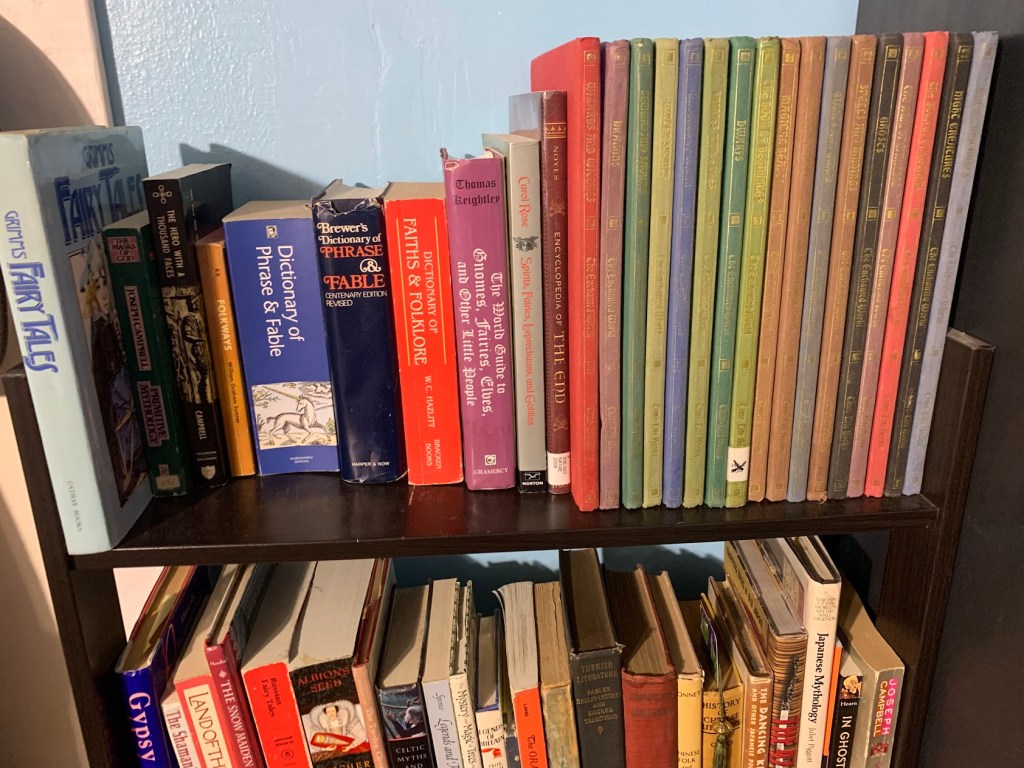
The two books I’m recommending today are Brewer’s Dictionary of Phrase and Fable, and Keightley’s The World Guide to Gnomes, Fairies, Elves, and other Little People. Both are freely available online as they were written in 1870 and 1880 respectively, and they will be a good start to finding interesting directions to take monsters, fae, and many other stories from.
I had them out, along with the also good (but not free) Spirits, Fairies, Leprechauns and Goblins by Carol Rose, as I was doing a bit of research before I write the introduction for Goblin Bazaar, and upcoming anthology from Raconteur Press. The word goblin itself seems to have originated in France in the eleventh century, but the creatures are linked to Paracelsus and his coining the phrase ‘gnome’ from the Greek for eath-dweller. Gnomes, goblins, and kobolds (German origin) are all very similar, living in mines and caves, playing tricks on humans. They can be kind to children, but only when the children are good. Naughty children will be punished! Mothers would threaten a misbehaving brat with the goblins. They were known to weave horse’s manes and girls’ long hair into ‘elf-locks’ which are known in the modern era as dreadlocks. However, goblins and kobolds both were also house-spirits, like the English hobgoblin or the Scots Brownie. They would play tricks, make noises, but offered protection of the house and family belonging to it when treated with respect.
I think you can see how the concept of the modern interpretations of the goblin departed from the origins, and have changed over the centuries. Such as it is, the historical tales are different, and fortunately with fantasy we need not worry if they are overly factual. Perfect fodder for the author!


Off you go, then, and have fun! There are so many monsters just waiting to creep out from between the pages and into your stories. Leave the werewolves and the vampires to rest a while, poor dears, and discover the lost ones who haven’t appeared in mass media a half-dozen times in the last six months alone.
*Look, I am very, very aware of the current trend towards making the villains into the good guys, and from there into the hot new F*ckb*ddies in chicklit. That doesn’t obliterate the origins of men who walked as wolves, devouring all they came across, or the slow consumption and death in pallor of tuberculosis that came to be called the curse of the vampire. Nasty, foul, and evil. Do I think that drift through tales over centuries can have honorable werewolves and vampires? Also, yes. But explain yourselves! Don’t just make it so, that’s not subverting a trope, it’s tossing it out the window and ignoring the screaming and resulting splat.

 Mad Genius Club
40 responses to “Monstrous Research”
Ooo, I have that collection. (The tall hardbacks on the right of the top shelf). I suspect they will be more interesting to adult-me than they were to child me. Thank you very much for the references!
You are welcome! Yes, the Time-life series are very pretty, loads of lovely illustrations. I discovered they were a thing and have slowly been collecting the whole series (I think there are 20).
They were also my introduction to the ungentled versions of some of these creatures.
For what it’s worth, there are 21 volumes in the Time-Life Enchanted World series. I bought 20 volumes from a used bookstore 17 years ago, and spent the next several months searching for the missing volume. I finally turned up a cheap copy on eBay, and completed my collection. The series came in handy during my years as a performing storyteller.
I didn’t know! I was buying them from Time Life when they originally came out, you were sent 1 per month (I also have the Vietnam Series they did). I have 14 of them and never knew that there were more! Now I’m going to have to search them out!
Wikipedia’s article on the series might prove useful during your search. It lists all 21 volume titles, ISBNs, etc.
https://en.wikipedia.org/wiki/The_Enchanted_World
I dearly want a set, but have neither space, nor space, nor spare funds just now. Or space.
I got a set at a library sale, my kids nearly melted down with joy.
First set of books I ever read out of the not-cute-animals-on-the-cover section of the library.
They were a birthday present long, long ago. I understand the space issue. So many books. So little shelving.
Shelving, floor, cat-shelf steps, top of bookcases …
If someone digs further into vampire lore, it turns out that there are a lot of variations on the theme of the undead. Some never leave their graves, some do walk, some can speak but others can’t, some bring plague to entire towns, others are more ghostly and are warnings of trouble but do not cause trouble themselves. Oh, and archaeologists have found neolithic bodies treated in ways to keep them in the grave, as if the people around feared that the deceased might return. [sees soapbox sneaking up, hurries off]
Vampires, werewolves, but what about incubi and succubi, the Wild Hunt, Frau Pechta and other earth or water spirits, the Mari Llawd (perhaps a recent invention, perhaps not and used very well in Silver on the Tree), water spirits of varying kinds … I’ve noticed some writers looking at Russian folklore, and Judaica, although the Russian stuff seems to be “rehabilitate Baba Yaga and bash the Church and Patriarchy!!!!!” Yawn.
Russian folklore was my first love. My first book was a large edition of the illustrated stories – received the Christmas following my birth! Improbably, given how many times I have moved since then, I still have it. Baba Yaga is complicated. She could be kind to maidens, if respected and treated kindly. But there are many others who are equally interesting.
I feel you on the soap boxes. Vampire legends are really interesting, as are werewolves. I’ve enjoyed your exploration of the latter in the Elect series.
Russia has a theme of “this is dangerous but may still be helpful if you treat it right” in their fairy tales. Baba Yaga also helped one of St. Vladimir’s Reitsar hunt down Koshchei (so it wasn’t just maidens). On the other hand treat her wrong and into the cookpot you go.
In the stories I’ve read, Baba Yaga is treated less like a villain than like a force of nature; she’s evil, yes, but she’s predictable to a certain degree, and something you can deal with if you have to; in fact, if you’re clever enough, you can redirect her power to use it against the REAL villains (evil stepmothers and the like).
A lot of Russian Fairy creatures are treated that way. They’re dangerous, but so is a wolf. (Though interesting trivia, they use a talking Wolf rather than a fox or cat as the ‘helpful creature’. The Wolf and Brother Wolf are different… and Sister Fox typically outsmarts herself.)
Some heroes give her the holy-whatfor if she doesn’t offer them a seat and food and drink — improper hospitality! — and she will admit they are right.
One of my favorite versions of the vampire is the Polish one that is so bloodthirsty it sleeps floating in its own coffin filled with blood. And that is active from midnight to noon. Which can be a nasty surprise for ‘clever’ vampire hunters that figure that Count Tomazski is going to be asleep as soon as the sun comes up.
Some vampires come from werewolves rising from their graves!
There are some lovely and less well-known entities to exploit. For example, as a fiddler of traditional Scandinavian folk music, I am well aware of the “neck” (nixie) who is found at the base of a waterfall, fiddling. If you are polite, he may teach you a tune. If you are arrogant, however….
One charming usage comes to mind in a Swedish folk tale. The “huldra” is a sort of forest spirit who looks like a maiden, but her back is hollow, and she has a cow’s tail. Young men encounter her in the woods. She’s not necessarily hostile, but certainly uncanny. In the tale I’m referring to, a young man comes to a village dance and spies an unknown young woman standing next to the wall, admiring the dancers. He notices the tip of a tail dangling down, and very bravely joins her and mutters, “something’s showing”. He turns his back courteously while she makes an adjustment, and then invites her to join him for the next dance. Needless to say, good fortune befalls the village.
It’s just a version of the “be polite to the fairy and it will profit you” story, but something in the considerate and discrete language has always pleased me.
Have you seen The Science of Fairy Tales by Edwin Hartland? It’s PD, and a fascinating exploration of many of the changeable maiden stories among other things. https://www.amazon.com/Science-Fairy-Tales-Inquiry-Mythology-ebook/dp/B0082RYYPA
Yes indeed, and thanks for the links. I actually majored in Comparative Mythology (after fleeing Math) long long ago, so I have a ton of traditional reference stuff, including the Stith Thompson and the related world folk tale indices materials. His searchable index used to be online but a quick look just now turns up dead links — I hope it’s still out there.
Take a look at the map in this:
https://en.wikipedia.org/wiki/Swan_maiden
Thank you, kindle bought and paperback wishlisted!
If you want to chance the site, there’s a Scandinavian artist named Loneanimator on DeviantArt who has drawn a LOT of forgotten monsters of all sorts from myth and fiction, including Scandinavian ones. The one I recall right now is the one called The Outcast, a monstrous troll-thing formed when a woman’s afterbirth is tossed on the trash heap rather than burned. It becomes a weird sort of stretched out giant humanoid thing and goes hunting for its mother so it can eat her.
Ah, the power of new olds, to paraphrase Terry Pratchett! (in The Truth, his book on newspapers; claimed that people don’t want new-s, they want old-s that they haven’t seen quite that way before)
Although, with werewolves, I strongly suggest folks be careful about what sources they read– not because they’re wrong, but because the case studies are basically TrueCrime on cannibal serial killers.
The fun thing is that when you go back a good chunk… you can find all kind of off-branches, or even “just” stuff that didn’t end up being represented in currently popular things.
Not infrequently you can find this by folks screaming about how something isn’t “authentic” to the “true origins”– similar to folks debunking that egg flower soup is Chinese, which at the end turned out it is a Chinese dish that’s almost a literal translation, it’s just not the specific sub-variety most commonly called ‘chinese’ in the US.
I’m a big fangirl of mythology, so I can vouch that WHEN people go and dig up something that isn’t commonly used, some of the folks will be raving about this “new take” and the geeks like me are raving “Aaaaah! Someone cared enough to go look and use this thing and look at the cool stuff they did!!!!”
I try not to be the one raving about “that’s not how the old stories go” but if people act like Guy Endore and Curt Siodmak are primary sources and start talking about how werewolves originally represented the Id, my eye does start twitching, because the only close parallel to that in actual folklore is the Viking berserker (bearshifter) and similar concepts in other fairly brutal warrior cultures, and even in those cultures there seems to have been a certain distaste or lack of love for the berserkers. Otherwise, you’re dealing with a lot of voluntary shifters, who are generally supernatural tricksters (fay or deities), or sorcerors and it’s a surprisingly common thing around the world that a shapeshifting sorceror is a power-tripping jerk who’s probably murdered people and/or made a pact with dark forces to get what he wants.
My trick is to wait for the “originally, last week” guys and make THEM the target of my geeking out.
Like, the US tribal skinwalkers that have to do some horrific family killing to get their changing power, and the wolf-skin-belt you get via a deal with the devil where you…do horrific things.
Depending on audience, you can also pull in the fairly-well-historically-recorded examples from history.
Oh, and psychology?
The modern-werewolf pack dynamics are accurate for *atomized, unrelated individuals dropped into packs*. It’s based off of observations in zoos.
I actually WANT to do a modern-werewolf book that looks into that, everyone I know who’s tried has over-humanized wolves. They’re still horribly dangerous, and will eat eachother, they’re just not as shown.
Yeah, in the wild, wolf packs are basically breeding pair+their adult, hunting-capable children who haven’t been kicked out of the basement yet+the breeding pair’s cubs and maybe adolescent children. Not that different from coyotes. A family member claims to have seen an article in the 60s or 70s where a human observer was shocked when the patriarch of a family of wild wolves killed one of the adolescent wolves for hurting a cub. Family member was not nearly as shocked by this behavior as the scientist.
You could maybe argue that urban werewolves might follow the zoo model, while small town/rural packs would follow the wild model.
It would be FUN!
Oh– and if you’re cornered by (real) wolves, hungry enough to hunt a human, shoot one of them.
They will eat the injured one.
Because starving, and not people.
(You can get an idea on how well fed a pack is by if they kill injured pack members for food or not. I don’t know if they’ve recreated the zoo or tame pack observed “bring back food for injured” in the wild.)
I’m nor surprised. I’ve had people try to tell me that because wolves live in family packs that means they never fight with each other. I just ask them how few families they’ve actually known if they can say that with a straight face.
Yep, exactly.
I wonder if the reason behind the few times I’ve seen Navajo-style skinwalkers redone as demons rather than the original ‘human witches who did horrible things for their powers’ is to avoid accusations of racism? I’ve read a book on the subject, Clyde Kluckhohn’s Navaho Witchcraft from 1944 or so, which went into some grim details on the subject.
It also goes into detail about how the Navajo hunted witches. They had one nasty one about 1878 or so that took about 40 lives. Which is no great trick given that their way of questioning you consisted of hanging you from a beam by your thumbs until you confessed. And if you didn’t confess, they killed you anyway. Because only a witch could endure the pain.
There were a lot of truly evil werewolves in myth, but there were some more benevolent ones too for use. Like the Irish Faoladh, which was a protector and healer. Okay, he stole cattle too, but that was pretty common in Ireland. Or the Scottish Wulver, which was an anthropomorphic wolf that left food at the front doors of desperate people. Heck there’s at least one French story about a werewolf who was also a high member of the clergy, who rescued a drunken monk from being torn apart by wildcats.
And for odd werewolf ideas in general, there’s a book from Osprey Publications titled Werewolves that has all sort of stories about them, done as a fictional guide to modern werewolf hunting and the use of werewolves in war. It’s pretty good provided you can ignore the author’s disdain for Catholicism. The section on how modern werewolves fit into rural and urban society gets hilarious. Suffice to say that neighborhoods with a friendly local werewolf pack living there don’t have much of a problem with muggers or other violent street crime.
Werewolves vary. I have known young writers to squee over the prospect of being able to write werewolves like Bisclavret.
My own hobby horse is fairy tales. On which I can rant at length.
Another good reference set to peruse for ideas are the GURPS source books. You do have to be careful sometimes, (do your research), but they are a good starting place because they usually do some good research themselves to put the source book together.
Especially the ones that are the world books such as Russia, China, Japan, Rome, Celtic, Egypt, etc. Then they have Undead (all kinds of), Vampires (from lots of different countries), Shifters (not just werewolves), Spirits (not just dead ones) and so on. And like I said, most do some pretty in-depth research, so it’s a great place to start.
I second this. I’ve got several of the GURPS books and they are good sources.
Nice, two more books I have to get!
If I may suggest some books that I’ve found useful for various monsters, one for the fae is Katharine Briggs’ Encyclopedia of Fairies. It focuses on the British Isles, but it records stories that were still being told around the countryside. Including local authorities who were listing some deaths as ‘struck down by supernatural agencies otherwise known as the Wild Hunt’ as late as the 1950s. Including at least one story of a Teddy Boy visiting his country cousins who was killed by the Hunt.
There’s also several books in the Dark Osprey/Osprey Adventures line that cover monsters like zombies, vampires, and werewolves, and do so in the form of one of their more real-history books. That is, they treat the monster in question as something that really exists and cover the various versions of the monster and how they’re best fought, or if they need to be fought at all. The little pop culture references that get worked in are fun when you recognize them.
Briggs is quite good
There’s an entire genre of “sporting tales” that focus on things like foxhunting, hare hunting, countryside sports, and so forth that have a similar folksy vein of uncanny stories, where “things happen” and “the unseen should wisely be thanked”. It masquerades from the common (Christian) view.
A traditional line that has ended up on no few foxhunters’ headstones, a prayer to his horse:
“If we should part, if we should part,
In mercy do not place
Your monstrous quarters on my heart,
Your hoofs upon my face!
—J.K. Stanford, And Some in Horses, 1965, p. 94.
No doubt stories about the Wild Hunt predate the various Christian purges, and this has a faint whiff of that (insults to the god(s) that must be punished, prayers to the gods for mercy, and all that.)