
A post on X by friend and fellow author MCA Hogarth caught my eye, and I found that I was nodding along in agreement while reading, so I wanted to share it with y’all, and add my two cents worth as well.
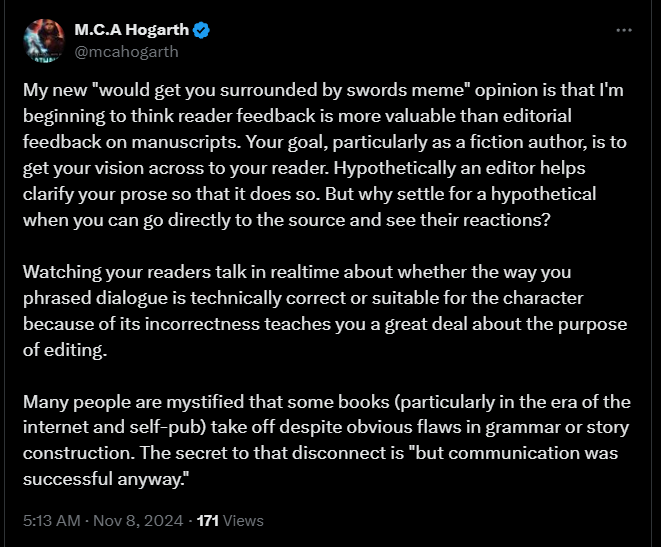
I’ve seen variations on this from readers, anything from ‘I didn’t notice typos, the story sucked me in’ to reviews that don’t mention grammar or anything else while they rave about story. I’m not saying you don’t need an editor – you do need a copy editor. And when you are new into writing, having an editorial look at your work when you cannot get readers to give you feedback may help you garner those readers once you have the ability to tell a story strongly and coherently.
My husband would comment to me from time to time that he didn’t understand why writers wanted to talk to him about writing, as he is ‘only a reader’ but what he isn’t getting is that is why they do. Writers, and especially some editors, can get so far up into their own navel the only thing they can see is the lint. A reader is looking at the whole body of work, with all it’s beauty warts and all. They have the perspective that we can lose when we’re leaning in so close to make sure that every word choice and punctuation mark is perfection.
This is why my beta readers are so valuable to me. They give me the reader’s perspective of ‘is this a story, or a cabbage?’ and while often they do catch technical minutiae, and I’m grateful for that, it’s not what I want and need most from them. I need to know if my storytelling skills have stretched far enough to immerse them into the tale, to bring a world alive for them, with living breathing characters who each have their own motivations and personalities. That’s my ultimate goal.
Are there readers who cannot, for whatever reason, tolerate any technical imperfection? Or, perhaps even more irritating, what they perceive to be a technique problem, particularly when it comes to dialogue. These we will always have with us. No getting away from them, but if your story sings to enough readers, the nitpickers will be lost in the signal that this book is worth the time of the reader. That’s what you want to see.

Editors are lovely people, too. Really! Mom, I love you… LOL
Still, though, as writers we can’t rely fully on the editorial eye. Only the readers can tell us if we’ve succeeded in what we were trying to do with that story. Also, it is here that we will get the feedback we need to sift through and take what is necessary to make the next story better. The reviews of the last book, if taken carefully, can improve the next book. Don’t get caught up in endless rounds of self-editing and let fear prevent you from putting something out for the readers to help you make the next book even better. Only the readers can pass the verdict. Not you the author, nor any editor you might hire, can really say if the story works until it is live in front of readers.


 Mad Genius Club
12 responses to “Reader Takes”
So many of us here are technical types, who ought to recognize this already. You must listen to your end users, because they are the ones who know what tech coolness is actually needed for the job.
(You listening, WordPress? Or do I need a bigger hammer?)
Sent WP sent your comment to Spam, apparently they ARE listening. 😉
Much bigger hammer, got it…..
😏😁⚒️⚒️
Wonder how much Elon would charge to land a SuperHeavy on their headquarters? And how fast the WP user community would fund the GSG to raise it?
And even when a writer has more experience, it really, really helps to have beta readers who say, “Yeah, I agree, the ending doesn’t feel right” or “No, everything flows, and the story makes sense, aside from Dangling Plot Thread that you already said will be tied off in the next book.” It’s great to have hunches and suspicions confirmed, or to have them tamed and shrunk back to the proper size.
The rules for writing: Don’t bore your reader. Don’t confuse your reader. Don’t insult your reader. Everything else is in service to those.
Now do I as a reader get annoyed by misuse of diffuse to mean defuse, or other usage and spelling/grammar errors? Yes. Will enough of them get me to exit out and never try that author again? Also yes, but that’s because it’s things that personally annoy me, and I’m willing to overlook a small percentage if the story and characters are gripping enough. Some people can even get me to overcome my great dislike of present tense.
The other problem I might note is that with so many new writers, there are also lots of new *editors* who might not be as experienced or knowledgeable or able to actually assist writers with development, or who might have been poorly trained on even copyediting methodologies.
Ideally, your style is perfectly written with no misspellings and no unartful grammar errors, and introduces your story to your reader with no more visible fuss than a swan gliding down a river.
In reality, you at least need a good, workman-like prose. Because, as our own Tom Simon so artfully observed, style is the rocket. As long as the rocket can deliver the payload of story, it’s adequate. The story itself is more important.
Foul calumny! Tortious libel! We editors are not lovely, and most of us barely count as “people”, too! How can you type such a thing, you’ve met some of us!
Well, I think you are lovely. So there.
You are, of course, allowed to be wrong. 😛
In the modern writing world, the editor is no longer your customer. Those who are successful have learned this. (Among many, many other things, of course.)
[…] Read more…. […]