
I needed to learn more about textile production as done in Europe in the 1100s or so. Oh, and the textile trade, which was one of the biggest items of commerce in that period of time. The latter is actually relatively easy to research and find out more than you ever wanted to know. The weaving part … Murphy and my muse must have gone drinking together, because I managed to find one of the more obscure types of weaving for the protagonist to do (although not as obscure as sprang work.) The descriptions about the technique were … confusing. Very, very confusing.
I finally sorted out where the problems were, and tumbled onto a really good video, and book, that provided what I needed.
My older knowledge had gotten into the way. The technique used for one far more common form of weaving is literally 90 degrees off from what I was reading about and trying to describe. The light dawned, rather like a florescent bulb with failing ballast. I needed to set aside what I knew, and study the other weaving style on its own, not as a variation of standard weaving. Only then would I be able to describe it for readers.
In standard cloth weaving, the devices used to change which threads are moved in order to make the pattern rest across the work, parallel to the loom frame. They lift some threads up and down, and the weaver works other threads side to side.
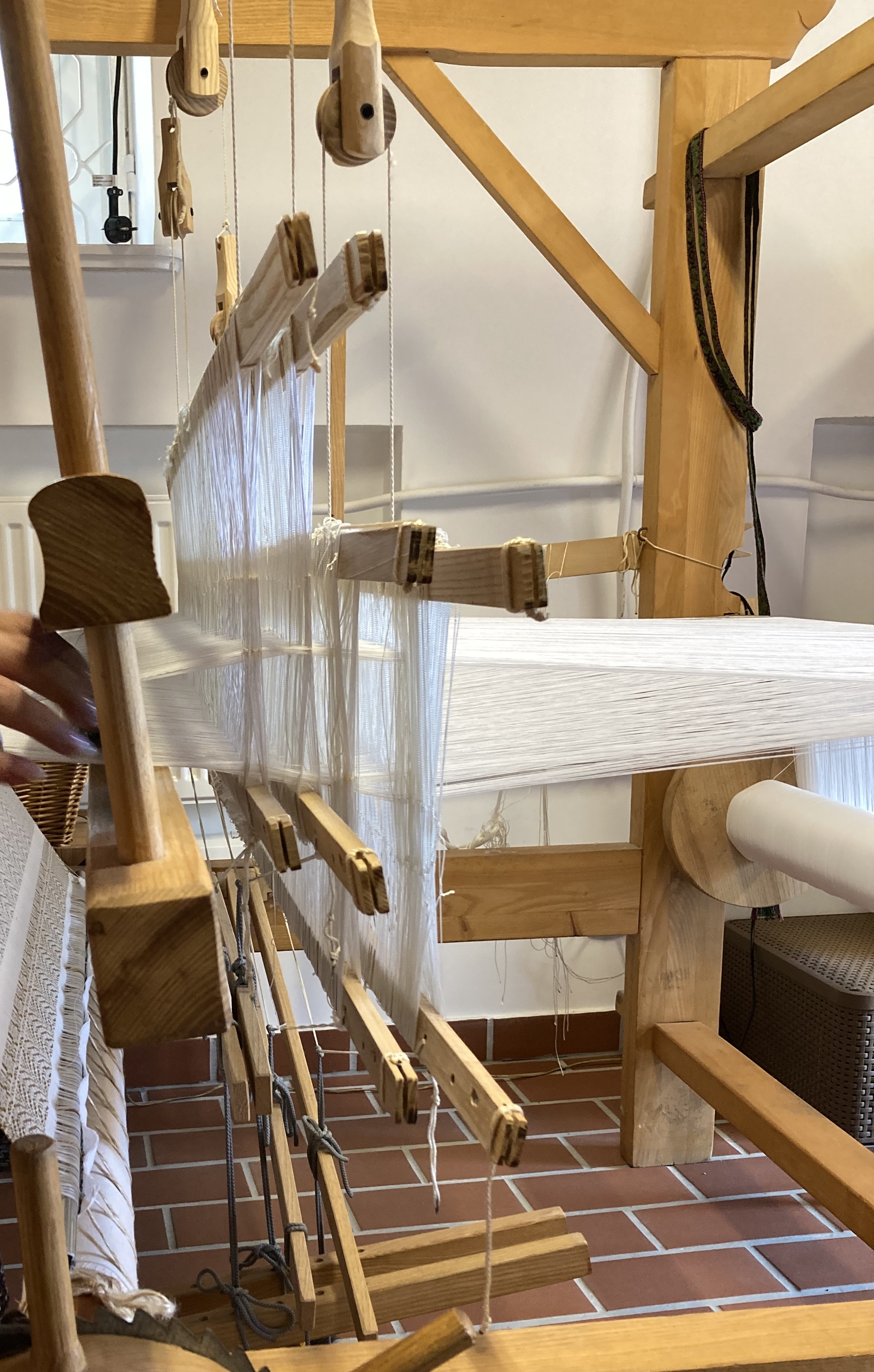
In tablet weaving, the devices to lift and lower the threads are threaded along the front-to-back threads, not across. In other words, ninety degrees to what you see above. The tablets, or rigid cards, are rotated forwards and backwards, lifting different threads. The weaver still works other thread or yarn back and forth, but instead of the front-to-back threads being plain, they are the colored ones that make the pattern.
You can see why my “weave cloth” knowledge got in the way.
So, what does this mean in the bigger picture? Most people probably don’t spend that much time studying the arcana of certain crafts. But if readers do know anything, the odds are it will be the most common form, be it weaving, or metal work, or carpentry, or cooking, or horseback riding, or … That means if you are doing a variation, or something offbeat, you have to be that much clearer in your description and what the character does. Otherwise confusion may drive the reader out of the story.




 Mad Genius Club
3 responses to “Seeing is Understanding – Now to Get It on Paper”
Being inordinately interested in fiber arts, I was quite excited about the possibility of a book from you that would include them. Alas, I never heard of ‘sprang’ and had to spend some time looking it up this morning — instead of doing other important things that were on my list. I’m glad you chose tablet weaving for your protagonist instead. It’s … different, but much more versatile.
From Bret Devereaux’s blog:
https://acoup.blog/2021/03/05/collections-clothing-how-did-they-make-it-part-i-high-fiber/
Barber’s Prehistoric Textiles is very good on the technical side, going into great detail about the mechanics of the development of fiber work. Collingwood’s books are the ne plus ultra for technical information as well as techniques.