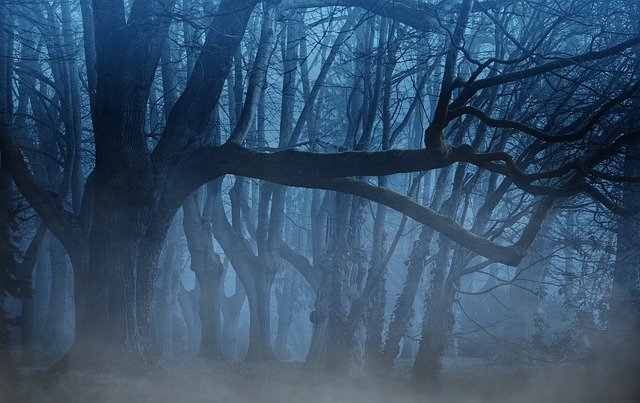
No, not my office, although I prefer a lower overall light with a lamp of some kind on my work surface when I write by hand. (Yes, I’m that kind of writer. As if you hadn’t guessed.) It goes back to my teenage years.
No, in this case I was thinking about writing darkness into stories, and where to draw personal and genre lines. This is a very individual thing, like so many facets of creativity are, and what one person is perfectly happy with in his story will send another person seeking help, because her mind just doesn’t go there. It varies with genre. Romance is and should be on the lighter side, likewise cozy mysteries and family stories. Other kinds of mysteries, anything noir, horror, some sci-fi and some fantasy (urban more than most today, although some of T. Kingfisher’s folk-fantasy goes really dark places, and G. R. R. Martin is almost in a category of his own) incline themselves to considering the uglier side of life – crippling sorrow that seems to never end, depression, suffering in general, loss, raw fear, cruelty for the sake of being cruel, despair …
My urban fantasy series tends to be dark. The Merchant series is not dark, although bad people sometimes do bad things. The Colplatschki books vary, while Shikari is pretty light. A Cat Among Dragons … grows darker, then lighter, as it follows the character’s struggles. But in every case there is always hope, and light in the darkness. I have to have light in the darkness – I can’t do horror or grimdark.
Horror in many ways is darkness of that sort, because that’s what scares and distresses most people. Horror also has to have an element of justice, of wrongdoing being punished. Hubris begets nemesis, as the ancient Greeks well knew, and as we also know today.
Darkness in other fiction … can slide into grimdark, depending on the author. I prefer shadows and chiroscuro, sharp contrasts between the forces of good and evil. Even if good characters are less than perfect, and can come across as cruel at times. It is not gratuitous, and should not be if that’s a good guy. Even for the bad guy or antagonist, gratuitous evil and sadism shouldn’t be needed. UNLESS you are writing grimdark, or some heavy psychological horror, or that’s your market. Looking into the abyss often leads to the abyss looking back, which is why I have hard limits on what I will depict. There are places inside me where it is not healthy for me to go on a regular basis.
Darkness in fiction needs light. Sarah Hoyt coined the term “grey goo” to describe the trend toward anti-human, depressing, hopeless dystopianism in genre fiction that started in the 1960s and really got going in the ’80s-’90s. They often featured unhappy characters in a dying or terribly broken world, scrambling for a crumb of something, and often failing, or escaping only to watch everything else fall apart. It also appeared in literary fiction, like Cormac McCarthy’s The Road. Some critics say that dark fiction, and grimdark as well, is more realistic. It is often more didactic, but that’s a topic for a different time.
What a lot of the heavy fiction of the past decades lacks is hope. The characters and/or setting are damned, reprobated without hope of salvation or even of escape. It’s something that gets old very quickly, at least for me. And judging by sales trends, by a lot of other readers, which explains why in recent years, indie books and fun “classics” appear to sell more than do critically acclaimed and much-lauded works.
Darkness has a place in fiction. Darkness makes light clearer, highlights the contrast between good and evil and the edges in between. It can also slide into anti-human and hopeless. There’s room for all of it, and markets for all of it. Just be mindful of what writing darkness does to you. Don’t feel compelled to write something that makes you miserable just because other people can go there without obvious difficulty. There’s a large, relatively untapped market for fun stories with some bits of shadow and broad expanses of warm sunlight.
You do you.
Image Credit: Image by Dorothe from Pixabay
*With profound apologies to Rilke, whose poem that begins with “You darkness that I come from, I love you more than all the fires that illuminate the night,” is one of my favorites.
 Mad Genius Club
8 responses to “You Darkness That I Write In*”
___There’s a large, relatively untapped market for fun stories with some bits of shadow and broad expanses of warm sunlight.___ I hope you are right… lol. Not that I know how to market to it, that is to say, how to find it. But I’ll keep trying.
Let’s hear it for chiaroscuro.
There is one scene for a story start came to me a few years ago that I just stopped at because I wasn’t sure I wanted to “go there.”
“Being immortal’s not what it’s cracked up to be.
Sure I’m unkillable and don’t ever age, but I can be wounded and feel pain.
But it’s the other kind of pain that’s the worst.
The memories.
You see, I can’t forget either.
Not that I haven’t tried over the long centuries. Drink, drugs, depravity of every kind.
It was actually the depravity that put me into this cursed existence in the first place.
Yeah, it’s a real curse. From the gods.
They’re real too.
Even if nobody takes them seriously these days, their power still exists.
I figure they eventually decided they have better things to do than mess about with the lives of mortals.
But then again, I’m not really mortal anymore.
Lucky me.
Actually, I’m theoretically not truly immortal, either.
There’s a sort of escape clause the big “Z” put in when he pronounced the curse on me.
“YOU SHALL NOT DIE UNTIL YOU HAVE SLAIN A THOUSAND EVEN MORE WICKED THAN YOURSELF.”
It hasn’t been easy trying to fulfill that clause. I was very wicked back then.
Not exactly a shining example to the youth these days, either.
Which is why I was now lying on the top of a sand dune in North Africa, watching the crumbling ruins through binoculars.
The wickedness had led me here. It was almost as though I could smell it.”
Interesting. This has ‘Casca: The Eternal Mercenary’ vibes to it. Of course, he only has to wait until the Second Coming 🙂
I shied away from figuring out just what horrors were occurring down in the ruins. I might get away with some “unreliable narrator” to avoid the details of just “how wicked was he?” for the viewpoint character, but I’m not into things like describing gore or slasher movies.
This idea is not total grimdark in that he can possibly achieve some kind of atonement and end his suffering, and maybe even become a bit less wicked by the end. The mountains of horrors he would have to encounter along the way, however, really stopped me cold.
Bob Ross always said, you need the dark to show the light. I don’t go very dark, just show bad guys for what they are. Should be good enough, no need to write in despair, even if you’re in it yourself.
That’s just what my painting teacher says as well (she may very well have gotten it from Mr. Ross; she makes no secret about the fact that she’s copied a lot from him). She calls it the number one lesson for oil painting.
But, on the other hand, the purpose of the dark is to show the light, not to paint the entire canvas black and pretend that that’s art.
On the one hand, I cannot write completely light and fluffy. I don’t believe in a world that’s innocent and free of bad things, without major consequences… and my fiction clearly shows that. Heck, the last time I tried, I made it 6 chapters before terrorists blew up the mall.
On the other hand, I cannot write grey goo, because I don’t believe in that, either.
On the gripping hand, I have a story that I’ve tried and stopped 3 times on… because I am prone to the winter blues, and the first try, I wrote straight down into depression, breaking the story and the characters. The second try was a stab at unbreaking it, disentangling the characters from depression, and it foundered on the darkness in the plot. The third tackled the plot, and foundered on a need to research. I may get it on a fourth time ’round…. though I worry a little about handing it to beta readers, and them seeing all the broken bits and disconnects I’ve missed, or losing anything that made it a good story by the time I’ve done all the revisions.
So I am careful about managing my mental state to avoid doing that again… which leads straight to consciously stepping back from horror, despair, and angst in the characters or plot. The closest I got to horror turned away from it and became tactical romance, because I must focus on the people fighting to become their best self, and to help each other survive through the worst that human nature, eldritch abominations, and nature has to offer… for my own mental health, much less the reader’s entertainment.