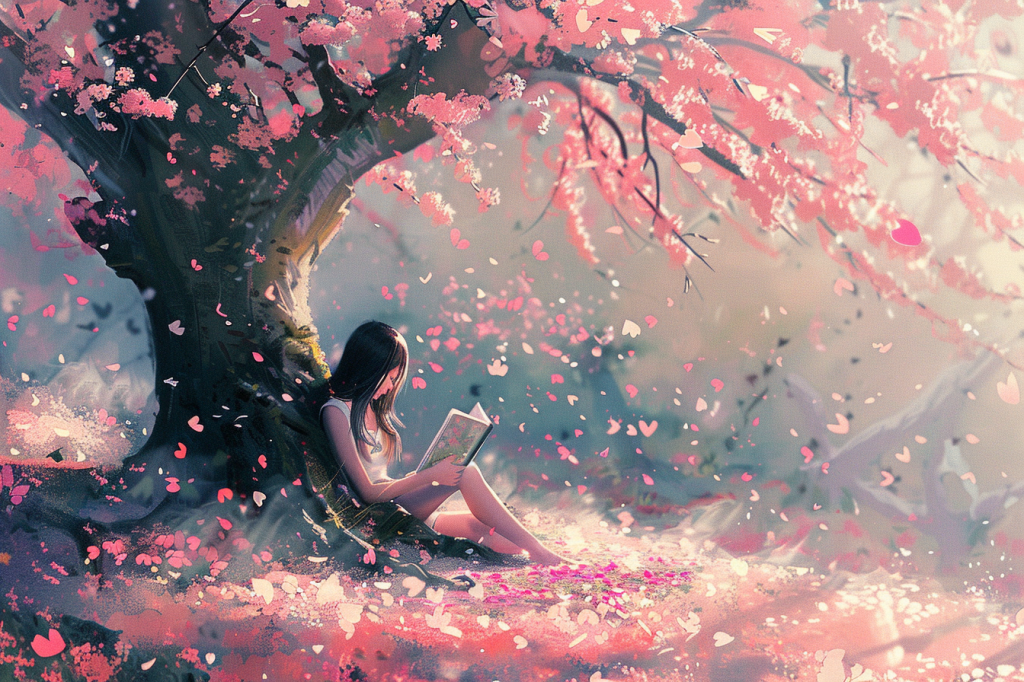
I was thinking about the peach tree, and what I could write about, and the conversations I’ve been having over the last week or two on the topic of the books that formed us. That all connected, as I contemplated what to do about the garden. Last year I planted a peach. Like many other things in the garden, it seemed to have died back entirely, but in the late fall, I saw shoots coming up from the very base of the tree. It meant the rootstock has survived. This spring, there is a cluster of shoots, with healthy leaves. I plan to pinch off all but one that can develop into a proper trunk. I have no idea what will come of it. Rootstock on many orchard trees is not good for fruit.
The rootstock is chosen for its hardiness, the ability to grow good strong roots and support the less vigorous fruiting graft. I don’t know just when this technique was first used by orchardists wishing to clone their best trees, but it is very old. For mine, I shall at the least let the tree regrow to a few feet tall and at least as thick as my thumb. Then I may order a scion of a good fruiting variety, and set it to graft. If it takes, in a few years, I might expect ripe juicy peaches. Or perhaps not. Gardens rarely do precisely what we want of them.
It would likely be easier and more reliable to dig up the scrubby little thing and compost it, replacing it with a nursery tree this fall. I don’t think I shall do that. It’s withstood the heat of last year, and the flooding of this spring, which means it is stronger than a new tree would be. We adjust, to the surroundings, and bring forth what fruit that we can.
The rootstock of the writer is of course the books they read. We learn, from the months before we are born if we are fortunate enough to have parents wise in reading to their children. The cadences of reading-aloud are old familiar friends, and when we grow impatient – and the very young are almost never patient! – we learn to read for ourselves so that we may spend hours immersed in the worlds between the covers of a book. Some of us – not all, but enough – read so much that we choose it for pleasure. Others find it a chore and give it up as soon as they get out of school and are no longer made to look at the words on the page. A few, very few, find they have run out of stories to read and start to make up their own. The worlds have grown out of all of the books, the adventures, the experiences of themselves and so many others they have consumed. They have become writers.
Their books, then, are the seeds for the next tree to grow up. For another writer to be grafted onto, having learned the necessity of a solid foundation of good story, a crafty plot, and delicious juicy dialogue. We are all supported on the rootstock of our libraries in the mind, the books we have read and grown with.


 Mad Genius Club
6 responses to “Rootstock”
The good as well as the bad…. by bad, I mean vicious.
Throughout school, from 4th grade at least, I never had fewer than two books with me to read under my desk, to survive the massive boredom of being yoked to the pace of the lowest achievers. With that much voracious engine, I was forced to vacuum up whatever I could lay my hands on, age-appropriate or not. Every now and then I would rifle the shelf where my mother kept books from the local university classes she occasionally audited.
I can still remember the horror on her face when she noticed me reading James Bond entries at, I dunno, 10, but those just rolled off me — the mild sex was boring, not titillating. But The Painted Bird was a shocker that no pre-adolescent female should run across. As a combo introduction to the horrors of the Eastern European peasantry dealing with WW II and sadistic sexual torture (and praise from the bien pensant) it was a shocker that any of those things even existed, much less that they would be presented in a book that had been praised by adults. The torturers disgusted me as a vivid revelation of indifferent or enthusiastic human cruelty and the capacity for psychopathy, and the torture was a shocker as an introduction to what adolescence might bring.
My fingers had been burned, and I was more cautious grazing through adult books, just in case, though I never found another one with that capacity for personal damage.
As a writer, I will never, ever, put that sort of risk in front of an unknown reader. My heroes are certainly put through the wringer sometimes (and I’ve had one or two readers complain), but the focus is more on their will to take a risk and the way they rise above disaster, not about the authorial delight in damage or torture. Bad people do bad things, and heroes can suffer, but I have authorial opinions about it, and there are consequences that balance the morality.
For added hilarity, Painted Bird is based on a big fat lie, so far as anyone can tell. Far from having experiences anything like what the book describes, the author spent the WWII part of his childhood being sheltered by a group of quite apparently harmless Polish Catholics.
They turned it into a movie in 2020.
I grew up with fairy tales (unexpurgated), archaeology and ancient cultures, Rudyard Kipling and the Raj, military history, science of all kinds, and fairy tales. Then I found sci-fi (Azimov, Clark, YA sci-fi of varying quality, Doctor Who novels). Alas, I also found post-apocalyptic 1980s “after the nuclear war” novels that I really shouldn’t have read, and some horror that I read far enough into to really mess with my head. A 13 year old is too young to be learning about some of that stuff.
You can see a lot of that influence in my modern reading and writing, and understand why I gravitated toward history and languages in college.
Hmmm — actually I did run out stories, though it was an artificial shortage. We were forced to return all our library books and not get out any more even though we weren’t going on vacation for a full week.
But the chief effect is “Man, that idea deserves proper treatment.”
I’ve pulled bits of stories out to graft onto others, and ends of stories that served as the root stock of the sequel, and I’m quite sure there are plenty of other botanical comparisons to be made, involving budding, branching, flowering and bring to fruition . . .
I rather like thinking of myself as a gardener. Because stories so often grow as they want, not how the writer expected. And I’ve definitely had some die on the vine.