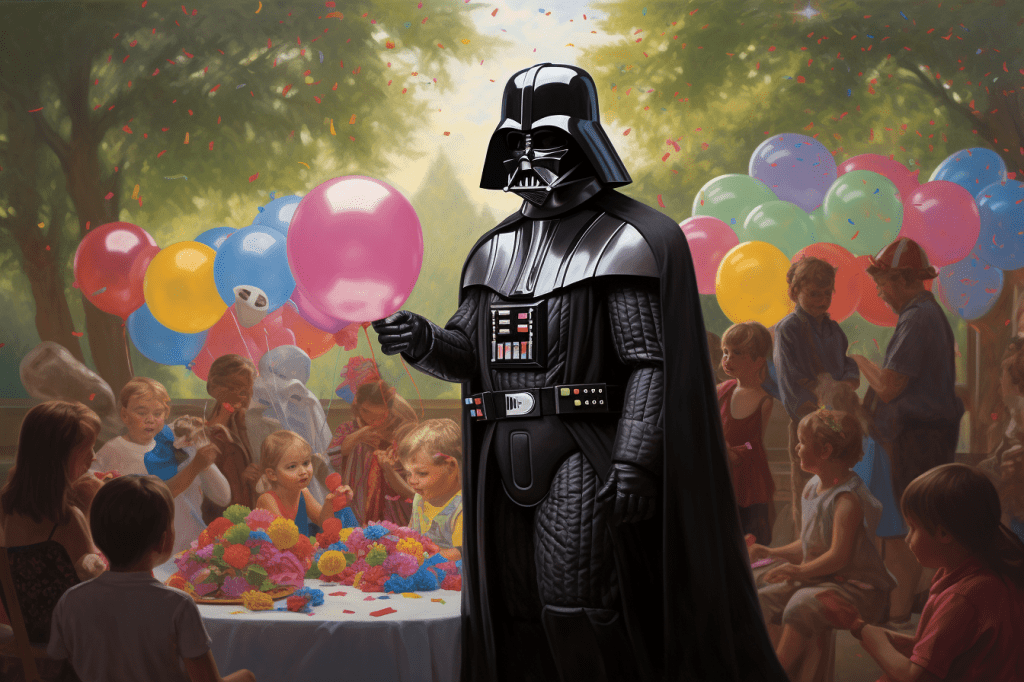
What’s Darth Vader doing at this birthday party? Do those two worlds belong together? I have no idea. Wouldn’t it be nice if I were able to explain it to you?
Many of us specialize in completely created worlds, where not just the story, but everything that isn’t quotidian reality has to be vetted for plausibility. (And the rest of us, who write stories set in “the real world” don’t really have it any easier — we still have to get it right.)
I think of the non-plot-related world-foundational issues as falling into two categories:
- the interconnectedness of technology/craft/industry/economics/resources
- the cohesion of social relationships and customs and behaviors
Taking the obvious case of SFF, there’s a long genre tradition of letting certain “givens” operate without explanation. If you’re off on an adventure in fairyland, you can still have horses, beer, farmers, etc., etc. Typically there’s an early indication of “Medieval-ish” or “Primitive” or “Sophisticated” or just bog-standard “Otherworld”, where you can pass over the basic expected props without explanation, and no one has a problem with it. “Once upon a time…” and all that.
Even Tolkien, with his fascination with (his own and other) languages, renders everyone fluent in “the common tongue”, regardless of their origin.
If you decide to stray from this genre approach (or even venture out into the wide universe), you will need to take on more of the background that has to be visible to support an alien economy, a futuristic technology, time/space travel, a history of contact or conquest or governing principles.
The version of this for stories set in the real world is getting the details right. If you’re going to refer to the making of weapons, better get the metallurgy and capabilities down first, since getting “real” things wrong is one of the sure routes to book-flung-against-(virtual)-wall reactions from readers. Getting the larger systematic things wrong, like economics and trade, is just as bad, though it may trigger fewer of the ill-informed readers.
“That’s not how that works!” is not what you want to hear, whether the “that” is an engineering mechanism (a water mill, say), or a trade practice (cash on the barrelhead if you’re not known), or the casual indifference to wastage (clothing, horses, food, candles) in a world with little money and significant class differences.
You can tell an author who is blind to these issues by the way that they glory in wish-fulfillment items: the endlessly wealthy romantic interest, the inexhaustible servants, the ease with which the characters’ environment can be altered, the convenience of clothing, food, water, sanitation on demand.
And while it’s not uncommon for the hero to be a “chosen one” for some special reason, that reason should have a foundation in the world’s actual technologies/magic/economics/politics/whatever. Otherwise you might find readers sarcastically referring to Empress Theresa.
I find the second type of cohesion fail — the web of social relationships/expectations — to be much more irritating, enhanced as it is these days by wokerei. It’s all very well to have a hero who somehow rises above or breaks some inherent social limitation, but those limitations exist in some form in all societies, and are not changed arbitrarily by an author without some reference to how that happens.
As an example, in a SciFi, I don’t need an explanation about gender ratios (or species ratios) crewing a starship to make me happy — that’s part of the malleable genre expectations. As long as it’s treated as internally consistent, I don’t care. But, please, spare me the “uniquely qualified unusual gender/species/your-daydreamed-persona-of-choice-specimen whose very existence seems at odds with the rest of the world building.
In an historical novel (real or fantasy variant), this is the “female pirate” or “werewolf harem mistress” or “Once and Future King”. This requires explanation… it can’t just be hoisted into the plot whole with the expectation that the rest of the world’s mechanism can just roll along as normal. Given a proper preparation, sure — tell the story. But that proper preparation includes presenting the world in which this is not only possible (female pirate) but convincing. The fact that it may or may not have happened in the real world does not excuse the author from setting the trope into a properly built world in which it is possible.
Projections of current woke and tech and civilizational assumptions into the past or into fully-created worlds stand out as ungrounded unless the author takes care to give them plausibility in their own context. (Darth Vader at the party.)
Got any favorite flung-books from your reading to adduce as examples?


 Mad Genius Club
21 responses to “Consistency in your worlds”
I notice a tendency among writers to assume that fires are easily lit, and that night scenes have sufficient lighting without named light sources.
I particularly remember one fortunately comic series where a cop was directing traffic in a pseudo-medieval setting. Sometimes it’s the things you think you know because you don’t even think about them. But very little history of policing would tell you how late directing traffic is. (Dante had to cite a specific historical event where they directed people to arrive by this route and leave by this one to convey the notion of lanes.)
The one who thought American Indian tribes rode “massive” horses, when as best we can tell, the stereotypical “Indian pony” was a wiry, agile animal, capable of surviving on limited food and water, and rather on the shorter side. I don’t know whether the author was a tenderfoot who found all horses tall and intimidating, or had seen some images of Kiger mustangs (compact, muscular animals with a lot of Spanish ancestry) without any sense of scale. Wikipedia claims that the originally slim and rangy Appaloosas were cross-bred with draft horses after the Nez Perce War of 1877, but the post-1877 Nez Perce reservations in Idaho would not have been anywhere near where the wagon train in the novel was going.
In the Older Than You Think department, the first attempts at blood-typing date to the 1900s or 1910s and used technology (blood samples, glass slides, observation of the way two samples interacted under a microscope) that were not terribly new. If you’re writing stuff with a late 19th century tech level, it’s not super out-there, IMO, to have your resident kooky doctor ordering blood transfusions be the guy who was ahead of the curve in terms of determining donor compatibility. So far I’ve only used this tidbit in an unfinished fanfic but have certainly filed it away for more serious use.
The English-speaking subtitlers on MHZ Choice who somehow manage to know less about guns than a). me or b). the people who write French and Austrian cop shows…are a thorn in the side of the more linguistically gifted people in my family.
While in general I agree with you, I will leave you with five words. Grace O’Malley, Zheng Yi Sao.
Yes. My point was… even though there really were female pirates, in fiction I had better construct a world where they were possible, not just assume that possibilty.
I recall Anne Bonny and Mary Read myself. The latter lady could’ve doubled as a character in a Robert E. Howard story with all the adventures she got into. Though she was very exceptional for any age.
I run into this a lot. Easily lit fires. Cheap clothes. No understanding at all that class divisions run deep and wide and we are NOT all equal and you should know your place. If it’s raining, you’ll get soaked and you have to suck it up and get on with it. That you can’t walk any faster than the slowest member of your party. That walking in waist-high grass is easy, when it is not.
We’re currently watching Ms. Ma: Nemesis, a Korean reworking of various Miss Marple novels (32 episodes!) and the class structure is on full display. Everyone accepts that if you’re high up the food chain, you get special privileges. It is not modern-day America, despite being a contemporary.
And this will be OT, for which I apologize, but in regards to the scene with Vader at a children’s birthday party above — I recall that there really was something like that in the old EU/Legends continuity. Vader visits the royal family of some world to ask why they’re not displaying greater obedience to the Empire and meets their 12 year old child. Who is basically a male Star Wars version of Rhoda Penmark.
Vader ends up talking with the boy in a downright friendly fashion, and even uses the Force to manipulate a toy starfighter for him while Vader asks the boy why he’s waiting to become heir when there are so many family members ahead of him in the succession.
Vader leaves, and a month later the boy murdered his entire family in their sleep.
I just have to say that I think I could have lived a long and happy life without ever hearing about that book, _Empress Theresa_. And as I read the comments on the book, I realized that, without a bit of luck, I probably _would_ have heard of it, sooner. Who knew I was actually super lucky? Or at least I used to be.
Oh, Empress Theresa is an absolutely essential (and famous) cautionary exercise for the beholder. Look it up on the web generally for the incredible tale of the author doubling down on the execution.
I had never heard of Empress Theresa. Turns out TV Tropes has quite a lot to say about it. Holy cow, and the author’s antics are, well, sad to say the least.
You made me refresh my memory by looking at some of the TV Tropes, and I stumbled across this one which I thought would raise some humor here:
“Sci Fi Ghetto: Despite being a story about a girl who becomes the host for an alien being that grants her superpowers, and involving such scenarios as all wind stopping, the Earth’s axis being messed with to create infinite summer and the entire world being put into a 600-year-long stasis, the author is very adamant that this is not science fiction as he for some reason is openly disdainful of it and fantasy. As such, the work is listed as “Contemporary Women” on Amazon.”
The Cold Equations. Guaranteed to give any engineer the pip. WHO designs a system with no safety factor?
One that thinks theory and practice are the same?
Yup.
Forget safety margin. Why wasn’t the door to the shuttle LOCKED? Why was the shuttle not inspected before take-off for stowaways? Why wasn’t there a guard at the door? Throwing them out the airlock is insanely late.
IE, why didn’t they act like this could kill them until it was way too late?
Those are all instances of ordinary human error. But, speaking as an engineer, things should have been designed so that ordinary human error wasn’t fatal. Like, you know, programming the computers calculating the trajectory of the emergency dispatch ship to allow for the possibility of a stowaway. Or providing the EDS with a parachute (even the primitive 20th century rocketeers knew enough to do that). Honestly, the whole setup of the story is so full of obvious fridge logic that I don’t know how it got past the editors of Astounding, let alone became a classic.
IIRC, the author was assigned to write the story, and the editor had to keep sending it back, because he kept finding ways to save the girl.
That would explain a lot.
:headdesk:
That makes sense.
It’s still stupid, mind you, but it does make the stupidity make sense.
I recall reading that the whole idea behind the story was simply to do an SF story where the hero failed to save the girl. Because that was going to be a needed corrective to all those other stories where he did. Or something along those lines. I had no idea it was so much trouble to write.