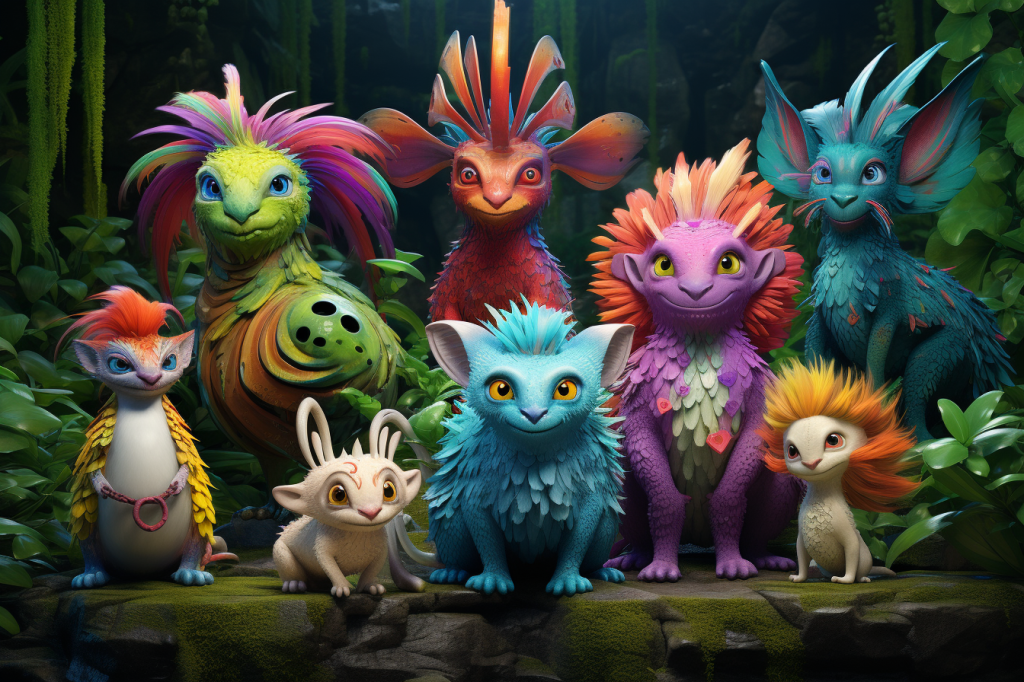
I’m sure we could figure out what the critters above want from us.
Emotions aren’t that hard to detect. We can empathize with the playfulness and cunning in far distant mammalian relatives, the curiosity in birds, the experimental trickery in octopi. Even an alligator can ask for a scratch on the head, and be clearly pleased with the result. There are fascinating behavioral experiments involving lobsters.
A lot of why we smile when we look at the endlessly amusing videos of animal behavior is the recognition of our common bonds, our common reactions. The instant empathy is a natural result. (This is not without its tragic considerations for the meat eaters among us, but that’s for another day…)
Well, your fictional characters aren’t any exception to this. And if you can feel empathy for an octopus who plays jokes on experimenters, a creature with bizarre senses who lives for only a year (tragically) in an environment you can barely comprehend, then I should think that extending this sympathy for an alien or a synthetic being should hardly be a stretch at all.
How does this play as a tool for writing? It’s the classic “show, don’t tell”. If your character is longing for a touch, for a bit of attention, it shouldn’t matter if he’s a puppy dog with big eyes, a horse sidling up to the door of his stall, or a human lingering uncertainly instead of going about his business. Even the visiting alien may be reluctant to leave, to disengage.
Common body language also engages many of our world’s lifeforms when we attempt to deceive. Whether this is really a “theory of mind” or (more likely) the end result of “try this, and survive to breed” is debatable… if the latter, then even synthetic beings will play the game, too, based on their success/failure experiences. Observers from the outside may be unable to tell the difference — think of all the mimic insects that have evolved to discourage predation by resembling something that tastes bad. Predator/prey relationships are a long arms war of deception, and the tactic becomes conscious and deliberate in intelligent beings. If you’re a player in that war, you’ll recognize it in others, both in direct survival situations and in long term evolutionary survival (breeding for the win).
If you’re reaching for a way that your character can show his emotions without overt discussion, you could do worse than wondering how he would do it if he were… a dog, a cat, a horse, a parrot… (I recently watched a young beaver construct a half-assed barrier to keep a rival out of the room, and then hop away with the most obvious anticipatory delight at the success of the plan, just as happy as a human child would be. This, from an overgrown rodent.)
If you’re looking for a way to reach successful communication with an alien, don’t forget to seek potential embedded (evolutionary) logically similar channels (protection of the young, curiosity, reciprocity, deception) that can be “recognized” in behavior as well as the more conventional explicit exploratory communication protocols (blackboards, and all that). There’s an awful lot of “how to communicate with aliens” SFF out there, and no few writers who specialize in that.
For the rest of us, just remember that there’s more than one channel available to our characters when we want them to communicate or to display their internal states. We see it all the time, if we pay attention.
What wrinkles have you explored in this area?




 Mad Genius Club
3 responses to “The behavior of others”
It’s tricky to make it seem alien.
I dunno… there’s a good bit of layman-level stuff to be found about experiments on captive cephalopods who might as well be aliens. It’s not like there’s communication we can tap into, but there is certainly stimulus-response and environmental interaction which is convincingly interpreted as play activity with the scientists. It’s eye-opening (tentacle uncurling?) evidence of cross-modality in alien minds in alien bodies with alien senses in alien environments.
For fictional aliens, I think the challenge is making them intelligible while still seeming alien. If the “intelligible” part gets the focus (for “story” purposes, since that’s where the communication is rooted), then the “alien” part can still be rooted in physicality differences (appearance and senses and movement) and behavioral differences (reactions and alarms), well before we understand the “why” aspect of that. We spend our species-evolved life observing other creatures with obsessive interest to understand them better (ask any 8-year-old with a plastic dinosaur collection).
Even in Mark-1 humans, there’s variation in reliance on hearing vs sight vs smell that causes behavioral differences, not to mention the athletic vs the clumsy, or the observant vs the oblivious. We spend our lives balancing the alienness of others with their familiarity.
Strongly recommended general reader books re: cephalopods and intelligence. (Peter Godfrey-Smith)
https://amzn.to/4bVq5JK
https://amzn.to/3TgOvpD