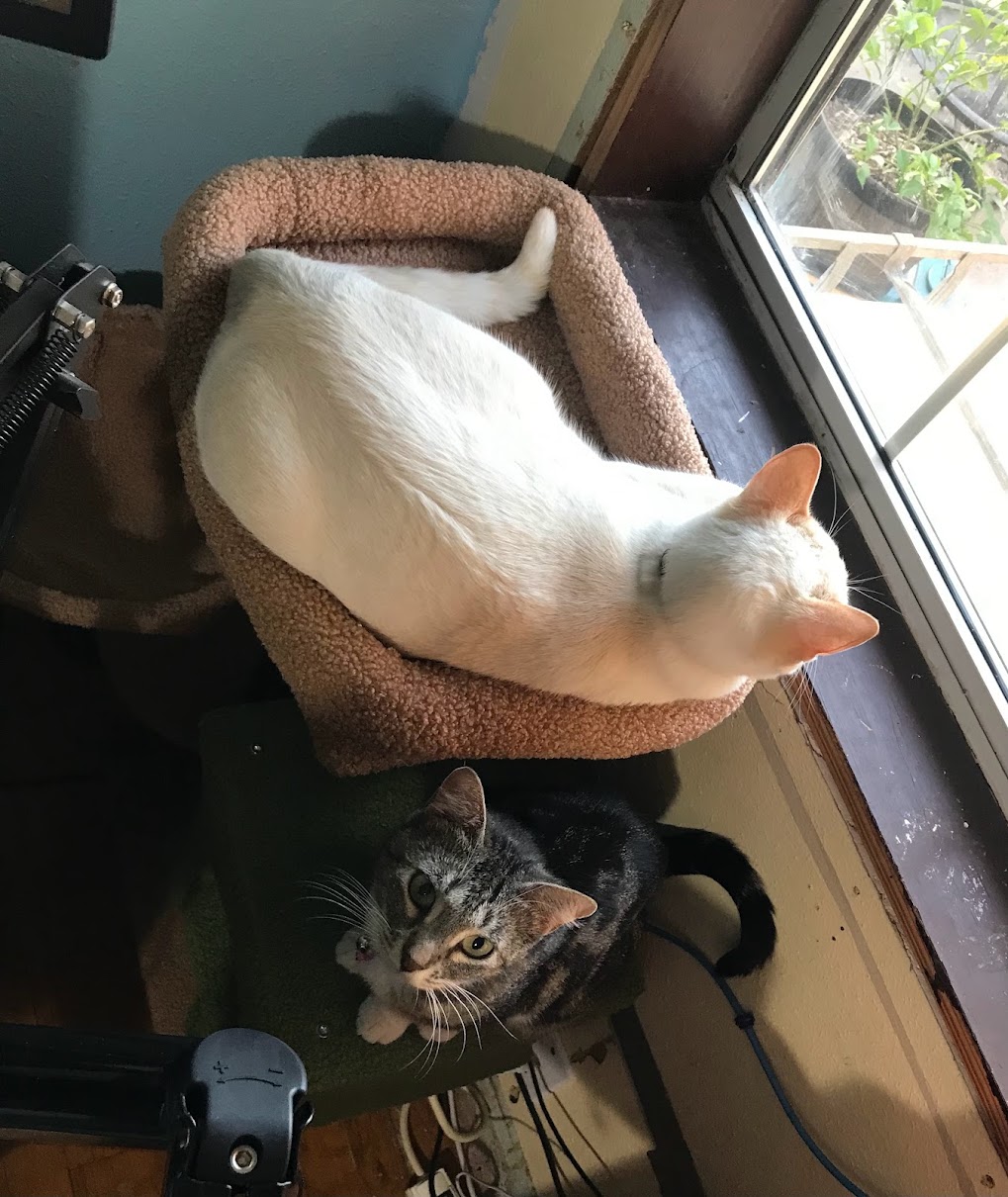
Alternative title: Cat, the Conqueror
We started out our morning quietly enough. My husband, the First Reader of my writing, doesn’t sleep well any longer, so he had been up in the night, with a cat in his lap as they so often do these days. While doing this, he’d been reading a book, and had put CatTV on to amuse the feline. Toast is accustomed to this, as he’s done it for her since she was a sub-pound scrap of kitten and all four of them (her siblings we fostered for a couple of months) would avidly watch the videos of birds, squirrels, and movement on the screen.

Kittieboo, on the other hand… Have I introduced the Mad Ones to Kittieboo? For brevity – she was Lawdog’s DependaCat, living under his porch with her kittens. Lawdog managed to find homes for the kittens, but their mother, a tiny feral lady barely bigger than they were, wasn’t so appealing. Lawdog’s Lady dubbed the little cat Kittieboo, and would talk to her while gardening. They are both very allergic, and their dogs would not think of a cat on their demesnes, so as fall chill settled in, it was apparent Something Had to Be Done. One fine morning, Lawdog ambushed a very indignant and spicy kitty, and late that afternoon I got Toast’s companion cat delivered as a groggy gray rock-cat who would purr if I petted her, but spent the next three days pretending to be a small river boulder behind our toilet while she was confined to quarters for recovery.
Oddly enough, Lawdog is still the only one who is allowed to pick her up with impunity. I’ve managed it twice, and although she is polite enough not to resort to tooth-and-claw, she is Most Displeased about that indignity. But I do know she weighs roughly seven pounds. A very smol cat. Toast, for comparison, is ten pounds of lanky legs and long tail, who can put her nose on a 31″ windowsill while hind paws remain on the floor.
To return to this morning: we feed the cats their gooshy fud as soon as I roll out of bed. The First Reader got up with me, a rare and pleasant occurrence, so we were making coffee and chatting in the office (the coffee station is in the office, as is Right and Proper). CatTV was on his big monitor, still running from when he’d gone to sleep but left the cat watching late at night. Kittieboo strolled in, licking her chops, and caught sight of a bird up on the screen. She froze. Then she crept nearer to the desk in the corner. Her tail twitched. We noted it, realized that she was intent on the video, and were chuckling over her sudden interest in it. She’d seen it before, we think, but aren’t certain – and until recently she had been very, very shy of all people even us.
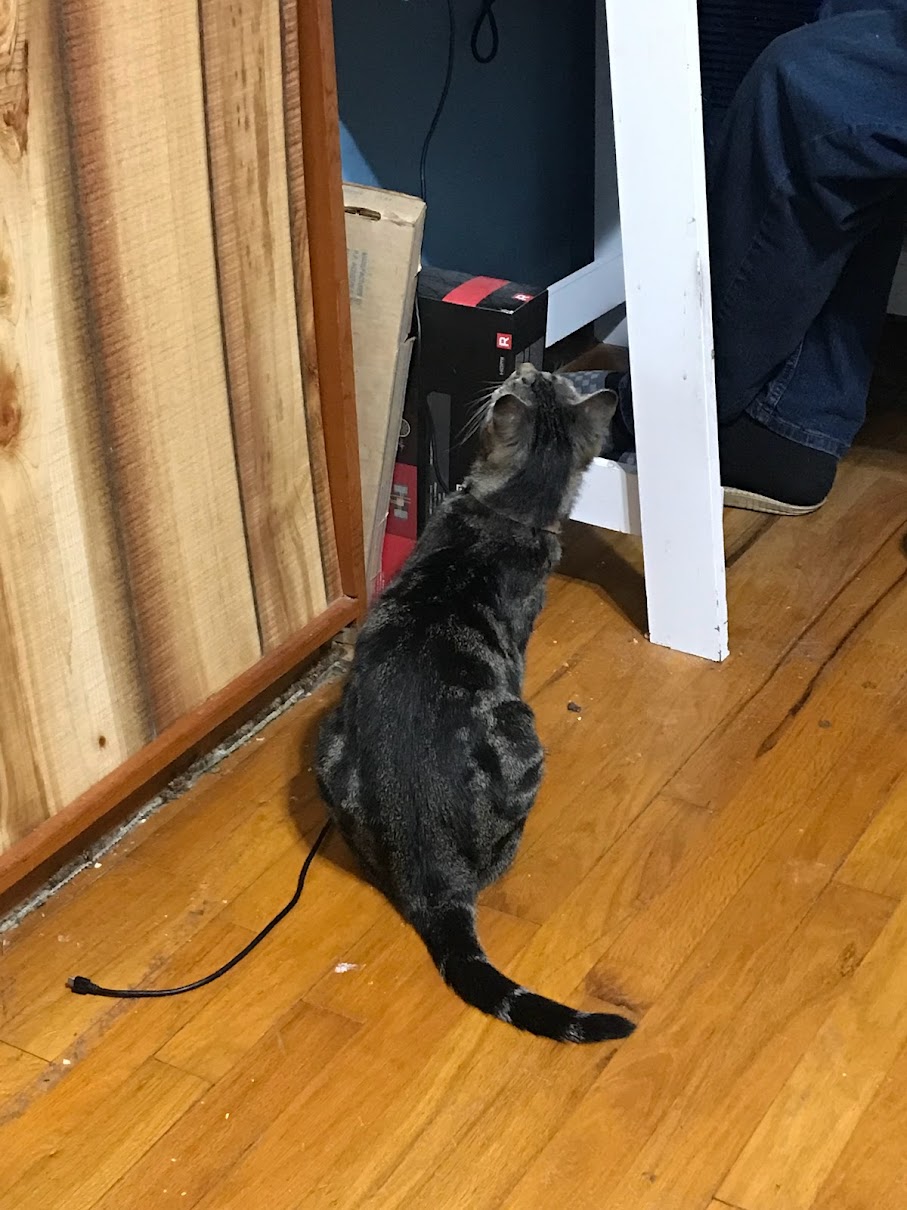
The First Reader commented that he almost wanted to leave on her video, as she was enjoying it. About then, she hopped up on top of his desk – something she’d never done in our presence – and crouched, tail signalling her intentions with vigorous lashing. Then!

She sprang, full at the screen, paws spread wide and ready… and splattered on the glass of the wall-mounted monitor. Both humans in the room doubled over in laughter. She proceeded to try again, while the First Reader was trying to shut down the tab and ease her newfound enthusiasm for his space. Then, for several minutes, she was convinced there was a bird in the house, she’d seen it, and was up on his desk and looking behind the monitor, all over, getting down and looking under it… Poor little lady. All the instinct, the experience, the training, and it was a fake bird!

I’ve been reading Cunliffe’s By Steppe, Desert, and Ocean as my bedtime book for some time, now. I keep falling asleep by no fault of the writer, but my own state of fatigue. It’s an excellent book for those who want to improve their world-building, and I’d accompany it with Thomas Sowell’s most excellent Conquests and Cultures. As I was still chuckling over the little cat, so valiant in her efforts to obtain food for her family (she thinks of Toast as one of her kittens, as we observe her with one little white-gloved paw holding Toast down while grooming behind her ears firmly), I connected her fully developed prey drive with the last couple of quotes I’d saved from Cunliffe’s writing.
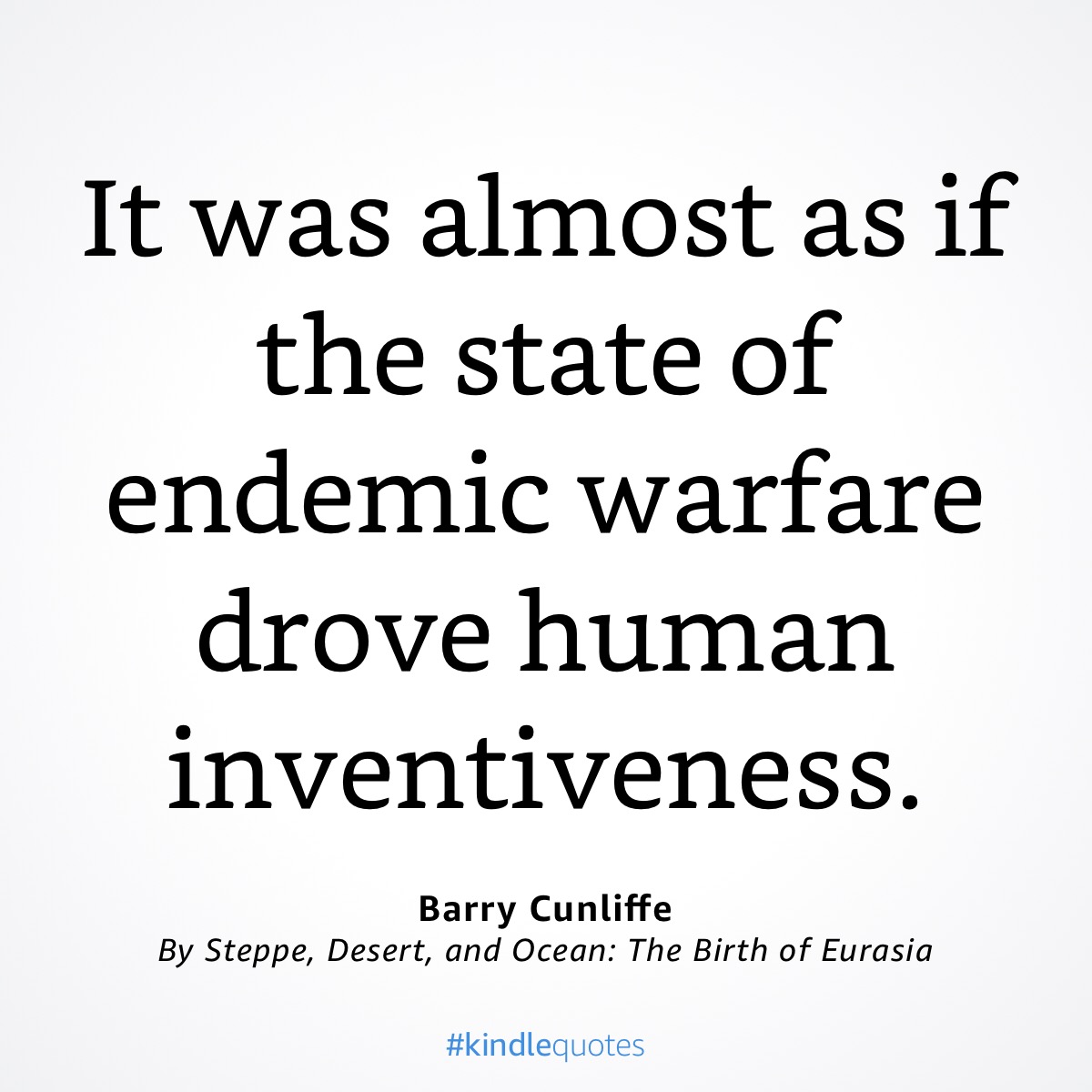
Cunliffe, bless his fuddy academic heart (and I have no idea what he looks like, but I have a strong mental image and an amused fondness for the mind that wrote this book), can’t quite grasp the fully developed prey drive. He has, more than likely, never needed to worry about finding food to feed his children. Kittieboo, for all that she now has a pampered existence, will never forget her early life. Even with a belly full of the nummy stuff, she’s still got to get that bird so there will be enough for tomorrow, as well.
Humans take that and spin it out into analysis in a way a cat cannot (or, possibly, can, if you read Kipling’s tale of how the cat came to domesticity).
We don’t need war, perhaps, but the hungry times leave us with a firm conviction that we Do Not Want, and so we work towards a future that is full of peace, the only need for a hunter’s drive is on the video games, and stories are where conflict belongs. Which is… well, let’s just say that it’s an admirable and impossible dream. But the society where a historian can be mildly bewildered about how conflict affects mankind in salubrious ways means that we’ve made it, in some places, in some times. Probably can’t hold it for long. History tells us that.

Conflict drives the plot, in fiction. In human history, it drives development and innovation – far beyond medicine and weaponry, as Cunliffe observes. The cat, curled up napping on her soft pillow, who never goes hungry any longer, has conquered. The human, tapping away at her keyboard musing on the metaphorical battles of life, and how giving it your all can still sometimes wind up with a splattered slide down the clear glass obstacle that reveals the falsity of the goal… is learning and using the experience to make her approach more refined and her philosophical musings more entertaining.
 Mad Genius Club
26 responses to “Giving as Good as you’ve Got”
When I first read Tolkien’s Unfinished Tales, I was very much struck by his description of Numenor, and the accompanying rough draft(s?) of Aldarion and Erendis, and what I mostly took away from that and the Akallabeth in the Silmarillion is that even if you give humans peace, tranquillity and plenty, they will want something else.
We are rarely satisfied, eh? There is no happy ending. Only a happy resting point, until we get curious about what’s over that hill, way off yonder.
Yeah, to quote Tennyson’s Ulysses:
“Come, my friends,
‘T is not too late to seek a newer world.
Push off, and sitting well in order smite
The sounding furrows; for my purpose holds
To sail beyond the sunset, and the baths
Of all the western stars, until I die.”
Good night, nurse! Toast looks to be as big as her brother Prince Fluff the Magnificent – who is huge and fluffy.
Some of Miso’s kittens have considerable size to them, as does Miso’s sister Snowy – but Miso herself has stayed small and dainty. Genetics is such a mysterious thing…
Toast is sleek and soft, but not small! The Siamese genetics are clear in her conformation: small head, long lean body. She isn’t a talker, though, she will chat a little but fortunately no howling serenades.
There was an experiment years ago, where they built a giant terrarium. I mean full size trees inside it type thing. If I remember right it was part of a survival on other planets, dome ecology experiment.
The ecology was kept perfect, everything balanced, proper nutrients, moisture, atmospheric mix… and everything worked well for about fifteen or twenty years. Then suddenly there was a collapse. It started with the trees just falling over. No good reason, they just fell. Then everything else started to fail, and eventually they had a full failure of the biosphere. But, we learn more from failure than success.
In the aftermath it was discovered that the trees didn’t have a broad enough root base. OK, so WHY didn’t they have a broad enough root base? Well, a lot more study later they figured it out. Wind and STORM. Those were missing from this dome. There was no serious forces driving the trees, and the rest of the biodome to develop the broad and deep root bases that make them stable when they’re large. As a result, they were not really healthy. It turns out that natural life needs stressors and something to fight against to be healthy.
Is it any surprise that this is also true of the human animal?
This is the current theory underlying the uptick in Autoimmune disorders, as well. The immune system is geared for hundreds of generations of doing battle against disease and parasites. When those are eliminated by modern medicine, the immune system goes looking for a fight…
seems viable.
The immune system goes from Audie Murphy in wartime to Audie Murphy in peacetime!
Okay, maybe I shouldn’t joke about that, but it was the first image that came to mind.
Audie Murphy was actually semi successful in peacetime, which is a rarity for MOH recipients. Ira Hays, Pappy Bonington, and several others who’s names do not come to mind on the other hand…
Good point, I guess I was just thinking of the line attributed to one of Murphy’s buddies from the stuntman community in Hollywood: “Audie didn’t seem to like it when things were going too well.” (or words to that effect.)
Many of the diseases have gone away because of vaccines, which do work on the immune system.
The ending of the show “The Good Place” is a nice example of this concept.
Without something to strive for, humans (and likely all other animals) stagnate.
Interestingly, it’s the theory behind the collapse of the passenger pigeon. Not simply that they were overhunted, but that genetically they were so dominant they couldn’t adapt fast enough to the increased predation by a previously unknown threat. There should have been surviving pockets of them in places where they weren’t easily available to bag a bunch at a time, but there weren’t. Once the population started to crash, it went all the way to zero in a way most populations under pressure do not do.
Another theory I’ve read is that they wouldn’t/couldn’t reproduce without a certain critical mass of birds. So one the population dropped below a certain very high point, the signals for reproduction stopped, and a cascade die-off followed. It’s one of those theories that fits the data but can’t be tested, and leaves a lot questions behind.
The theories entwine there, I think. If the adaptation is to require a large population, and they are unable to adapt to a shrinking population, it follows that the collapse would not be reversible.
Are you familiar with American poet, Robinson Jeffers? Here’s one of his poems discussing exactly your post.
The Bloody Sire
It is not bad. Let them play.
Let the guns bark and the bombing-plane
Speak his prodigious blasphemies.
It is not bad, it is high time,
Stark violence is still the sire of all the world’s values.
What but the wolf’s tooth whittled so fine
The fleet limbs of the antelope?
What but fear winged the birds, and hunger
Jewelled with such eyes the great goshawk’s head?
Violence has been the sire of all the world’s values.
Who would remember Helen’s face
Lacking the terrible halo of spears?
Who formed Christ but Herod and Caesar,
The cruel and bloody victories of Caesar?
Violence, the bloody sire of all the world’s values.
Never weep, let them play,
Old violence is not too old to beget new values.
Robinson Jeffers
You can easily find his poetry online or at your library. He doesn’t write like anyone else.
That is terribly beautiful. I love it and I will be looking him up. Thank you!
You’re welcome!
This basic idea, that humans need something to strive against, runs throughout Poul Anderson’s writing as well. Anderson expert Sandra Miesel called it “Challenge And Response”, and it shows up differently every time it appears.
In Harvest of Stars (my vote for his masterpiece), humanity has spread through the solar system, but stagnated under a largely benign control by artificial intelligence (though North America is under a religious tyranny of sorts). One group of humans, employees of a successful company still directed by the downloaded consciousness of its founder (name of Anson Guthrie; Anderson does like to let the reader seek out his influences), comes into conflict with, eventually, everybody, and ultimately they get kicked out of the solar system and head for Alpha Centauri, where a habitable but doomed planet was found by a probe, simply because creating a new civilization in a new frontier is human.
In his much earlier novella “The Critique of Impure Reason”, he presents a society where nobody has to work, but some people choose to, while others pursue intellectual frivolity. The hero of the story works for a space mining company and convinced his bosses to invest in a very expensive robot capable of withstanding the heat and radiation on the surface of Mercury. Unfortunately, when he activated the robot, said robot read the hero’s girlfriend’s literary magazine, and acquired an instant disdain for mere physical concerns, finding more meaning in ridiculous literary fiction and criticism of same. Hero has to figure out how to convince the robot to work, or the expense will be wasted, he will be fired, and the robot will get ever more irritatingly pretentious. The solution to this is brilliant and will put a smile on the face of any fan of pulp fiction.
(And I realize that, yes, I’m the guy who always brings things back to Poul Anderson.)
I think ‘all roads lead to Poul Anderson’ is perfectly cromulent.
That embiggens my heart.
I remember enjoying ‘Critique’, though I saw it more as Anderson’s thumb in the eye to the affectated pretentious ‘only True Ahrt is meant to be seen as Real Literature’ mindset. And yes, the character’s solution to the problem was brilliant.
That story works at several levels, beginning with taking a similar premise to Asimov’s robot story “Reason” and mocking Asimov’s conclusion. It mocks the lingering censorship of the pulps in a hilariously meta way. It’s a great, and very funny, story.
Which is a long winded way of saying “You are not wrong, but because it’s Poul, there’s a lot more going on in the story as well.”