
After last week, when we talked about formatting tools and software available, I took a closer look at the other articles on publishing we have linked for you in ‘Navigating From Writing to Publication.’ It’s not the first time I’ve thought about updating that section. Honestly, it ought to be done annually, but none of us here have that kind of time.
So in the meantime, despite not being an expert in either, I’m going to take a stab at telling you what I’m doing for categories, keywords, and blurb. Right now I’m engaged in an experiment involving weekly short stories: every Tuesday I will publish* a short story, complete with cover, blurb, and all the details. So far? It’s doing well, but that’s with two out and one in progress. I’ll have more to report in a few months, no doubt!
What it does, though, is force me into decisions without time to consult anyone in the publishing process. Also, being shorts with less weight riding on them than a novel, I can learn and tweak and adjust from week to week. I’m not saying you should do this. I am saying that as a challenging exercise, I can already feel my publishing muscles are sore which means they are being worked. It’s a good thing.
When I get to the part on KDP where I have to write a blurb, I try to consider several things:
Who am I selling this story to?
What are they looking for?
How can I catch their attention?
Am I using passive voice? (Spoiler, if you are me… you probably are)
With a blurb, you want to introduce the story, the character(s), and the problem the story presents to the character. You don’t want to reveal the plot, any resolution to the problem (although you may hint at it), and you want the whole thing to be active. Here’s what I wrote for Dust Storm this week:
The deadly planet of Sumire continues to hold secrets. Lyndi of the Space Patrol must make an arrest, before the threatening dust storm arrives. Her partner is a man she can’t trust, whose name she doesn’t even know. Racing against time, and the threat of the Djinn, they might not make it…
Dust Storm is an immediate sequel to Djinn, so I opted to tie them together not only as a series on Amazon (an amazingly powerful tool, by the way, you want to make sure all your series books are properly in this) but in the blurb as well. I think Dust Storm could be read standalone, but will be better coming after Djinn. I’ve introduced the characters, and attempted to build tension. Could I have done a better job? Sure… but I wrote this in a few minutes late at night racing a midnight deadline. Amazing how that will clarify your decisions.
The planet Sumire’s dry surface holds many surprises. Seona’s academic background hasn’t prepared her for what happens when her flitter crashes, and she nearly lands on top of Henry. Henry has his own secrets, but first, they have to survive…
Both blurbs are short, very short. They belong to short stories, after all. However, you don’t want a long blurb. Amazon hides long blurbs, and most readers need to be hooked well enough in that amount of real estate on the page to even consider clicking ‘read more’ and if you do it right they will instead click the ‘buy’ button, as you want them to do. Or, and here’s a thought, they won’t. You want readers who will enjoy your book., You do not want to get readers who will be lured in by false promises, find out they’ve ‘been tricked’ and wall the book before leaving a disgusted review. Know your audience.
When it comes to keywords and categories, this is also a crucial bit of data to have beforehand. Who is reading SciFi? Who is reading romance? Where do those two audiences overlap in the sliver that is the sweet spot for my short stories and this penname I’m building up slowly? Amazon’s been changing their categories, and adding in this wonderful granularity. You can now target a book right at the audience most likely to be looking for it. But you must know who that is, and what your book is. If your book contains multitudes of genres? Woo! More audiences! (maybe, with caveats, but that’s out of the scope of this post)
Something to look at, as you study the best sellers in your possible subgenres, is the use of subtitles. Some don’t use them, and your book would look odd if you did. Others do, and they can be a powerful tool in helping readers who are looking for books like yours. So keep that in mind and if you can use one, do it.
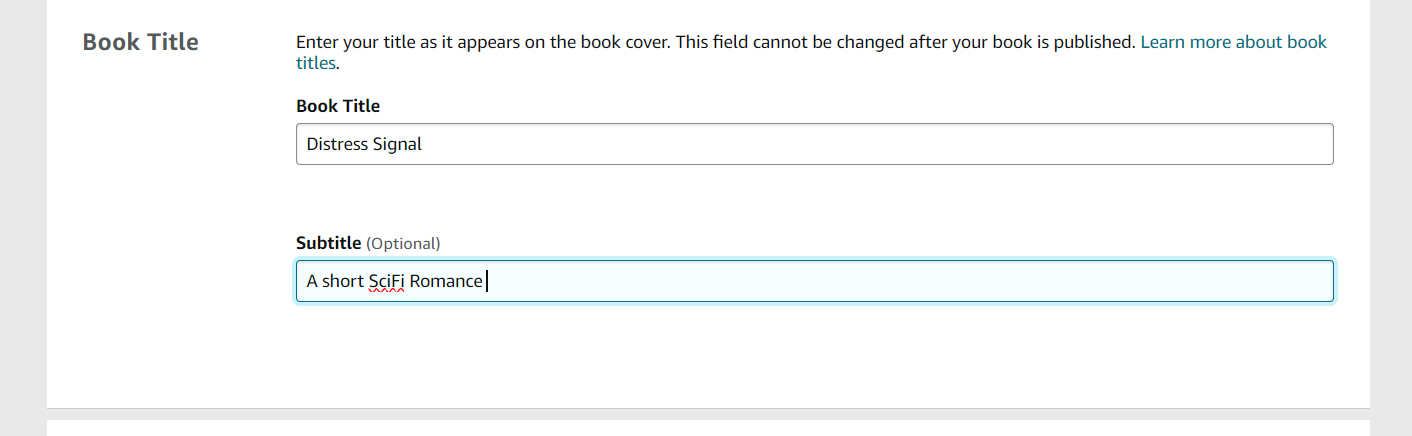
Now, on to Categories: You get up to three of these. There are a lot of them!
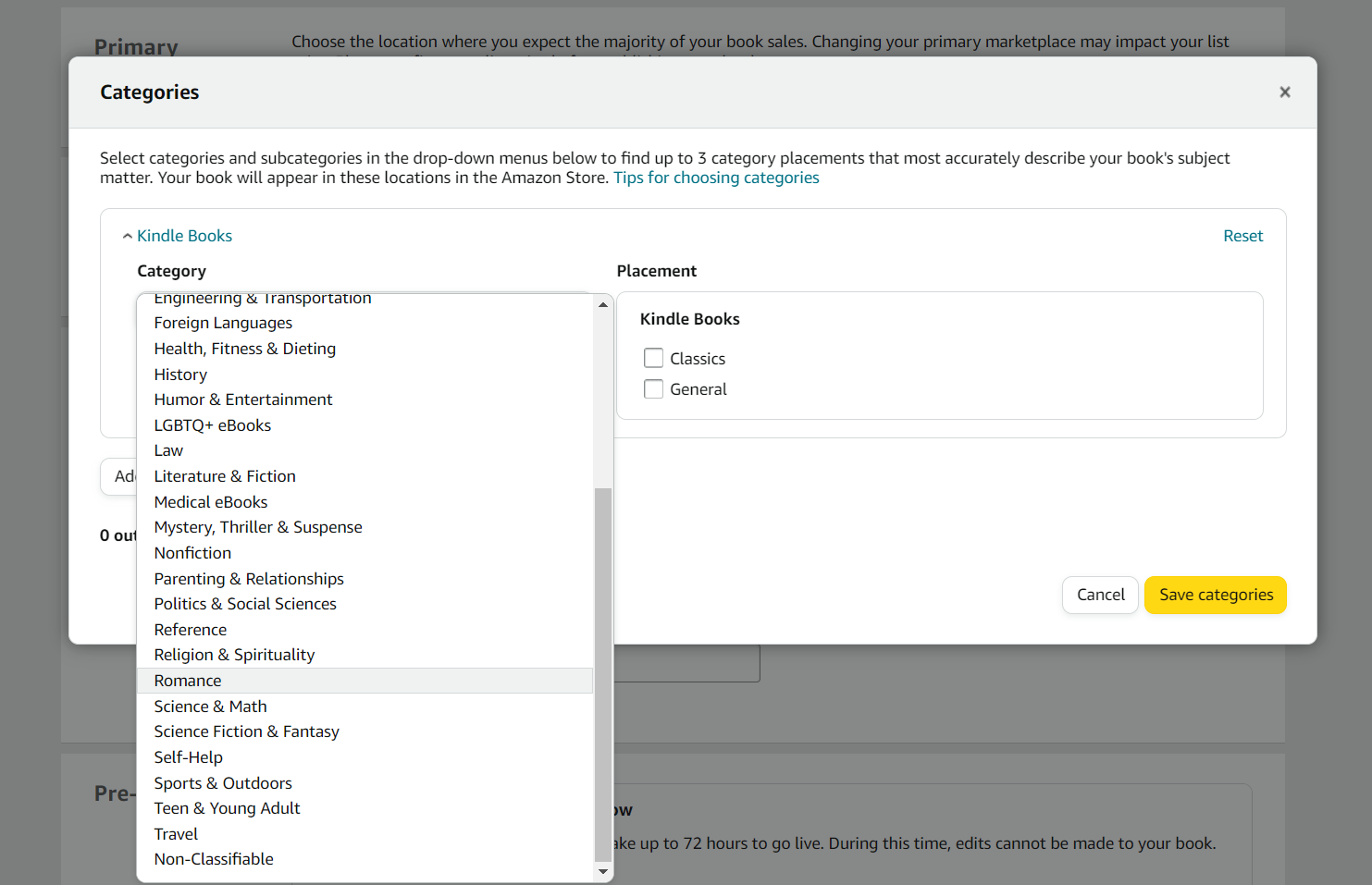
For the Sumire series, I’m mostly targeting romance readers, so I’ll start off with Romance.
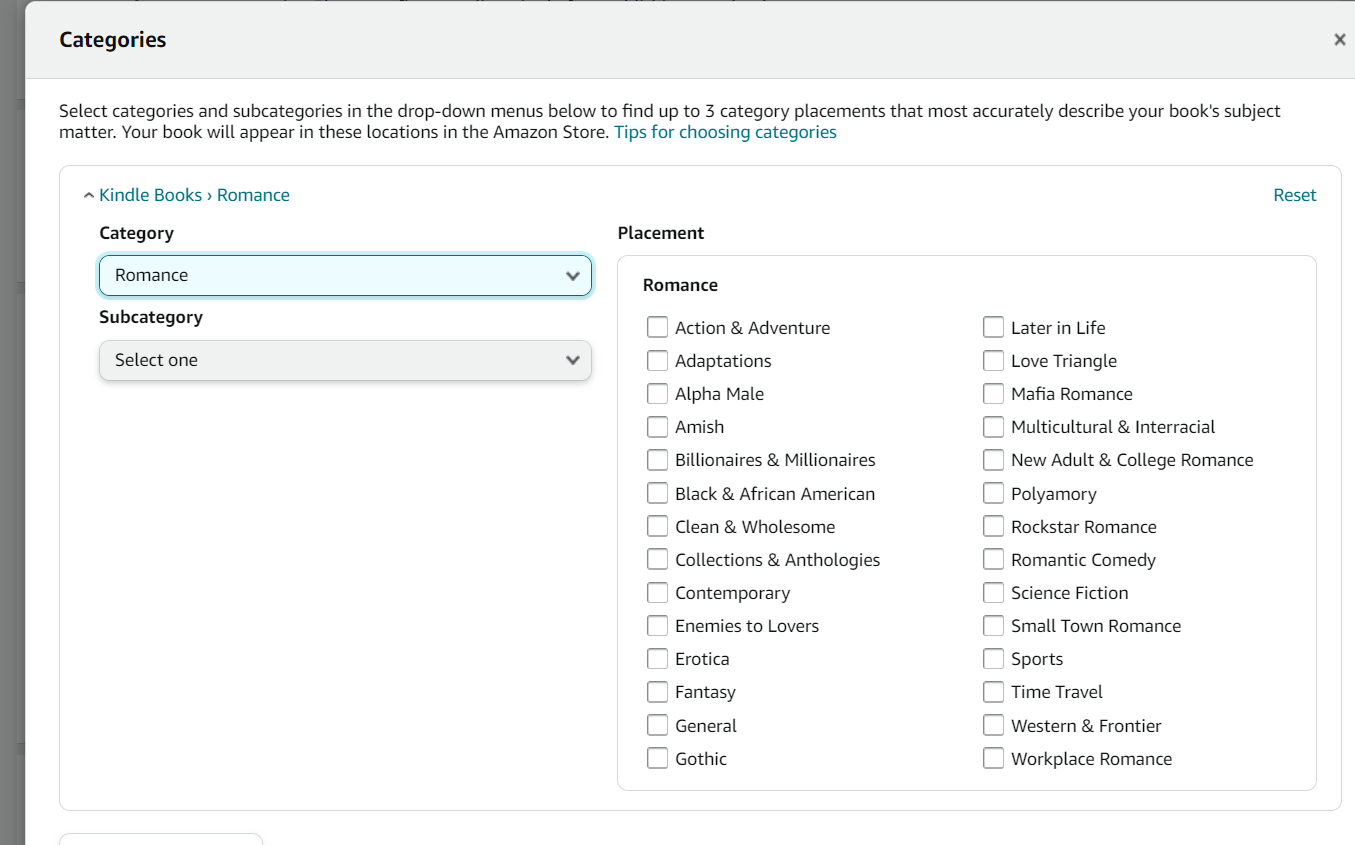
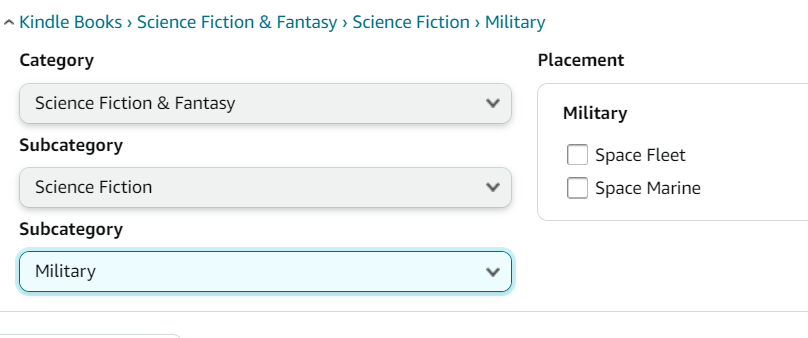
Don’t be afraid to play with the dropdowns. There are a LOT of options in here, so look at this, then maybe save before you lock anything in, and go look at what’s in those categories on Amazon itself.
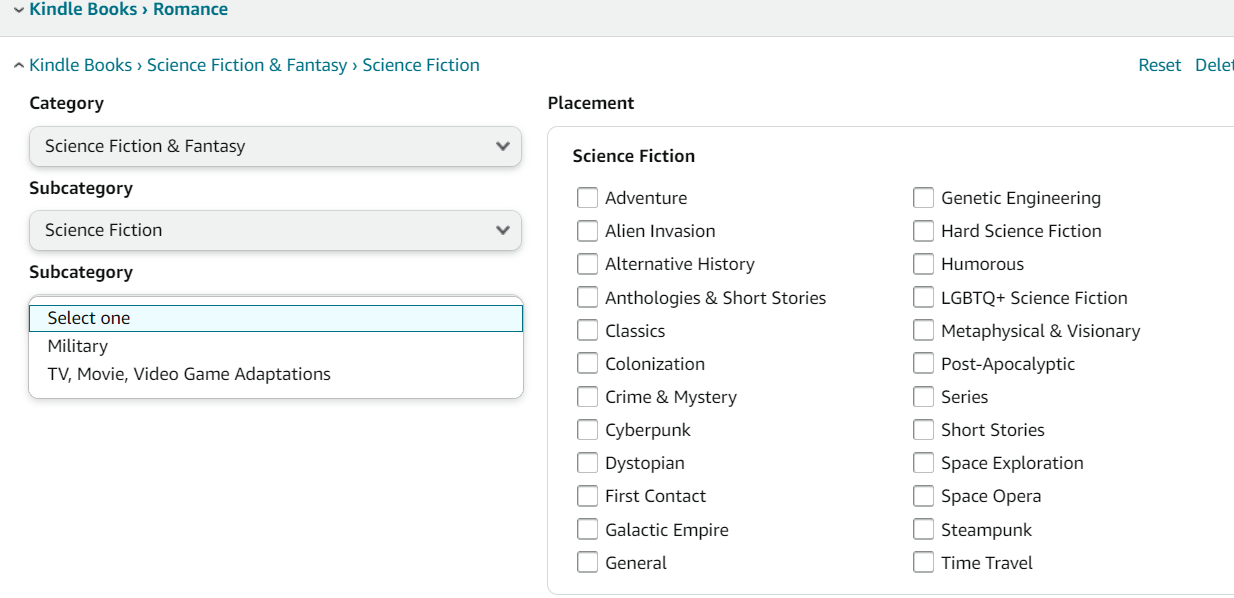
I’m not an expert here, but I do know this… the subcategories indicate the larger groups. So Military, up there in the dropdown? Huge. Your book may drown in it if you choose a more generic ‘Mil SF’ as your only category. There are some even narrower niches to put a book in, which may help. Possibly. Use all three categories, to give your book a fighting chance. And know that Amazon will also slot the book into more categories of their choosing, based on the keywords and other factors.
When I first started, I thought keywords had to be just that – a word. I was surprised and excited to learn that no, they do not.
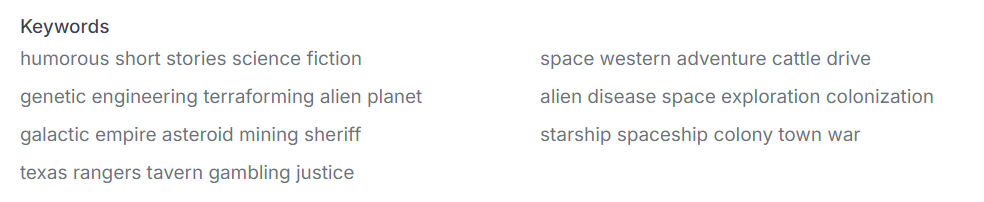
That’s not a screenshot from Amazon. And it’s not my work – it’s from CV Walter’s setup of one of the Raconteur Press’s Space Cowboys anthologies. She really is an expert on this, and I wanted to show you what a real professional does. I’m learning from her, and if you can ever find her at a con with a few minutes (woman is busy!) ask her about keywords. She’s amazing.
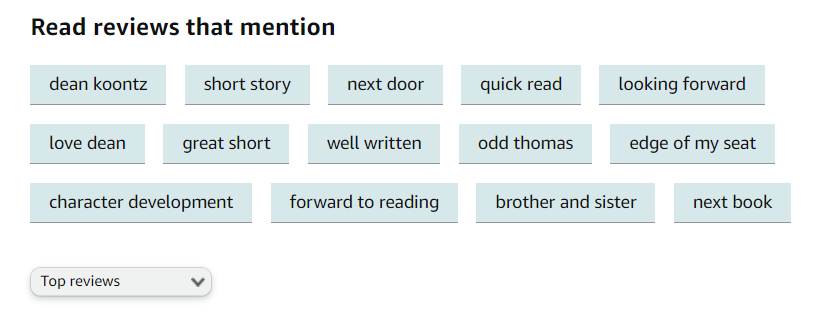
But where do you find keywords? Look at the comps – the stories like yours that are out there and are selling well. Then look at the tag cloud of words above the reviews. Here’s one from a Dean Koontz short (not sure what it’s doing in 45-min romance reads, but hey…)
This one is from a steamy romance short:
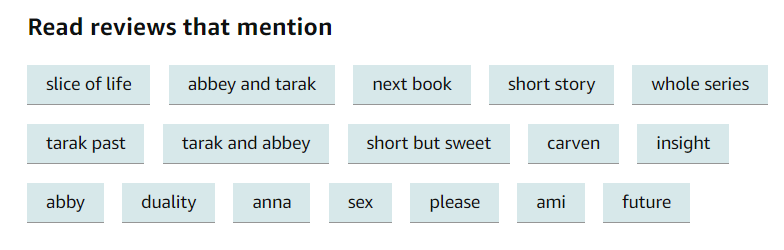
Some of those words aren’t going to apply, as they tie into characters – but if you are writing a series, do use your MC’s names as keywords, so readers looking for them can find them (or better yet, use the series set-up). With romance in particular there are code words you’ll want to learn and use. Short and sweet, slice of life, cinnamon roll… they all mean things. Things you can use in selling your book to readers who are looking for those things.
If you’ve been doing this for a while, use your own tag clouds to generate keywords, as well. This is from my Groundskeeper book 1, which has been selling through solidly since I’ve released more into the series:
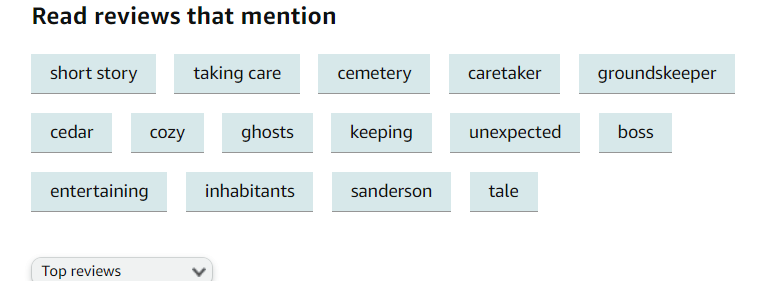
Set up a spreadsheet, start putting words in it. Create your own wordcloud, and then pull out the ones that you think will get this book in front of readers who have been looking for it. Have that blurb all hooky, and a fabulous cover, and then…
Well, maybe they’ll like it! Maybe they will want more!
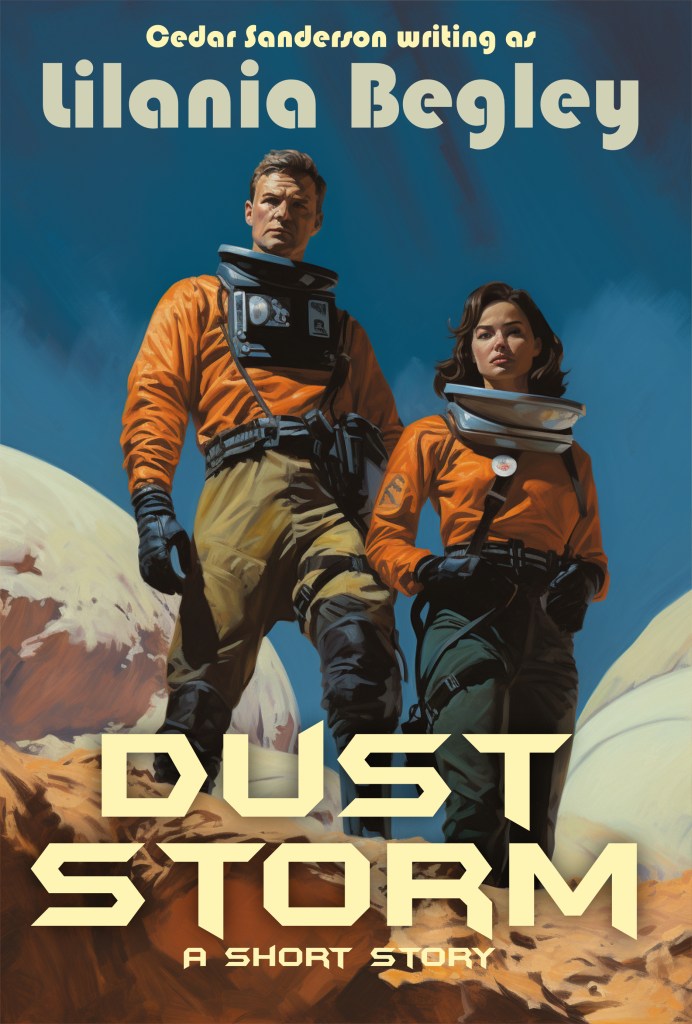
*Publish is going to be loose, here. CV Walter, my challenge partner, is putting hers up on her substack as love notes to her readers. I’m putting my first three weeks up for sale to jumpstart Lilania Begley (my open penname for romance), but I may use later stories for my substack (where paid subscribers get free fiction).


 Mad Genius Club
9 responses to “The Fiddly Bits: Keywords, Category, Blurbs”
I am definitely going to have to re-think the tags for my stories… Thank you for this!
I would add to the blurbs: When you’re writing them make sure you’re clear on tone. One of my readers pointed out that my first blurb for Bearskin signaled tragedy not “make the Devil make good” which is more what the story is about.
Since I just grabbed a link to Bearskin to promo it over at my substack, I have the blurb handy:
How do you cheat the devil?
Cut loose and abandoned after a losing war, Gregor seeks to bury the past and find a future. Any future.
When his own stubbornness leads to a desperate deal with the devil, Gregor must forge a new path. Can mortal man beat the devil at his own game?
Gregor sets out to do just that, and heaven help the devil if he tries to drag anyone else into it.
I think the tone here is quiet desperation. Maybe unwise decisions, and repentance. It’s a nice tight short blurb, which I think is good (again, not an expert on these… I’m hoping she’ll wander by with a coffee clutched in one hand later in the morning).
First: Thank you for the promo.
For the blurb: This is the updated blurb and that tone definitely fits the beginning.
(I mentioned tone because it is often one of my weaknesses in blurbs.)
The original started with “None one cheats the devil.” and carried on in that tone. It didn’t get to the upswing.
I’ve found two books to be truly helpful in blurb writing: Saves the Cat Writes a Novel and Fiction Blurbs, The Best Page Forward Way. They contain slightly different approaches. The latter takes you through creating the blurb sentence by sentence, from The Hook to The Gut Punch and on. Saves the Cat provides a little more room to maneuver. Both are helpful.
Awesome! I try to run mine past Dorothy Grant – she’s the expert there, and a whiz at it – but these would be good so I’m not imposing on her very limited time.
As a reader, let me emphasize connecting the books in a series. I have a large To-Be-Read list, so I usually buy a series one book at a time. When I finish a book that I liked, I then buy the next in series. If I know it’s a series. If the book (or Amazon) has a link to the next in series. By the time I get around to reading the book (long TBR list, remember?) I will have probably forgotten that it’s in a series. If there’s no “next in series” link at the end, I won’t know to buy that next book.
Yep! It’s important for sure. Amazon now allows you to link related books into a series, as well, so you can have the main series, like my Pixie trilogy, and a title like East Witch as part of the links to books in the same world but not part of the series arc.
I got very frustrated when Amazon removed urban fantasy as a category. I sort-of understand the logic, given what has been creeping into the category, but trying to sort out how certain works fit into other categories is … irritating. *wry kitty shrug* I’m a creature of habit and don’t like having to change without warning.
I understand, and hated having all the work of going back into my books and resetting categories when I was reworking covers. However, a more targeted niche will serve you better than the very broad, crowded field of all Urban Fantasy.