This is a re-post because I got busy with writing a novel and doing Day Job work to finish what I had planned for this week. Mea Culpa. I know that Joseph Campbell and the Hero’s Journey have lost their sheen for a lot of us, but his stuff can still be a useful starting point, or source for ideas, so I have left him here. Sarah Hoyt’s books about writing are also good, as is Dave Farland’s Writing Wonder.
Important caveat: these are books that I have found useful. Not all books work for all authors. Guides for people who do genre fiction (thrillers, romance, sci-fi and fantasy) might not work so well for people who write literary fiction, and vice versa.
Dwight Swain’s Techniques of the Selling Writer. This is the one I go back to every year, especially when I seem to have trouble with pacing, and as a refresher. Swain’s goal is to walk you through the techniques that work to keep readers interested and following your protagonist’s adventures. His “W” pattern of rising and falling action works very, very well as a rough guide that you can adjust to fit the character and genre. After you read the book once, you can go back and refresh your memory easily, because of how Swain divides up the book. I won’t say that this is the One True Book for writing stories that move, but it is up there. Obligatory disclaimer: Swain wrote in the 1970s. He’d be considered sexist and a few other things today, I’m sure. Ignore that and focus on the big picture.
Joseph Campbell The Hero’s Journey. If you are going to look at the Hero’s Journey archetype, you might as well go to the original, and then read the riffs on it.
Christopher Vogler, The Writer’s Journey: Mythic Structure for Writers 3rd Edition. This is the Hero’s Journey, but for screen-writers. Vogler uses movies to walk through how the idea fits into story, but you can easily apply it to print/electronic fiction. Each chapter is one stage of the Journey, so it makes a useful sort of checklist.
Donald Maass The Emotional Craft of Fiction: How to Write the Story Beneath the Surface. This is a relatively new work, and Maass is a NYC editor and publisher. However, what he provides are exercises, and ways to working through a character’s emotional state. The goal is to hook readers without leaning on cliche too much. I don’t agree with all of his ideas, and he inclines more towards what I consider more literary fiction, but his exercises can be useful if you are stuck and need to kick the cardboard out of a character, or if your alpha readers complain that “I’m just not feeling it.” I know I am changing the character arc in the work in progress because of working through one of his exercises.
Orson Scott Card, Character and Viewpoint, and How to Write Science Fiction and Fantasy. There is some overlap in the two books. His point in Science Fiction and Fantasy about the vital importance of genre signals, and making sure your readers know that, for example, your trees talk because of genetic experimentation and mutations rather than magic, is a good one, especially for those of us who tend to blur genre lines at times. If you only get one, I’d recommend Character and Viewpoint. It includes things like MICE (what drives the novel’s actions or lack thereof), character development for major and minor characters, and a lot about the different points of view, and when you might want to use one or avoid one. Plus it applies across all genres.
There are a lot of other books out there, and some more general author-life sorts of books like Stephen King’s and John Erickson’s books (of the two, I like Erickson better, but he’s a relative of a good friend, so I’m a little biased.) Nibble around, check books out from your library, and find what works for you. Your needs as an author change over time, and what was too nit-picky for you as a beginning writer might be exactly what you need later on.
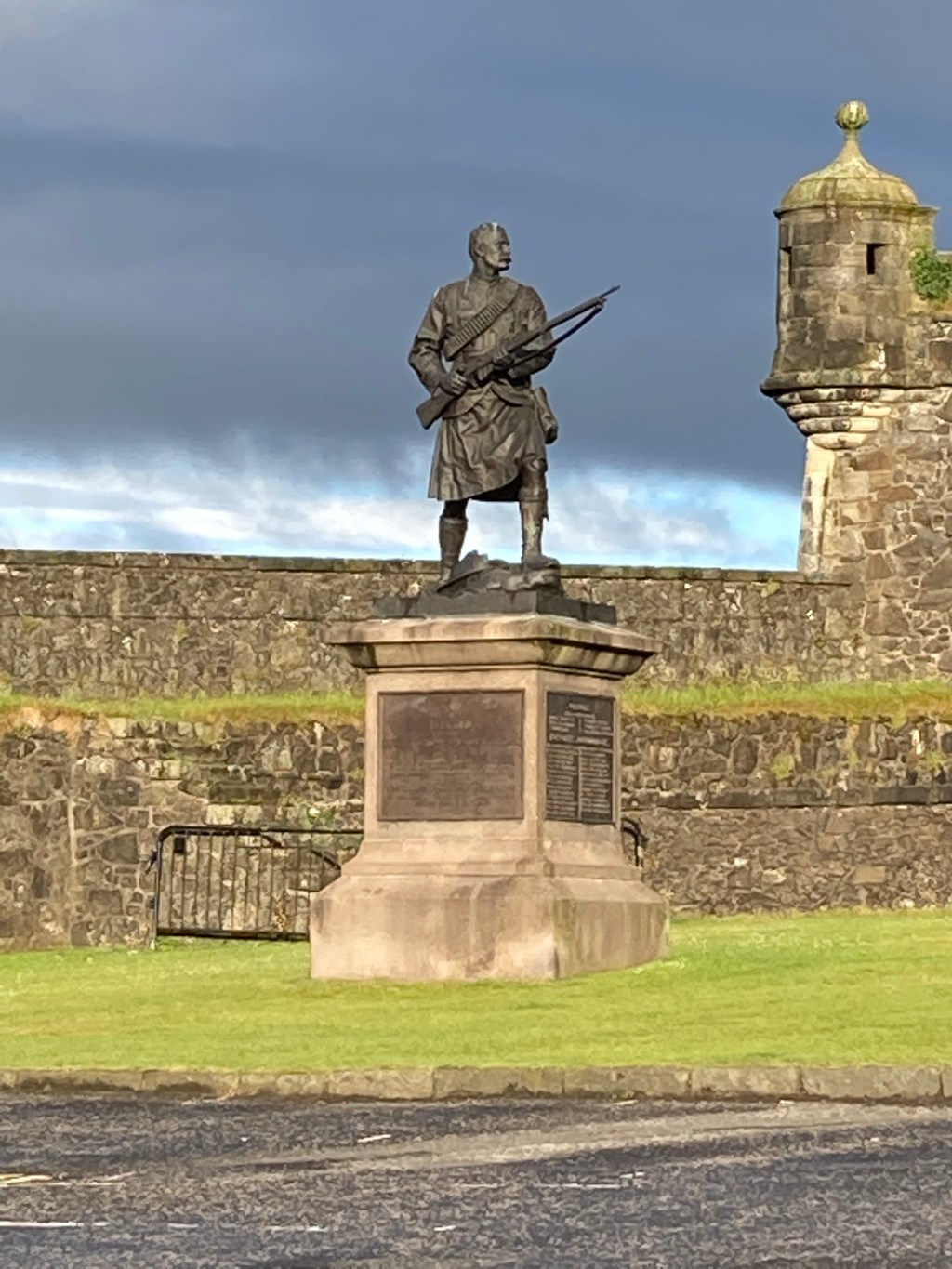
Image Credit: Dramatic Sky, Stirling Castle, Scotland. Author Photo, June, 2022.



 Mad Genius Club
3 responses to “Books for Writers”
That’s an inspiring statue in the picture! My google-fu allowed me to discover this is the Argyll and Sutherland Highlanders Boer War memorial. By the time of THAT conflict, a unit of the A&S Highlanders had become the first recipient of “The Thin Red Line” designation, based on their performance at Balaclava on October 25, 1854.
Oscar Wilde was EXACTLY “nine days old” on that date; coincidence? Or CONSPIRACY, making subtle commentary on British colonialism, under which policies British clerks and troops experienced extreme climates. (Some liked it hot; some liked it cold.) The evidence is there for all to see….
I spent as much time in the Argyle and Sutherland Regimental museum as I did in the rest of the castle, or so it seemed. I know most of the names and battles, to the mild surprise of the docents. Lots and lots of stories, adventures, close-calls, and fascinating traditions (a snuff-box in a taxidermied ram’s head, anyone?)
“(Some liked it hot; some liked it cold.)”
And some of them liked educating idiots…..
https://www.poetryloverspage.com/poets/kipling/pagett_mp.html
“We reached a hundred and twenty once in the Court at noon,
(I’ve mentioned Pagett was portly) Pagett, went off in a swoon.
That was an end to the business; Pagett, the perjured, fled
With a practical, working knowledge of “Solar Myths” in his head.
And I laughed as I drove from the station, but the mirth died out on my lips
As I thought of the fools like Pagett who write of their “Eastern trips,”
And the sneers of the traveled idiots who duly misgovern the land,
And I prayed to the Lord to deliver another one into my hand.”