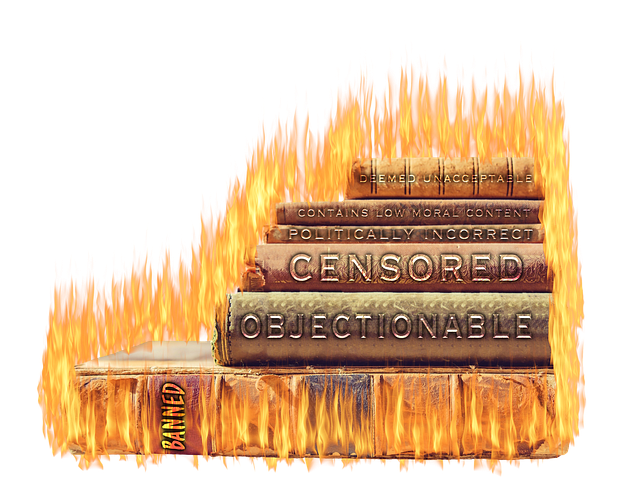
No, this isn’t about having your story bleeped because you used all of George Carlin’s “seven words*,” at least twice per page, for 200 pages.
Over the past few weeks, several news or commentary articles about censorship have caught my eye. These all focus on the US: the question of “what is censorship and who may censor” is very different from any other country’s laws. Censorship by state institutions has been in the media a great deal in recent years because of complaints by parents over material being presented to students. This led to state legislatures passing laws limiting access to certain categories of materials, in some cases based on student age. Many of the books on the various lists are works of fiction that include material considered sexually explicit. Other books have “other problems,” whatever those might be.
This isn’t the first time “school censorship” has been in the news. Amanda Green covered the topic extensively, often with a sense of frustration because of how rules were written, and the “you’re one” “you’re another” tone of much discussion about censorship. However, it does point to a larger question in the US, one that has had direct effects on genre fiction: do readers have a right not to be exposed to things that might cause offense? If so, who decides that a book should not be published? And as Dave Freer pointed out yesterday, there are also voices who encourage self-censorship even before writing, because ” You’re not a member of that community. What can you know/understand/dare to describe about them?”
You might recall several instances three-four years ago when social media pile-ons led to the terminations of several books even before the manuscript made it past the first editing pass. The authors were deemed “not authentic voices” for the topics, which included cultures from Southeast Asia, China, and Africa. In a few cases, the publishers decided that they didn’t want to bad publicity and activist pressure, and dropped the book. In other cases, the authors requested that their manuscript be removed from consideration, and made public apologies and promised to “educate myself” to prevent future offense. Sensitivity readers also got hired, to ensure that the books met the approval of a member of the group under discussion. Fear of offense led to censorship even before anyone saw the potentially-offending story.
I admit, I have limited distribution of one of the Cat Among Dragons e-books because it might violate British laws about criticizing religion. The statute is sufficiently vague that having proxy bad guys (manipulated by an alien Big Bad) who are motivated by religion could possibly be illegal. Rather than get charged in a British court, I restricted distribution. Preemptive self-censorship? In a sense. Government censorship? Also in a sense.
I am vehemently opposed to national-level censorship unless the work endangers national security, OR is sold as something it is not (a “children’s poetry” book that is a paean to paedophilia.) Local communities should also be free to say, “No, we don’t think that Lady Chatterly’s Lover should be required Junior High reading.” The book is still available, just not required in school or shelved in the junior high library. (If you can’t read the book aloud without violating all sorts of rules about obscenity and explicit materials in a public meeting, it shouldn’t be in grade schools or middle schools, in my opinion.)
Should you censor yourself? Depends on your market, your genre, your personal feelings. I don’t write paranorma-rotica, I try to limit curse words in my books, and I to hesitate sometimes before I “trespass” into cultures and ethnicities. On the other hand, it’s my choice, not something imposed from outside. The market has said that readers prefer not to be bombarded by [bleep@!], *$^#, and &$#*s, so I try to oblige. Readers don’t want certain things, so I leave them out. Other writers with a different readership leave them in, or add more (Paladin of Shadows, anyone?)
Unless you have a publisher to please as well as readers, write what you want, ignore the social media harpies, and see what happens. (Keeping in mind that your national laws may differ from those of the US.)
*Not to be confused with “The Seven Last Words,” which is choral composition.
Image Credit:Image by Amy from Pixabay
https://www.thefire.org/research-learn/chilling-effect-overview


 Mad Genius Club
13 responses to “Censorship: Self, Outside, Market”
It is certainly possible to write without using the Forbidden Words, and I generally take them out when I write them in because they just don’t fit on re-reading the passage. They’re the salt that seasons the steak, if you will. Too much salt and the meal is spoiled.
Once upon a time I thought that this was mere prudery but lately I’ve been subjected to some writing by a quite famous author about woodworking, of all things, who has included in their writing some distressing vulgarities.
I don’t want to be reading along about three-legged milking stools and their traditional construction, only to find a hideous reference to some bodily function or perversion in the middle of it, without warning. It is repugnant, and in fact somewhat distressing because it smacks of mental illness. I wonder if Famous Author might be going off the rails, or having an un-diagnosed neurological disorder. To the point were I’m considering unsubscribing to this author’s email list, because I don’t want to read anymore if they’re going to keep doing that. It just isn’t worth it.
That would be a case where a little self-censorship would go a long way. Gratuitous vulgarities and casual mention of perversions do not mix with woodworking in a positive way. Or, more to the point, the number of people who would applaud is smaller than the number saying “ew.”
In my own writing, I do have themes and occurrences that certain deeply religious persons probably wouldn’t like. Your hard-core Religion of Peaceniks, your Red Underwear Leftists, they’re not going to be happy with all the guns, girls kissing robots, lack of respect for Chairman of Central Committee, and so forth.
I feel I can live with their disappointment. ~:D
Another group, apparently, is the bunch that say they want “darker themes” included in the romp. And I’m sorry, it is an un-serious romp of romantic encounters between sad boys and fabulous robots with some giant tanks thrown in for good measure. (Can you have a boy-meets-giant tank romance? Difficult. Easier to give the tank a -fabulous- “social interaction scout” drone.)
To those readers I reluctantly say: Who puts dark themes of Man’s Inhumanity to Man in the middle of a kissy-face romance adventure story? Save that [expletive deleted] for the Hugos. That’s their jam, I’m not doing it.
One of Correia’s Writer’s Dojo talked on that. Apparently they way we read, we actually scan each line there times. Normal words just get filtered into the mix, but swear words effectively get triple counted.
C.S. Lewis observed that while ancient Greeks and Romans were rather fond of bawdy writing, their epics with the rarest of exceptions have no passages that could not be read aloud in a mixed audience at the most cliched Victorian times.
(And the passages are comic, which is hardly irrelevant.)
There’s aesthetic decorum.
Re-self-censorship… I won’t censor myself on my actual convictions.
However, I admit, I have a dirty mouth. I blame the particular transgressive years when I grew up, as well as my foul-mouthed (when no adults were present) adored older brother. I learned to try and tone it down in public when, as a high school freshman, I was on the team in the local science quiz show and answered the question about which kind of eclipse it was when the moon blocked the sun, and under stress blurted out the answer which I realized was wrong as I said it: “Lunar Eclipse! Oh, damn!”
On live television. Into the living rooms of the parents of the other team members. News travelled.
Oops.
While expletives are a useful component of rhetorical language of which I approve for their expressiveness, and I still don’t restrain myself much in private, I have learned more consideration of those around me and can mostly tone it down in company. It’s a matter of manners, to me… propriety. If I don’t mean to insult someone or their beliefs directly, it’s wrong to do it by accident by crude expression when there are other choices.
In writing, well, all cultures need swear words. They can be religious, scatological, colorful, long-winded rhetorical, etc. I use them instrumentally in my writing, but they’re there to suit the characters, not to shock the readers.
Karen, you rebel you. ~:D
My mother had a lot to say when she heard about it. Me, I was more chagrined at letting myself be triggered into the wrong answer.
Everybody in my social group was foul-mouthed (and this was an elite crowd — it was the fashion of the time), and it took years before I could reliably play an adult in polite company, just in time to seek my first adult jobs.
So few people see what I write that I can do as I please.
That said, I don’t write porn and I limit my obscenities to what’s critical for a character’s emphasis because that’s what I prefer. Same with intimacy.
Unless it’s critical, we all know what goes on behind closed doors so why spell it out?
This is what I do too. It is my humble opinion that people can imagine things like that much better than I can write them.
Write the kissy-face and cow-eyed glances part, leave the details of who did what to the reader as an exercise while the curtain is discreetly drawn. After-action reports are permitted, as long as they’re funny and in good taste.
Exactly!
I have read precisely one sex scene that was actually important for a character arc and a story’s plot, that being the one between Gretchen Richter and Jeff Higgins in Eric Flint’s 1632. Other than that, it’s pretty much always gratuitous.
That was a good story. Those are two great characters as well. I think Alice Haddison, my character, owes some things to Gretchen. Mostly on the attitude side.
I’ve read several books where the sex scenes were important for the plot– the characters wouldn’t phrase it this way, but it’s really obviously induced bonding on a level that interferes with unaltered thought.
Basically, it is a super-charged version of the actual bonding that occurs in sex, sped up so you can actually see the changes happening over a single event, vs slowly building up over years.
Which I was really not expecting when I started reading romances to research if I can actually write the best-selling genre of book. 😀
OR is sold as something it is not
Welp, that covers my one time I think folks have a right to not read something that “might offend.”
Basically, fraud where the point is to Get One Over On those evil nasty Themses by tricking them into buying something other than what you’re selling.
(This, incidentally, covers most of the actually-removing-books vs not-buying-new-curriculum school examples as well. Educational materials, and even public entertainment, vs…. well, that I can’t write out a lot of the objectionable material because it definitely violates the decency standards of the blog pretty much covers it.)