At the one and thus-far only major writers’ workshop I attended, I was told that there are three basic conflicts: Man against man, man against himself, and man against nature (that being human nature, not the non-human environment.) I was rather puzzled, because I’d learned different lists of basic conflicts. One had “man against nature” as “man against non-human environment.” However, conflict is the driver in stories that we write and sell.
MasterClass.com adds another three: man against the supernatural, man against society, and man against technology. You could probably argue that society and technology both fall into sublcasses of “man-vs-man,” because both are made by mankind. “Human vs. alien” could also fall into “man-vs-man” because again, it is individual against individual. Supernatural? Here I’d wonder if the supernatural is the antagonist, or is invoked by the protagonist’s actions or lack there of. If we go back to Oedipus Rex and the following two plays, the core conflict was Oedipus’ and Laius’ pride in arguing over who had the right-of-way. And yes, Laius violated the laws of the gods and of hospitality, thus starting the curse on his family. So we are at “man vs. man” and “man vs. self” as the driving mechanisms. The actions of the gods are not as antagonists but servers of justice.
Blog.reedsy.com has seven conflicts, because they add “man vs. fate.” OK, here’s Oedipus et al, or at least Oedipus, King Arthur in some versions of his story, and a few others. This doesn’t seem to be used that much now, in part because for American writers, it flies smack in the face of the American tradition (“I can be anything, and there is no such thing as an inescapable fate.”) It is also very, very difficult to do well. It probably works better as an element in a story than as the main driver of the story.
WritersRepublic.com removes “supernatural” and replaces it with “man vs. the unknown.” Here we get into Lovecraftian cosmic horror, some dark fantasy, and some of Stephen King’s novels. I can see this as a horror pattern, but also more as an element in the story to be resolved. What is the unknown, and how does the protagonist deal with it? Often that includes identifying the mysterious, looming presence.
Or you can go back to four, as Writers’ Digest does. They lean on man-vs-man, man-vs-self, man-vs-environment (or in their example, penguin-vs-environment), and man-vs-supernatural. Interestingly, they use the films of Lord of the Rings as an example of “protagonist fights the supernatural.” I suspect that one could argue that there are a LOT of other leading conflicts in the story, including “hobbit vs. self” in the story of Frodo and the One Ring. And all of those conflicts go back to Morgoth vs. Illuvatar.
The big point of all this wandering and surveying is that you must have conflict in your story. It can be a small conflict in a small story, like my story in Tales Around the Supper Table where the driving conflict is “dragon vs. chemistry.” It can be a large conflict, the forces of light and darkness racing to collect six sacred talismans in order to make them tools for a final battle between the Dark and the Light (The Dark is Rising). A story without conflict is a scene, a meditation, a vignette, perhaps even New Age Post-Modern Literature, but not a story in the “will people throw money at me in exchange for this” sense. Who or what is your protagonist struggling with or against? No one and nothing? Why not? What drives your plot, if not conflict?
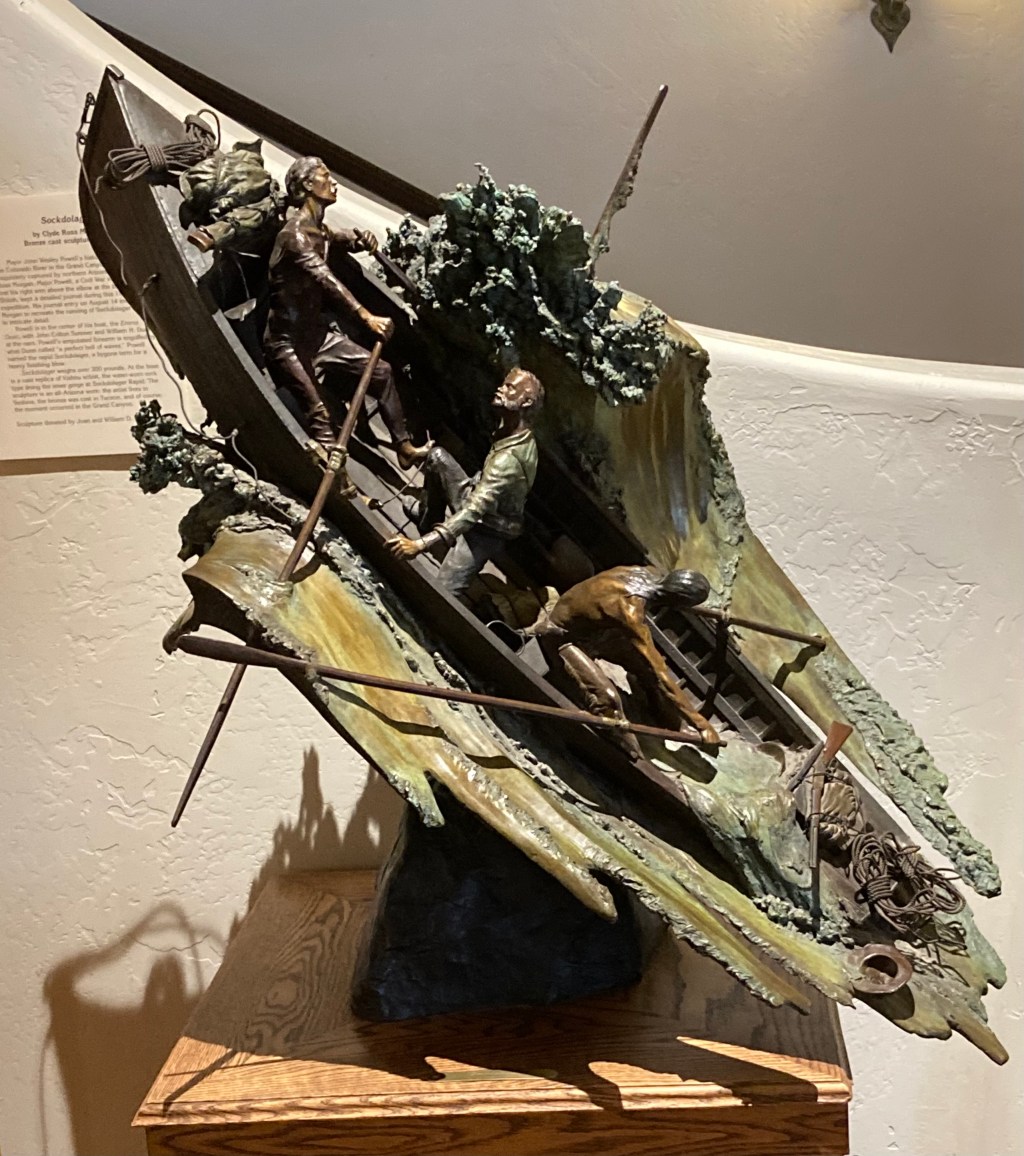
Image credit: Man vs. Nature in the shape of the Colorado River. “Sockdolager” by Clyde Ross Morgan, in the Museum of Northern Arizona. Author photo, July 2023.
 Mad Genius Club
19 responses to “The Three Basic Conflicts?”
I find myself inherently suspicious of the reductionist overviews, because they seem to me to be attempts to make categories simple enough every story can be shoehorned and pounded into them for meta-analysis, instead of tools for creating good story.
That said, I have issues writing villains, so I tend to do a lot of man vs. bigger forces than a single human – be it culture, politics, or the world itself.
Heh. Maybe I need to write something with a mustachio’ed villain, just to see if I can.
A well-written [almost said “good”} villain can be hard to write. Snidley Whiplash might actually be difficult to do well, because trying to make the motive believable (not that Snidley Whiplash actually had a motive, aside from the compulsion to tie women to train tracks.).
Villains are my bane, so to speak. Though my current long WIP has antagonistic elements, they are not the most important ones — they’re mostly on a par with business rivals rather than personal conflicts.
My fictional conflicts come through over-reaching ambition, accidents of industry/nature, creating teams/leadership, accepting personal limitations (or not). There’s enough of that around in life that I don’t feel the absolute necessity for explicit enemies. Plenty of sources of frustration without that.
Maybe she’s not a stereotypical villain, but Jenna’s room mate is pretty nasty and easy to hate.
++
I’m still trying (and failing) to understand the real-life villains. The elitists that have hijacked our society and are doing their worst to destroy the economy, industry and civilization that make their privileged lives possible. How can anybody be stupid enough to sink the ship they’re sailing on?
I suspect that many grossly underestimate the complexity and amount of work it takes to keep the luxuries they so enjoy flowing. Some probably assume that they can go to a bunker somewhere, then emerge and go on living in the rank and custom to which they believe that they deserve. After all, they are superior to all the hoi palloi.
They don’t realize it’s a ship. They think it’s solid land.
They’re convinced that they were born with boots and spurs and the rest of us were born with saddles on our backs.
Interesting picture illustrating this post. I read Down the Colorado by John Wesley Powell, which the sculpture is memorializing. Powell could be thought of as dealing with all three conflicts, self, others, and nature. He had lost one arm so he struggled with that. He was obviously struggling against nature going down the river. He struggled with members of his party who wanted to quit, and he struggled with the native inhabitants of the area he was traveling through. If he weren’t real, could he be invented as a protagonist? A wildly successful one at that.
My latest protagonist is struggling with herself, and then with the part of the world that took advantage of her weaknesses. Not that I understood that, when I invented the story…
In an odd sense, the recent books published by Lawdog/Raconteur Press (=Your Honor, I Can Explain=, and =You See, What Happened Was=) are Man against Fate. Andrew Spurgle is utterly incompetent in all his incarnations and at least as clueless. He is doomed to failure, or to success at bizarre cost. His struggles are a jest by Fate, and amuse us in the process.
My experiments with “fate” have been an extension of “man vs. himself.” It’s not that there’s some malevolent force out there, twisting all of the characters choices so that no matter what he does, he’ll end up in the same place. It’s that the character’s own nature is such that, even knowing where the road he is on leads, he can’t choose a different one while still being true to himself. The characters own inner demons or inner angels will put him on the same path every time.
The thing I’m realizing is I need to understand both what the character thinks they are on conflict with and what they are actually struggling against.
Because a character who thinks they are struggling against an unchangable fact of life, when they are actually fighting themselves will do fundamentally different things than if they realized they were fighting their own tendencies.
I feel like “man vs self,” “man vs environment,” and “man vs other personality” are better reductive labels than some. If a story contains impersonal supernatural forces (Oedipus, a lot of Lovecraft and Machen, maybe LOTR films) then those are by definition part of the setting, the environment. Meanwhile, a story like the LOTR books, or like Dracula and certain of its adaptations, is about humans in conflict with a hostile, nonhuman entity which has a somewhat knowable agenda and some degree of personality. There might be a few “man vs society” stories where the other side of the conflict is impersonal enough to qualify as “man vs environment,” but the ones I can think of offhand, like Mansfield Park, are really “(wo)man vs other personalit(ies).” Ditto most versions of Robin Hood: he doesn’t so much have a beef with the system as such, just with specific people running it and the abuses and corruption they commit or cause.
Ultimately, it’s a classification for the readers’ benefit, as with genre, and its main relevance to writers is whatever value they get from figuring out what other books have similar conflicts, and what they can learn from that.
Let’s see if I can post a link here: (I gave up on posting the image directly):
I understood that reference 🙂
Yes, ever since I saw the Daffy Duck plot matrix, the rest don’t do it for me any more.
Everybody knows the three basic plots are Man Embarks On Journey, A Stranger Comes To Town, and Godzilla Vs. Mechagodzilla.