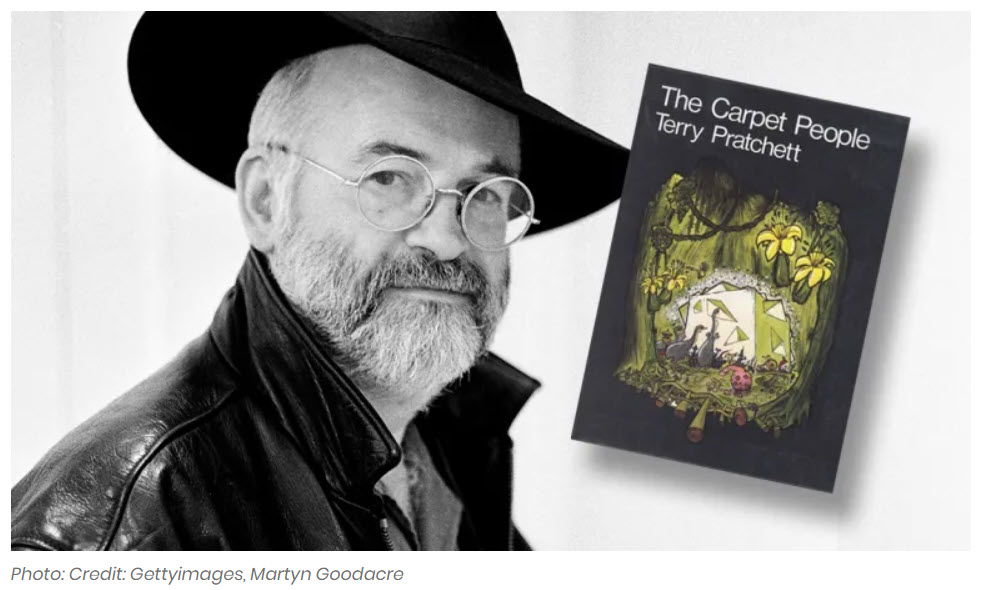
This week, let me point you to a really interesting article by Juliette Harrisson.
“You can’t buy Terry Pratchett’s first novel – or rather, you can, but it will cost you. A first edition of the original 1971 version of The Carpet People will set you back somewhere between £400 and £1000; Forum Auctions have one on sale with a guide price of £400 – £600. You can, of course, buy the current version of the book, and “first editions” of that one might be going for less than £5. But that is the version that was edited and re-published in 1992, after the original had gone out of print. And it is not quite the same book.
In his introduction to the 1992 revised edition, Pratchett said The Carpet People “had two authors, and they were both the same person”. When the Discworld novels began to sell and demand for Pratchett’s debut novel went up, he told the publishers that he needed to do some re-writes, and the resulting new edition of the book was “not exactly the book I wrote then” and also “not exactly the book I’d write now”, but rather a joint effort between 17-year-old Pratchett and 43-year-old Pratchett.
Pratchett described the key difference as being that, back when he first wrote the book, he “thought fantasy was all battles and kings”. Two decades and several Discworld books later, however, he had changed his mind and decided that “the real concerns of fantasy ought to be about not having battles, and doing without kings”. As a result, as Andrew Butler puts it in his unofficial companion to Pratchett’s novels, the book transformed itself from an homage to Tolkien and The Lord of the Rings, to a parody of it.”
RTWT


 Mad Genius Club
13 responses to “How Terry Pratchett’s First Novel Went From Tolkien Homage To Parody”
Just another deconstructionist post modern joker. I look back on Pratchett like I do on Colbert, Jon Stewart and the rest.
I’m not sure Pratchett was a postmodernist. He didn’t deny that there are fundamental truths – in fact, he sometimes skewered people who did deny that. If you mean that he attacked institutions that he saw as flawed or out of date, and used his books to play with ideas, then absolutely he shared some things with Colbert and Stewart. And with a lot of other writers.
Rather ironic, someone who supposedly believes in fundamental truths while attacking any institution that might try and bolster them in the world, and in hindsight a lot of those outdated things were the dam holding back the floodwaters.
I’m just vaguely curious if Prachett would be like Gaiman, gung-ho with approval about how his own work has been ruined and bastardized in the screen adaptations.
I rather suspect he would be.
Like King, like Whedon, like all the other artists who were so “daring and brave” in the 90s and early 2000 in terms of tearing everything down, they are now the staunchest defenders of the new orthodoxy.
The only judgment I can make about Pratchett is that about 60%-70% of all quotes from him make me smile and nod along, and only about 1% of them make me want to read him for myself. The revised version of the Carpet People saga just sounds glib and annoying, not funny.
But hey, he seems to have given a lot of people pleasure, and been a reasonably gracious person IRL, and I know I can’t say as much for myself on either point.
Pratchett is one of those authors that I feel like I ought to like, given that so many people who share many of my tastes love him. But I’ve never actually read an entire book of his that I didn’t end up finding vaguely annoying.
My favorite way to consume Pratchett has always been to sit next to someone reading him, wait until they laugh, and then ask them to read the funny part out loud.
Interesting! I have never redone anything as drastically as Pratchett did, but I can see how, as an older writer, he would find problems with his earlier “voice” and the emphases of the original story. The stories I wrote as a teen were much darker and fatalistic than older-Alma would put up with. Among other things.
I’ve never really been a fan of authors going back and “fixing” novels. You were 17, you did your best, have some respect for the teenager.
What I’m writing now is technically better than my first novel. I should bloody well hope it would be, after all that practice and ten years of going at it. Should I go back and “fix” things?
Only if I think my book is a “product.” I’d fix mistakes in it if that made it sell better, sales being the goal. But completely change it because I’ve changed my mind about what’s cool since I was 17? No. It’s art.
Leave it alone. Write a new one.
I can kind of see both sides of the argument. Pratchett had this very early book sitting out there in lists of his works whether he liked it or not, some publisher was probably pestering him to reissue it just to make the money printer go brrr, and when he went back and reread it, he realized he wasn’t sympathetic to the book’s attitudes anymore, and his current readership wasn’t going to be sympathetic to its tone, so he felt like he had to change it.
But man, if I were in his shoes, my inner editor, who strongly resembles the sloth from Zootopia, would be languidly encouraging me not to bother changing the old book, just issue some “I was young and stupid then” disavowal if I was really offended by my younger self’s ideas, and move on.
I didn’t go read the original article. Also, just FYI, I have read two or three Pratchett novels and liked them sort of.
I am struck by this. Pratchett says first — I thought Fantasy was… — then later he says, — Fantasy ought to be … —
That’s quite a change of attitude, from observation to coercion.
And then you get people who undermine the entire series with the last book. . .
Earthsea is worst, since you have the original trilogy and as many bad books following it.
I’ve read the Carpet People series. It’s a fairly good read, with a different take on the then-popular “tiny people living in the walls” trope. They’re the “carpet people” because they live in the carpet section of the big department store.
On sale today: The Carpet People.
I’d try the original.