[ — Karen Myers — ]
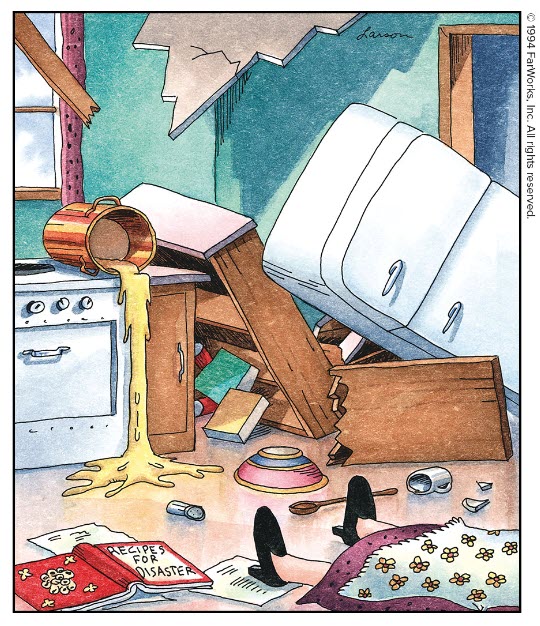
Once the disaster (crisis) has happened, will your reader remember the cookbook above and all the inevitable suspenseful steps taken from that moment when it was first introduced?
In a one-panel comic like this, the whole mechanism is laid out for the viewer, and an author (alas) has much the same point of view, since he’s the one who designed it. It reads from left to right: cookbook straight to catastrophe, in the (literal) blink of an eye.
For the cook (and the reader) — not so much. If they didn’t happen to notice the title of the cookbook, they’re going to feel blindsided.
A lot depends on exactly what the design of the crisis entails. If the reader just gets to see the very start, but none of the intermediate steps, then either that start will be so worrying that he keeps expecting it to resurface (which is good), or it won’t be memorable and he’ll feel cheated when the mechanism closes. But if you expand on it, make it a complexly designed mechanism heading for the crisis and keep revisiting its progress, then the reader gets both the increased suspense of the reminders, as well as a chance to admire the inevitability in the design of the mechanism.
So, for anything longer than a single-panel comic, tell ’em once, tell ’em twice, tell ’em boldly, tell ’em nice. They may be so captured by your story that they relish all the clues as they skim on by, even as the suspense ratchets up.
Ever have any notable successes with your foreshadowing apparatus? Missed opportunities?


 Mad Genius Club
10 responses to “Is your foreshadowing too subtle?”
On the one hand, most readers caught on to the fact that the scientist was being an unreliable narrator when he acted like he knew all about the highly complex bit of military machinery he was wearing. They also picked up on the evolving nature of the nanite plague. I did trick a few people when they thought I’d killed off the MC early on. The mysterious business with Raspberry has several running fan theories. Still not telling which one (if any) are correct.
The existence of survivors was, I hope, a surprise. No real foreshadowing there, by intention. Ditto the existence of the wider survivor community, with all the consequence and complexity that implies. The *other* surprises are, I hope, still hidden.
The ongoing psychological thing hasn’t really been commented on, so I don’t know if it is a miss or not. It’s part of what turns Act II into Act III, starts the buildup to conflict, and changes things somewhat for the MC. The big whammy that ends the first book *should* be a kick in the pants, but hopefully a satisfying end. Yes, it’s sort of a cliffhanger. No, it’s not that bad.
One thing I am eagerly awaiting is to see if the readers twig on to the hidden character that’s been there for ages now. There’s hints. The HC is not a traditional one, though. Muahahaha!
Foreshadowing is one of my worst skills. I have to have beta readers to tell me what they missed. Not whether. I always miss something.
Sewing All the Incidents Together More Tightly is a big part of the polishing/cleanup process for me, and trying to do it on a story I have simultaneously releasing on Vella has been an interesting change of pace.
I haven’t really had a lot of complaints about lack of foreshadowing in my books, but I still get “um, missed opportunity here and here” vibes when I reread my early stuff.
It’s a difficult balance to strike. I didn’t used to consciously notice foreshadowing, so sometimes it worked, sometimes it didn’t. Now that I do notice (y’all’s fault), I sometimes find it a bit heavy handed, which was previously “just right”.
Three! No more. No less. Three shalt be the number thou shalt foreshadow, and the number of the foreshadowing shalt be three. Four shalt thou not count, nor either count thou two, excepting that thou then proceed to three. Five is right out.
Okay, bad Monty Python parodies aside, Sarah Hoyt taught me this one, and she’s absolutely right. Put it in once, and the readers will miss it.
Put it in twice, and the few readers that find it, will think it’s an Easter egg.
Put it in three times, and it’s foreshadowing.
Oddly, this holds up even to re-reads, although you’ll get more and more people catching the mentioned-two-times, and then a very few people who finally spot the singular reference, and have an “Ah-hah! So that’s how it ties together!” moment.
(Yes, I sometimes do this deliberately. Because that way I can put things in there that are worldbuilding, but don’t detract from the story flow – but then readers will enjoy them on re-read.)
I learned this the hard way, when I was complaining to friends a few years ago about how utterly slow and boring a thriller was. It opened with a note, “Lebanon, 1982.” Then it shows a bunch of kids playing football (soccer) in a street, and one kid’s sister coming to get him, because the parents are going to be pissed eh hasn’t done his chores yet. And we have pages of these kids, and I’m going, “Oh, get hit in an Israeli airstrike, one of you die, the other grow up to be a terrorist already. It’s Lebanon in the early ’80’s. Seriously, why are we dragging this out to a full prequel short story?”
…finally, one of my friends said, “Um, Dorothy, I didn’t know there were airstrikes in Lebanon in the early ’80’s.”
After I finished boggling that they’d missed that same bunch of terrorists still launching attacks on Israel today got kicked out of Jordan in 70-71, retaliated for losing their attempt at a civil war by continuing to bomb Jordan, killing members of the royal family, and then committing the Olympic Games Massacre in ’72, proceeded to turn the once-beautiful country of Lebanon into a hellhole, launching so many attacks on Israel they got an entire war, and the awful peace deal that left the terrorists free to go on to the bombings of the US embassy and the USMC barracks in 1983…
I realized once again that not everybody reads the way I do, nor has the same knowledge base I do.
So anything that I don’t expect my readers to know… I have to put in there three times. Unless it’s not vital to the plot, and then I can hide it away by only mentioning it once or twice. (Twice if it’s going to tie into other books, so it becomes foreshadowing for that book, too.)
In support, I only heard of the Beirut Bombing post-9/11, full on adult, IN the Navy.
History class “didn’t cover current events.”
Reader comment: That was a good twist ending.
Writer: Wait, what twist ending?
The fanfic thing actually worked well, sort of by accident. It was a series of short stories, but I’d realized during one of the late ones one of the characters was going to do something pretty horrific to one of the other characters. They were “helping.” (Yes, that was their internal logic.)
But, I also couldn’t explain why because it would require defining something that wasn’t defined in cannon. Ended up having to write two full short stories just to show that the character was intentionally up to something that could seriously hurt the MC, not just incompetent.
It was still something of a surprise for the readers, just not an alien space flea from outer space surprise.
I think it falls under the “three times is enemy action” rule.
I’m not even sure if I’m doing foreshadowing. I almost exclusively discovery write. In the book I’ve finished, the main bad guy for the book doesn’t start that way, and in fact is seen as a kind of protector (despite the fact that she hates him) to one of the main female main characters. Another character is introduced and in the second book, it turns out that she’s related to someone else. I went back to change her appearance and … she already had the right hair and eye color, and was about the right age. Even noted that her complexion hinted at a connection to the nobility.
I’m trying to do a little bit of plotting as I’ve gotten massively stuck in the second book. It’s coming along slowly, and I had to trash about 3/4 of what I wrote before. But it is coming along. Hopefully I can work out what is wrong and get back to really writing.
I just finished watching *All About Eve* and it is a masterclass in deception. It begins in exactly the right spot to mislead people about what has happened, even if they correctly guess villainy. And yet, if you go back and look, the clues are all right there in that very first scene. It’s just that I got bored listening to the blithering idiot, and forgot to pay attention to the ‘scenery’.
I’d … do a lot to be able to write a scene like that. Unfortunately, it did rely on some shared knowledge and as Dorothy points out above, working out what bits of knowledge are shared these days, is complex.
A genuine “Recipes for Disaster” book would be recipes you can cook, or perhaps make, without things you normally have.