So, to begin with, I am most vehemently not a lawyer, especially not a contract and business lawyer. I am writing as an author who does business with one of the groups in the suit, and who has been listening to complaints about Amazon since …. 2013, I think, if not earlier. “It’s a monopoly.” “It’s a monopsony*.” “It’s evil.” “It’s a blessing to society.” “It’s flawed but serves a purpose.” “It’s a monopoly that needs to be, um, well, it’s a monopoly!” And monopolies are bad, unless they are sports leagues, or are favored by a government (see the original Progressives and the “good trusts” back in the 1800s-early 1900s.)
People have been worried about the size and scope of Amazon’s business for at least a decade, especially in the book selling field. Pointing out that Amazon is not the only source for buying books led to (and leads to) counter-arguments that it is a de facto monopoly by size, if not de jure. This popped up several years ago, when the Big Six publishers and Apple’s iTunes were found guilty of price fixing. It seemed, from well outside the arguments and legal decisions, to have been done in an attempt to undermine Amazon’s power to force discounts on publishers. Some arguments made by outsiders included things like, “Well, if Amazon weren’t a monopoly, the publishers wouldn’t have felt the need to do that.”
Which brings us to this past week, and the Federal Trade Commission suit against Amazon, claiming that the company has monopoly power and is harming consumers. According to the FTC filing, Amazon, uses a set of interlocking anticompetitive and unfair strategies to illegally maintain its monopoly power.” The result of this is that Amazon stops “rivals and sellers from lowering prices, degrade quality for shoppers, overcharge sellers, stifle innovation, and prevent rivals from fairly competing against Amazon.” Seventeen state attorneys general have joined in the suit, including New York, New Mexico, Delaware, Maryland, Oregon, Pennsylvania, and Nevada among others. They filed on behalf of state residents who were consumers or sellers affected by Amazon’s monopoly power. If you read the press release, it says that the problem is NOT that Amazon is too big. The problem is it chokes current rivals and keeps new competition from getting started. The FTC dings Amazon for harming sellers, who must pay high fees (up to 50% of income) while charging the same across all platforms, and harming buyers who are charged more.
Amazon, as you would imagine, disagrees. They argue that just because they are the first, and then the best, does not make them a monopoly.
Some groups, including the Writers’ Guild, independent booksellers’ association, and others, are pleased to see the filing. They argue that it will help both small publishers and smaller bookstores compete, thus helping readers as well. Some law firms are somewhat less optimistic as to the FTC “fixing things” in court.
Me personally, I’m not certain which side I’m on, other than on the fence. I’m not pleased about the recent quality of service from Amazon (as a seller), although I’ve not had any major problems. As a consumer, I’m tired of seeing ads for completely unrelated books and products overwhelming my search. If I want a book on civil engineering in the Roman Empire, published by Oxford University Press, showing me a page of ads for everything from Roman Empire best sellers to romances set in the Roman Empire is not helpful. Likewise the Great Re-Categorizing that Dorothy discussed on Sunday. However, it is still one of the best places to find odds-and-ends that I need, their non-US sites that I use are still superb, and I don’t expect a discount on low-print-run academic books**. Since I don’t get clothes, toys, food, or other things through them, I don’t see the problems people are reporting (aside from third-party sellers charging $25 dollars for a box of cereal that is also sold in grocery stores for much less. I boggled, then went to the grocery store.)
People have been fussing about Amazon for at least thirteen years. We’ll see what becomes of this. I’m not sure what it means, if anything, for us as readers and writers. They are a valuable distribution center, yes, but more and more people were already going wide because of other problems. Time will tell.
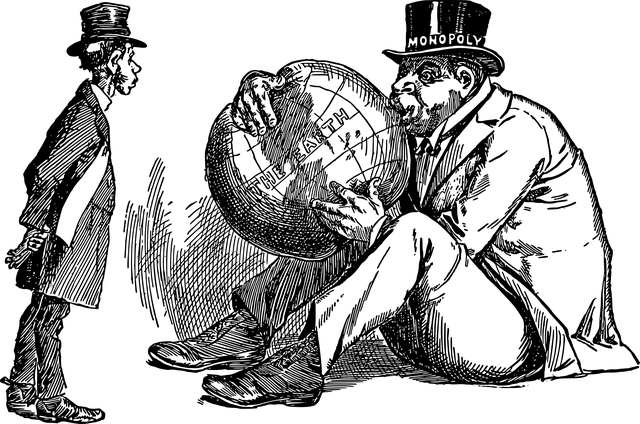
Image Source: Image by Gordon Johnson from Pixabay. Alas, someone still holds the rights to the great cartoon of the various Gilded Age commodity trusts in the US Senate.
*A single buyer for the product of multiple producers, like the government is for certain commodities in some countries. The buyer controls the market, and can force suppliers to jump through hoops.
**You’ve seen my rants about university presses that charge a hundred dollars for a 250 page monograph, so I won’t rant again.



 Mad Genius Club
11 responses to “A Bad Breakup? A Long-Needed Correction?: The Suit Against Amazon”
“*A single buyer for the product of multiple producers, like the government is for certain commodities in some countries. The buyer controls the market, and can force suppliers to jump through hoops.”
So they’re Wal-Mart. Which as far back as the 80s defined its’ own transaction formats for X12 EDI (Electronic Data Interchange). You could use the standard fields….. but when your delivery showed up you would find yourself in the “low-priority lane”… Which caused your shipper to lobby hard for you to do things “the Wally Way” so their drivers and trucks weren’t waiting for hours.
“Alas, someone still holds the rights to the great cartoon of the various Gilded Age commodity trusts in the US Senate.”
If you are talking about a cartoon drawn in the 19th century, actually they do not. Anything published prior to 1927 is now in the public domain. What they may own is a high quality image which they are willing to let you use for a fee and your promise that you not reproduce it outside the permissions they give you. If you can find the original image (in an old book printed before 1927 for example) and make a copy of it, it’s yours to use.
Back in the late 1990s I wrote an article about the Yacht America. I scanned several images of the boat from a book published in 1919 and used them in the article. I got a nasty note from the museum owning the originals of the images demanding payment because “they owned the rights to them.” After I told them where I got the image, and that the book I got them from was in the public domain, they backed down.
I have bought images that are in the public domain from such institutions from time to time when I could not secure a public domain version, but only as a last resort.
….that’s the kind of thing that makes me want to upload them to various Public Domain sites, with citation of where I got it….
Wonder if that’s why some museums started putting their collections up in high quality free for all use sites.
Getty claims distribution rights for the hi-rez images. The original seems to have come from *Harper’s Weekly*. I didn’t feel like trying to fight that battle right now, so I found something close to what I wanted.
Seeing the list of state AG’s on the suit makes me suspicious that this is less justice and more shake down.
Doesn’t mean that Amazon isn’t doing anti-competitive things, but seeing a bunch of blue tag AGs running it makes me defacto suspicious.
“As a consumer, I’m tired of seeing ads for completely unrelated books and products overwhelming my search. If I want a book on civil engineering in the Roman Empire, published by Oxford University Press, showing me a page of ads for everything from Roman Empire best sellers to romances set in the Roman Empire is not helpful.”
That is my biggest complaint. I search for an author to determine if they have released any new books and it returns hundreds of books that seem to be unrelated. Once in a while older books by the author show up but they aren’t even at the top of the list. And lord help you if the author has a common name or a last name that is similar to a first name, ie John Adams. Every book that was written by Adam “whatever” or “first name” Johns will show up.
And it’s not just Amazon. All sorts of search engines have gone to pot.
There was a time when you could give two terms to Google and get back results only with both. Now? Hardly.
Ironically my greater complaint is that Amazon Web Service is the backbone of virtually the entire cloud which means that when Amazon censors, people listen. But this suit does not address that.
No. I’m not sure the current administration wants to address that concern. Plus two big suits at the same time might suggest that the FTC or other agencies had something besides pure consumer interest at heart.
Elon Musk was unavailable for comment…..
This is my impression. Shake the money tree before the election.
Also explains why Bezos is no longer CEO. He saw this on the horizon.