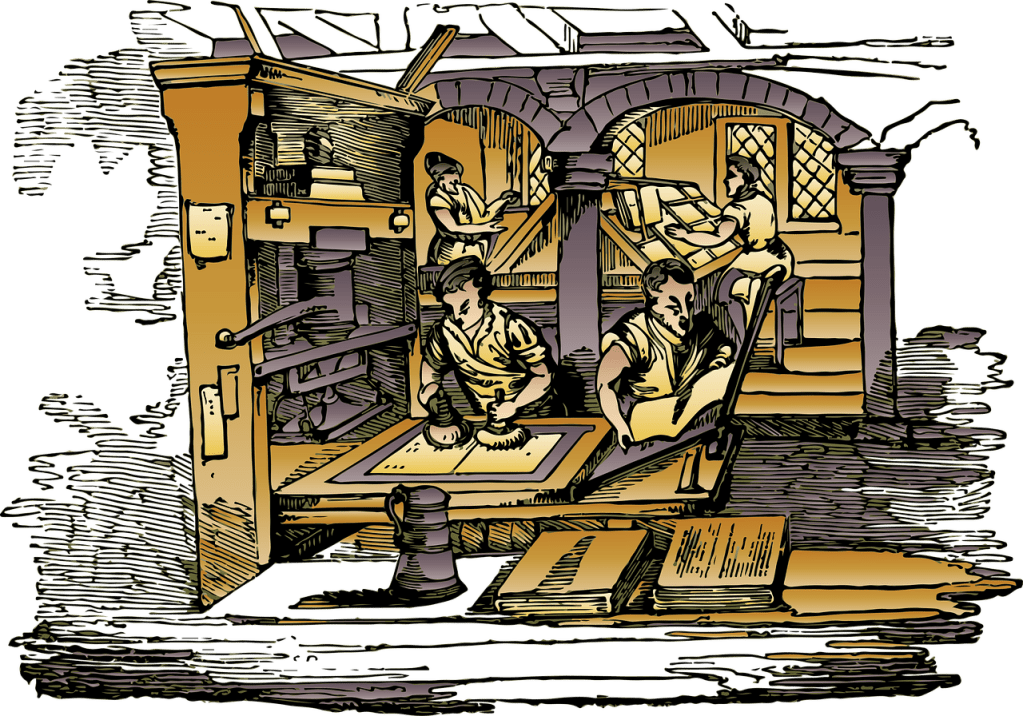
When is your new book not your new book? When it might be an AI-generated title that uses your name to boost sales without your knowledge and permission.
Most of us are used to the usual forms of piracy, where someone scrapes your book, or they buy a copy, then change a few things (if that much), slap a new cover and their name on it, and sell it. Some of us have gone to the file-sharing sites and filed Take-Down notices*. Jon Van Stry has gone much farther and has fought and successfully won battles to protect his name and works, although it wasn’t easy. Amazon has had several rounds of going through and removing pirated books, including banning and blocking one individual in Pakistan who kept uploading Anne McCaffrey’s works as his own. I remember that one because the guy was so persistent and so focused on McCaffrey.
However, a new one has popped up. I’ve heard of people occasionally claiming to find a “long lost work” by a deceased author, and if you have studied Romantic Literature you might remember the controversey in the 1700s-1800s over the Ossian poems. This one is new.
Short version: Do you own the Trademark to your name? Can someone else use it to market books? If not, how do you protect yourself?
According to the management at Amazon KDP, unless an author can prove that he or she owns the trademark to his or her own name, it is not protected, and other people can use it. Note that this isn’t about people with similar names, like David Weber the sci-fi writer and David J. Weber the historian. A quick look at title and cover will clear up that sort of confusion. This someone using the name of an author with a good reputation, publishing in that author’s genre (or other genres) and profiting from it. Or perhaps doing it to harm the author, as one writer mentioned in the original article described.
Again, unless you can prove that you own the trademark to your name and have the documents to prove it, at the moment, Amazon KDP’s management will not take down titles that are not yours but are attributed to you. UNLESS you raise a huge fuss in public after exhausting all other options, and get a large group with lawyers to back you up (in this case, the Authors’ Guild.)
Should you trademark your name? I don’t know. Can you? That’s a harder question to answer, and it depends on what you want to accomplish and how you run your writing business. Will Amazon change its policies based on this? No idea, but I agree with The Passive Guy that they probably ought to seriously consider it. AI isn’t going away, AI-generated fraud isn’t going to vanish, and both authors and distributors need to consider how to block the cheats now, while it might be easier.
Updated: Annie R. Allen has a roundup of some scams. Not just the “use your name” problem, but fake marketing offers, and people pretending to be with agents. SIGH. It’s starting to feel like the late 2000s all over again.
https://decrypt.co/151674/amazon-refuses-authors-request-to-remove-fake-books-written-with-ai
https://decrypt.co/151780/amazon-authors-writers-fake-books-trademark
*Which I was doing last week, thanks to a head’s-up from Law Dog and Jim Curtis. Do YOU check to see if your books are being file-shared? I do, but I missed this one.
Image credit: Image by Janet Gooch from Pixabay

 Mad Genius Club
12 responses to “What Do You Mean “My New Book”?!? – Alma T. C. Boykin”
Seems like a good place to post a reminder about fraud & scams in general, which are centrally collected by Writer Beware.
Here’s an overview from SFWA: https://www.sfwa.org/other-resources/for-authors/writer-beware/
Here’s the Writer Beware site: https://writerbeware.blog/
Oof.
Sagging!
You’d expect filing a trademark to be at least one of the three:
Cheap
Fast
Straightforward.
But I guess that would mean less money for lawyers.
Well, that, and there have been people who tried to trademark common phrases and terms, so they could then demand money [extort] from unsuspecting individuals [victims]. Including an author who tried to trademark a phrase in a certain font, and discovered that Romance Writers of America was NOT the bear to poke. The individual who owned the copyright on the font wasn’t pleased, either.
“superhero” is trademarked. DC and Marvel mutually hold it. Even though it’s obviously a generic term.
It is? I’d love to see the storm that would rise if they tried to enforce that copyright.
Mostly by having stacks of cash.
More complete than what I found on Wiki. 😉
From the Wiki article on “superhero”.
Trademark status
Most dictionary definitions and common usages of the term are generic and not limited to the characters of any particular company or companies.[7][65]
Nevertheless, variations on the term “Super Hero” or “Superhero” are jointly claimed by DC Comics and Marvel Comics as trademarks. Registrations of “Super Hero” marks have been maintained by DC and Marvel since the 1960s, including U.S. Trademark Serial Nos. 72243225 and 73222079.[66] In 2009, the term “Super Heroes” was registered as a typography-independent “descriptive” US trademark co-owned by DC and Marvel.[67] Both DC Comics and Marvel Comics have been assiduous in protecting their rights in the “Super Hero” trademarks in jurisdictions where the registrations are in force, including the United States, the United Kingdom, and Australia, and including in respect of various goods and services falling outside comic book publications.[68]
Critics in the legal community dispute whether the “Super Hero” marks meet the legal standard for trademark protection in the United States: distinctive designation of a single source of a product or service. Controversy exists over each element of that standard: whether “Super Hero” is distinctive rather than generic, whether “Super Hero” designates a source of products or services, and whether DC and Marvel jointly represent a single source.[69] Some critics further characterize the marks as a misuse of trademark law to chill competition.[70] To date, aside from a failed trademark removal action brought in 2016 against DC Comics’ and Marvel Comics’ United Kingdom registration, no dispute involving the trademark “Super Hero” has ever been to trial or hearing.[68]
End Quote
Where do you go to see if your books are being illegally shared or otherwise ripped off?
I do searches by title and by author several times a month, using several search engines.
Thank you.