
The era of the newsboy standing in the street attracting attention with his brazen cry is long gone, but the cultural memory that attached to those two words lingers. As does that of the ‘news’ which I will propose is equally past. At one time in my lifespan, I know and have watched the phenomenon, the family gathered in front of the flickering screen at 6:00 pm sharp to watch ‘the news.’ The words of Walter Cronkite, or Dan Rather, were gathered in like pearls to be relied on and gossiped about at the dinner table or workplace.
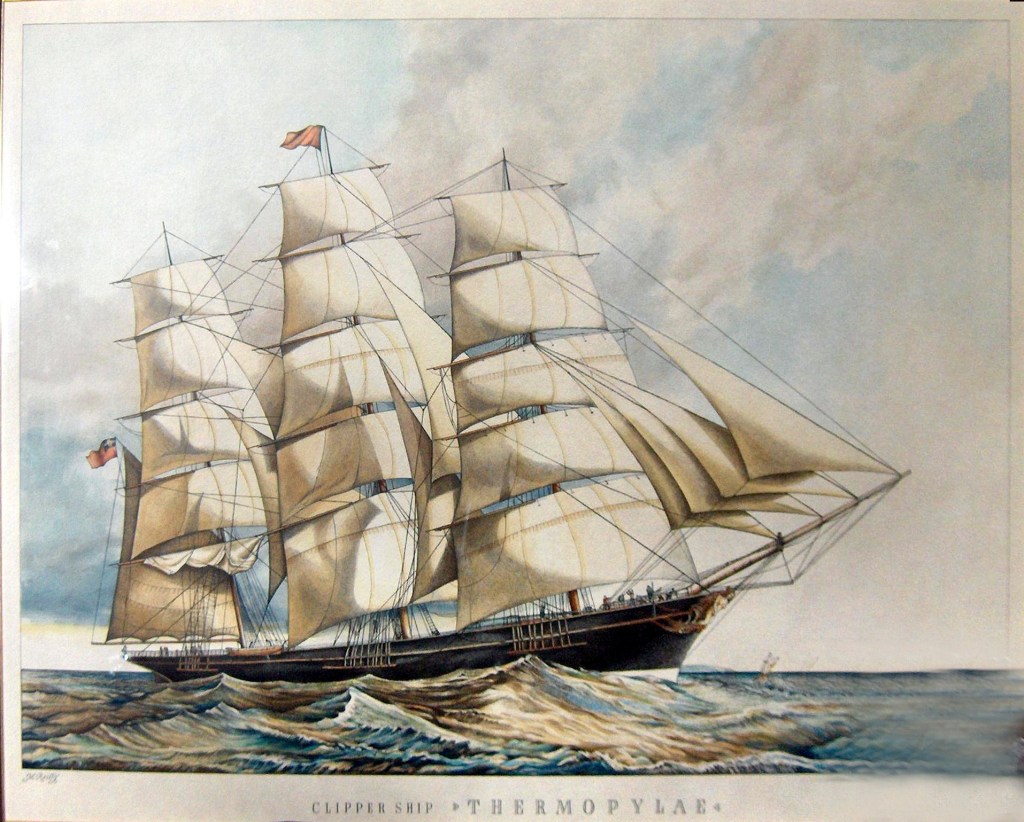
That’s done and gone. My kids never saw this, and I suspect a large number of their peers don’t, either. Evening news is so last century. Now is the time of blazing-fast internet, where the news is tweeted while it’s happening, and even before it’s done, is being discussed with varying levels of veracity worldwide. Once there was a slow deliberation to news, savoring each tidbit that washed up on the shores of our nation with the arrival of the fast mail-clipper (and this isn’t just America, it’s a global phenomenon) because it was costly, rare, and worth as much as treasure.
Now, I’m never quite sure – well, no, I have a few trusted sources – where to look for the facts in a sea of information. We’re drowning in it. But who to trust? I found an old book on the Pony Express (it’s free on google books) while I was researching for this article. I mention it despite knowing it was one of the shortest, most expensive, methods ever tried to deliver mail. But you knew where that packet had come from, by gum!
When writing a science fictional world, how do you convey the news? Does it come creeping in at the speed of light? What happens when a fast courier-ship picketed at the far reaches of the system picks up the transmission and slips in-planet to hand it off to the traders first… Once upon a time, watchers on high hills over the port kept an eye out for the incoming ships, and when one was spotted and identified, that information became the basis for their master’s shop to set prices by. A fire sale on spices when the ships from India were drawing near, perhaps, or silk for the trader due from China.
Who do you trust? Sure, that sensie-feeler makes you all warm and tingly when it jives with your mind-jack, but will the malware corrupt your wetware? Who rules the world, when the alien lands and demands to meet our ruler, this Kim-Kanye-Branjelina person. What sources can you cite to people who are so far on the other side of the divide they can’t bear to look at you, but you are compelled to throw facts at them in hopes of their catching the truth?
When the first AI blinks its cyber eyes and decides to cooperate with us, what encryption can possibly keep it out? Or, for that matter, will it let anything pass through unchanged… type an email in here, there it says something completely different. It’s like a game of telephone. And what child nowadays knows why that’s even called telephone? I vaguely remember a party line at my grandmother’s house, but now, we are accustomed once again to the concept of personal news (it’s a boy!) being private.
There are so many possibilities. From the stones of the ancient past, to the papyrus scrolls, to paper, to electrons… what could possibly come next? And how can we use that in a story, to frustrate the hero and develop a truly newsworthy conflict. I don’t know. I’m still trying to figure out how to get reliable local news in a world gone beyond tv and newspaper!


 Mad Genius Club
25 responses to “Extra! Extra!”
As a writer, I suppose it depends on whether it is (or in a series, might ever be) an important plot point. If the answer is “no” then you slap a name on it and go on to the important stuff. “He caught the flash update of the news and then . . . ”
But of course, if there _is_ a plot point, then you’ve got to rationalize how the information can travel so _slowly_. The instantaneous news, as you say, we’ve already got that. Was there a breakdown somewhere in the laser line through the dimensional gates? Was your ship in hyperspace when the news broke? Were you, ahem, busy and turned off your implanted alert?
Or perhaps the problem is veracity. How about an app that trawls all the news sources, runs them through the filters you’ve set up [if it mentions climate change positively or UFOs in any context, toss it] and delivers a restatement based on the rest? Until the Anarchy Virus hits . . . then you can’t trust any new received electronically, at all. Face-to-face or physical letter, and if you wrote it on your computer, you’d better read the printed version carefully before you seal that envelope.
Yes! Oh, I like that… the return of print, because electronic is no longer verifiable. Really what this was was me musing on the news, and I’d shocked a classroom full of kids by saying I don’t watch the news. Ever. “But how do you know what’s happening?”
Excellent musings, and so timely for me.We don’t watch the news, or listen to broadcast news in our house either.We get accidental SNS feed information, or someone mentions something at work and I do a web search click to a local news station. We so don’t need to know the latest political selfies or antics of the entertainment glitterati.
By timely, I mean it gives some thought to the paper I am doing for my current communications class. The class is “Social Dynamics of Communications Technology” and has a big focus on SNS. The Professor gave us some suggested topics, including one: “Have blogs and other user-created content made mass media irrelevant as a social institution.” I liked the idea, but my preliminary research has had me change it to a study of mainstream vs. alternative media, and how the two have actually always existed side by side. in an interpenetrating flux.
Anyway, boring, I know…. But I think this article on the history of communication media should give me some good ideas — and if anyone has suggestions for “scholarly” sources that would help me, I will take them. Free and online is a plus.
Speaking of sources, I commented in my blog today about the professor’s list of preferred and deterred resources. Among his deterred resources were, of course, blogs, but also “Politically-charged think-tanks such as the Heritage Foundation, American Enterprise, Cato Institute.” I instantly noticed that all his example political think-tanks are conservative — not a liberal among them..
Among his acceptable sources was “Any data and reports from government and international agencies such as FCC, FTC, DOC, ITU, WTO, EU, Un, World Bank, etc.,” because we obviously know that governments and international agencies are all above bias and have only the good of people and the quest for pure knowledge at heart.
I understand the reasons for not wanting us to use the blogs or think-tanks, but I don’t think the academes see the subtle and not so subtle biases in their choices of allowable sources — a mainstream assumption.
And apologies, it looks like I just wrote my blog all over again here 😉
They are excellent points, though, and certainly things I have contemplated recently – for instance, in being tempted to throw cites at someone who was being *ahem* silly on FB, I had to stop and think what sources I could cite that they would not dismiss out of hand. And I have to do this for classes, too. Any source seen as too biased – whether it is or not- will be dismissed. Makes it challenging.
Brings to mind some complaints I have read about Wikipedia, it seems they don’t accept something like first hand evidence – I can’t recall details but I think it was somebody complaining that when he tried to straighten some false data on the page about him it was not accepted, and if I recall correctly it was some rather hard data, not his birth date but something similar, because he was not a verifiable source.
But, of course, you are most biased in cases about yourself. Only someone outside yourself can be unbiased about your…. which is why the government is so good in telling people what is good for them.
I’ve been told that Wiki only accepts secondary sources, and no I don’t understand the reasoning behind this.
What makes you think print was ever any better?
At best, the only thing about print media that was ever really different was that once printed, it was damn hard to change. But, the inherent flaws were always there, just a lot less visible.
Part of the issue we’re having today with regards to the media is the discovery by the majority that our formerly “trusted” news sources really shouldn’t have been trusted, in the least. I can think of half-a-dozen different instances where the old-line media was just as bad as the new is, potentially.
Seriously–The average American trusted the NYT implicitly as a source. So, when Walter Duranty reported that the Soviet Union was a wonderland of plenty, everyone believed him. Meanwhile, Holodomor.
Here’s the thing: The reliability and accuracy of news has always been a bit of an illusion, even when we were relying on first-hand oral reports of participants or merchants who’d witnessed the events in far-off villages. The illusion of accuracy and veracity has always been that–An illusion. Eye-witness reports are almost always flawed, in that what that particular set of eyes saw may not have included the full truth of the matter, and the inherent bias of the reporter. Hell, in the end… Can you really trust what your own senses tell you, about things you see and hear personally?
In the final analysis, we’re all living in Plato’s Cave. No matter what source of information we have, it all boils down to trying to make sense of imperfect information.
I actually don’t think print was ever any better (Yellow Journalism! LOL) but we are vulnerable, on this level. We need news to inform decisions, but how to trust what we hear and see?
And back in the late 19th and early 20th centuries, you generally knew who and what newspapers and journals supported, because they included the party or group affiliation in the masthead or on the editorial page. The Square County “Intelligencer” might be the Republican paper, the “Daily News” for Democrats, and the “Herald” was Populist or Progressive. And the “Daily Worker”, well, everyone knew their politics. 🙂
Heh. Or the story starts when that UFO happens to be real, this time. I like that personal filter idea, could explain why the hero misses something big.
[…] Read more at Mad Genius Club… […]
There might also be several stories in how our heroes manage to fight when all the main news sources have been captured by one faction, and as a result most of the news is biased in one direction, but it would be important to get the unvarnished truth to the masses in order to get the important changes made.
And now I want to read one where some alien actually insist on dealing only with this Kim/Kanye/Brangelina/(or rather fictional counterpart since lawsuits are a pain) person since it seems to be so damn important here. Would she/he/they be able to rise to the occasion (er, maybe not, but either version – does or doesn’t – could make a fine comedic story). 😀
I’ve got a story around somewhere where the first alien to land on Earth gets interviewed on Oprah!
The concept of fiction itself probably arises from the unreliability of our senses and the inherent issues in trying to communicate through our available techniques. We came up with fiction in the first place because of that built-in lack of “trusted veracity”. We can tell ourselves and others lies without any other recourse than to work things out for ourselves.
Now posit an alien intelligence that has much more reliable senses, and a much better way of communicating between individuals. Call it telepathy, call it whatever, just assume they can do it–Perhaps by transferring chemical records or something electromagnetic. They can’t lie to others, or themselves, the records and transmissions are all “hard copies” of reality as they perceive it. Now, would they ever have even come up with the idea/concept of “fiction”? I would suggest that that’s pretty unlikely, except in the most abstract ways.
Now, imagine how a civilization like that is going to interact with humans. We’re going to appear utterly insane to them, when they can’t tell the difference between a news broadcast and a soap opera, and don’t even have the concept of “soap opera” to begin with.
It seems to me, and my memory is unreliable, that someone wrote an alien race like this… and they were quickly defeated by humans.
There are two variants of this I know of. Eric Flint’s Course of Empire and The Hoka. In one the human’s sort of corrupt the aliens with our decadence and crazyness. In the hoka stories the lack of the idea of fiction turns them into a race of larpers which drives the humans who watch over them crazy.
I don’t think I’ve read the Hoka… I need to, sounds like!
I grew up with a party line, and I am I think younger than you. In fact it was less than ten years ago when phone company finally made my parents and grandmother get private lines (only a few years before my parents dropped their landline altogether). The party line was actually extremely handy, we could answer our phone when at my grandparents house and vice-versa.
I think it depends on where you are/were. I am, for the record, 37 😉
Yep I was right, I am still 34, I just feel old.
The only problem with relying on blogs is that they all typically reference back to the MSM as their primary sources.
Ans as there are so many news sources, and we all tailor our consumption to our personal interests, it’s increasingly possible that something important will be missed.
In my first book I mentioned plausibility ratings for the news. Of course, the plausibility raters could be suspect, too.
Sort of like Amazon and Goodreads reviews? 😀
Hah! I was more thinking of the “fact-checkers” but I was avoiding making political statements.