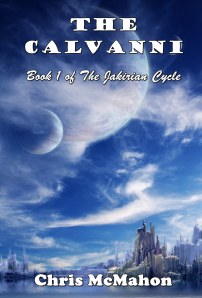
 by Chris McMahon
Hi, everyone. I am off to Gold Coast Supanova this weekend (this is the Aus equivalent of Comicon). I am busily preparing my posters and books for my table in Artist’s Alley.
This has got me thinking about the pitches for my Jakirian books. I’ll probably get about a microsecond to grab the attention of passers-by in what will probably be a very busy area of competing artists – most of whom will be selling neat stuff and gadgets like toy lightsabres.
The latest reading I have been doing on pitching your work talks about creating three levels of pitch.
The first level is basically a description of what type of book it is, and should be no longer than seven words. This is the ‘scene-setter’ i.e. “Fantasy Action”, “Near Future Science Fiction” that sort of thing. It doesn’t hurt to make it interesting if this truly reflects the book i.e. “Memoirs of a Venusian Slave Trader”. I find the level 1 pitch to be fairly straightforward.
The second level of pitch is downright difficult. Here you have to say what your book is about in short, catchy and well-written prose – and in no more than 25 words. For someone that tends to be wordy, and whose mind gets tangled up in the vast knot of plot threads I create, trying to get this right is agony. This is the ‘elevator pitch’, something said in one or two sentences that grabs the listener’s attention and drives them to want more. In a letter or email, this would be the second paragraph, drawing them on to read the more detailed description below, or perhaps open the attachment that has the synopsis.
The level 2 pitch is the marketing grab. It should be punchy, and it has to go right to the core of your work. Ideally it should bring out what is unique about it. I have never been one for flash fiction, and so far I have pretty much filled three pages of discarded paragraphs. I know the damn story. But trying to get to the core of it – trying to convey that powerfully in such a tight space. That is tough. My own penchant for complicating things and adding setting ideas gets in my own way here.
The question you are asking yourself is: What is at the core of my story? What is unique about this work that would grab a reader’s attention? What sets it apart from all the other competing works in this genre? See. Even the questions are longer that 25 words! That is not a lot of space.
But the exercise itself – the way it gets you thinking – is vital. It pulls you out of the blinkered writer’s workspace and puts you into the position of the potential reader or buyer. Consider it from their point of view.
The level 3 pitch is really the story outline or synopsis and will be familiar to most writers. It also has to be tightly written, and with excellent word choice. Every single word in it has to be working to evoke something in the reader. This might be anywhere from 70 to 150 words, and is basically the 2 page synopsis that most guidelines will ask for. It will probably share many of the characteristics of the back book blurb – and may even be the same.
So – anyone heading to Gold Coast Supanova this weekend? Have you got your pitches down?



 Mad Genius Club
5 responses to “Pitching Your Work”
I need to practice in front of a mirror or something. I do much better in print . . .
It’s very different talking to someone. That same thing that can seem really good in print can seem stilted or overly formal. I find you need the ability to adjust the wording on the fly – and go in softly. I tend to ‘hit with the pitch’ too fast sometimes.
Chris McMahon
http://www.chrismcmahon.net
It’s tough to come up with that tight pitch that sells your story in record time. Good luck at the convention. 🙂
Cheers. I think I have my pitch down by the end of day 1. I sold 9 books and gave away probably almost a 100 book covers. A lot of people were keen to get the electronic version for the Kindle, so I had the link on a printed sticker on the book cover to Naked Reader.
Pretty happy with day 1.
Chris McMahon
http://www.chrismcmahon.net
Sounds like you had a pretty productive day! 🙂