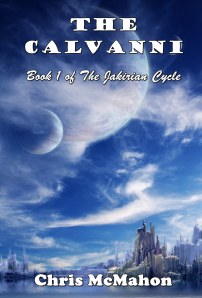
 By Chris McMahon
As I progress with my fantasy series, the Jakirian Cycle, the story is widening considerably in scope. Without giving too much of the plot away, at the start of the first book The Calvanni the Eathal – a cavern dwelling cousin-species to humans – are launching a major offensive on the remnants of a once vast human Empire. But this is very much in the background.
In the first book the central characters are struggling to survive amid civil strife and assassination attempts (Ellen), while dealing with the emergence of their own unique magical powers (Cedrin).
In the second book, the first major engagements are taking place between the Eathal and the last few human Legions, but the focus is still on the characters and their personal journeys and the mystery of the Scion (the lost heir to the fallen Empire).
In Sorcerer – which is about three-quarters complete – the clash of human and Eathal is happening on a massive scale. Tens of thousands of human and Eathal troops are fighting across two major fronts. From the PoV of the central characters, they are being drawn more and more into the centre of power in Yos. Both Cedrin and Ellen find themselves right at the core of the reestablished Bulvuran Empire. Amidst all this are the various Warlords who divided up the fallen Empire. The most powerful of which is facing the Eathal in southern Yos while being heavily outnumbered and under strength in the magical department. To do justice to this, I needed to make that Warlord a PoV character, and needed to portray these major engagements.
Various subplots that have been in the background since the first book are now also coming to the fore.
All of this has led to the introduction of a lot of new characters. Each is important to the story in some way, but most are not central or point-of-view characters. Trying to control this crowd, and do them justice is certainly a real challenge!
Three or four times now I’ve had to scramble back through the book and insert a few key paragraphs. ‘Oh, Damn! Such-and-such was still with Cedrin in that scene.’ or ‘Oh, crap. Where were they when that combat was happening?’ I need to keep them in the picture, but without diluting the thread of the main character too much. There are so many of these characters sometimes I grit my teeth. Oh for a simple story! I am my own worst enemy with this. Yet with this third book I am also trying to lay the foundation for the ultimate conclusion of what might extend to a possible six books series. Don’t worry – Sorcerer will end with a great climax and the first three books will stand as a trilogy.
If you love battle scenes, Sorcerer will definitely be your sort of thing. In that regard it is almost my homage to David Gemmell:) Using the unique magic of Yos, including the glowmetals, on that scale was a real buzz.
Back to dealing with multiple characters: I always try to maintain the focus of the story through a small number of key point-of-view characters. There may be many other characters introduced to support the story, or to give the setting the feel of the political landscape, but I try to have these experienced through the viewpoint of the key characters. I think it can even aid the tension in the story to have the motivations of these characters unclear – and that’s hard to pull off if they are the narrator. It’s also surprising how much you can convey objectively, without having to make them a PoV character.
It is a tricky balance though. It’s hard to do them all justice, to convey their motivations and to give the reader a sense that they are moving through the story not just being present as a background cut-out. More than once I shook my head writing this draft and said ‘What the Hell have I got myself into?’
Still, I think it’s worth it to see the various sub-plots come into effect. It gives the whole thing a depth and complexity.
Have you ever been frustrated by the Cast of Thousands? How do you deal with it? Kill them off? Limit their appearances? Tear up your draft?
 Mad Genius Club
11 responses to “Dealing with the Cast of Thousands”
That sounds very complicated. Most of my stories have a focal character, maybe two, that have a PoV. I sometimes introduce another character or two, especially if I have them in mind for another story, but they are usually just a secondary character that doesn’t get much press until their own book. What you’ve done here is amazing. I am sure I wouldn’t be able to keep track of so many characters! 🙂
Hi. Thanks for the vote of confidence. I just hope I can maintain the integrity of the major PoV characters and still have readers as involved in their arcs. These books also have a major romance elements. This book was the cruel was to write – where Cedrin and Ellen become estranged through his infidelity (he was seduced and drugged, but hey that doesn’t count. The further complication that Ellen becomes pregnant and they are forced to marry by the political powerbrokers – wow. Those scenes hurt.
I’m sure you will be familiar with the first draft emotional roller-coaster – ‘Oh, this is great!’ followed by ‘Oh my God, this stuff is crap.’ Hopefully I can land somewhere in the middle!
The battle scenes were fun though. I love that stuff.
Chris McMahon
http://www.chrismcmahon.net
It’s very frustrating, I can’t help you. I don’t know myself when I’ve gotten so many POV characters that the reader can’t follow the story of the main one. Some times you just need to put in a scene from a new POV, but if there’s no real reason to follow his particular story, don’t feel like you must do another and another. Killing him at the end of the scene might be appealing (I’ve done it myself) but not necessary.
My current Mess-in-progress involves three groups spying on each other. So an occasional intercepted message can cue the reader as to what the other groups are doing while I’m sticking to one specific POV for awhile.
Hopefully it will work.
Hi, Pam. Nice one. The message or the letter is a great way to introduce another viewpoint. I’d forgotten about that one. Anne Rice used this device a lot in the vampire books – kind of like nested first person sections.
Three groups spying on each other – sounds good! Is it fun to write?
Chris McMahon
http://www.chrismcmahon.net
Oh yes. Very fun. I’ve got a high tech world, a high tech world with magic and a medieval level world with magic. Parallel worlds, mind you. The two tech worlds discovered the medieval world at roughly the same time. Neither will back down, and cede the world to the other. The locals have some odd idea that the world belongs to them. So the Locals are scrambling to convince both the others that they just aren’t worth all the bother, and definitely should not be used as a battleground.
It was fun having most of the POV characters be nice people, just following orders. Then I had way too much fun with some nasty assassins, and some really obnoxious teenage girls.
Brilliant, Pam. Sounds great. I suspect you might have my habit of just coming up with way too much to fit into one book! Like trying to pack a suitcase for travel – ‘Damn. I’m going to get this stuff in here somehow!’
Chris McMahon
http://www.chrismcmahon.net
Oh, that’s another thing I don’t know yet. How much is too much detail and description for the story to carry, and how much is too much glossed-over told-not-shown for the story to be readable?
Too many POVs, too many subplots . . . or make it into a trilogy instead of a novella?
I’d say keep it a stand-alone if you can. It makes it easier to sell, I think. Just leave the room for follow-ons.
In terms of description, that’s really a hard one. I think generally you need less in SF than Fantasy, but that is reader expectation. Less is more? I guess a balance is good. Tough call though. Maybe think about your target market and pull a couple of recent books from that publisher to get an idea – probably the best way to go.
Chris McMahon
http://www.chrismcmahon.net
Until now I’ve used a single PoV character or at most two in novellas. Since I’ve begun what I fear will become a novel, I’ve made a flow sheet of characters, their relationships, and a few key points about each one’s personality (and markings). At this moment I suspect that I’ll end up with five or six PoV characters, maybe seven at most. I already know that one will be killed off at the end because his ideas and his lack of forethought are too dangerous for the remnent population to deal with. Another one may die of medical problems, but I’m not sure yet. Given that my readers will be trying to sort out a non-human, semi-feudal culture that is in the process of recreating itself after a pair of disasters, six PsoV may be the most I should ask them to try and keep straight.
I keep thing of other writers and what they’ve done. For example, Guy G. Kay seems to average three major and three minor PoV characters per tome and makes it work, even though he has casts of thousands.
Good luck with the storylines. Certainly I think it is possible to keep the narrative thread with six PoV characters, certainly if some of those only have minor appearances. I think Calvanni and Scytheman had three major PoV characters with five or six others that made fairly short appearances. I think you can manage to convey a lot through short PoV sections, even if that character does not appear again.
Sorcerer has considerably more. Yikes. Hopefully the flow of the story from the prior books will help to give forward momentum.
All the best for the developing work. Not easy is it!
Chris McMahon
http://www.chrismcmahon.net
No, it’s not easy. And I’ve always used an outsider’s PoV for this culture until now, so trying to “think” like people in this different, earlier phase of the culture would have thought is a real challenge.