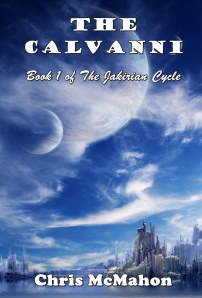
 by Chris McMahon
First of all I would like to thank all those people who managed to get me back from the dreaded clutches of the slavers and the smuggler-bots (and their nefarious ways) and back safely to Earth from the mines of Venus.
Lately I have been getting back into my Jakirian universe in preparation for writing of book 3 in the series – Sorcerer. There is a lot to soak up. The world of Yos was my first major foray into building a unique world, and some might say I took it a little too far. You want to be different, but not too different – at least where sales are concerned.
Around the time I was dreaming up this world, I was reading David Attenborough’s Life on Earth. I think it was that beautiful presentation of evolution that drove a lot of my early work on Yos.
I thought a lot about the creatures and the races, and how they had come to fit into the niches that existed on the world. All of it was driven by the unique astronomy. The world of Yos orbits two suns (OK for the astronomy buffs, technically the centre of mass of the two sun system). The red sun, which provides only a fraction of the solar input of the yellow sun, regularly eclipses the yellow sun, causing Storm Season. A period initially of intense cold, followed by – you guessed it – violent storms as the world rapid heats up again. This regular period of intense cold gave rise to various evolutionary coping mechanisms.
The were two main routes. Warm-blooded surface mammals who remained active during this time developed the Heat – an accelerated metabolism that provided warmth, but at the expense of the body’s resources. Modern humans on Yos try to resist the pull of the Heat during Storm Season – the time of the red sun Uros. It can keep you alive, but at the loss of control. In the dangerous world of Yos, the overconfidence and loss of inhibition that comes with the Heat can be a deadly weakness.
The second coping mechanism was to get underground. Birds and other animals evolved to be able to dig burrows they could use to ride out the cold. Others went even further, living more and more of their span under the ground. This eventually gave rise to a parallel evolutionary path that existed in the extensive caverns of the Yos. Creatures such as the drakons with their hot acid breath, delved deep into the bedrock, paving the way for others (their prey). Bats were great winners in the evolutionary race. The bounty of the forests of the Yos was drawn down into the caverns, where a whole ecology of luminescent fungi developed, using nutrients from the upper world. Other creatures evolved to eat the fungi – herd animals that never saw the light of the suns. And then came their predators.
Cousins of man – the Eathal – adapted for the caves. They developed acute hearing and a form of echo-location, as well as sensitive eyesight.
Then came new settlers to the upper world, clearing the forests – inadvertently destroying the world below as they robbed the bats of their bounty. And so the ancient enmity between the Eathal and Man was born. . .
Right. Back to worldbuilding. Easy to get carried away with this stuff:
One other thing that comes to mind was an idea for the mammal evolution. I wanted a winged race (the Verial), but I wanted them to have hands and wings.
Now in Life on Earth, Attenborough explained how the form of all land animals basically was derived from the same basic quadruped – lizards, monkeys, birds – all had four limbs (and a tail) to begin with. So to have my winged race I needed not only a proto-four-legged, but a proto-six-legged creature. So that’s way on Yos, some land animals have six limbs – or started with them. One example is the narsiit – the winged horse of the plains. It does not truly fly – its metabolism is so fast that when in full flight it needs to extend its wings for cooling, although it does get some aerodynamic lift.
So all the birds of Yos have two wings and four limbs. In many cases the second pair of legs or arms has become vestigial – I mean who needs the extra weight? But for birds on the ground – or those that need to compete for space in the crowded caverns during Storm Season, the extra limbs really come in handy for fighting . It also means you can shake hands with a bird:)
So what fun have you been having lately with worldbuilding?



 Mad Genius Club
6 responses to “Worldbuilding”
A world of mine, which I need to get back to, has been extensively terraformed. The few susrving native plants have chemistry evolved to offend or poison the now extinct native biota. The effects of the chemical on Earth critters varies widely, ahem, according to plot reqiurments.
I think my favorite was thinking about Mars, millions of years ago. I sort of let go of the science at some point, and went with plot needs again, though.
HI, Pam. That sounds interesting. I’ve never really played around with the plants all that much on Yos. The only thing I did was get the flowers and leaves to close up to conserve moisture during the cold of Storm Season – and made them glossy with oils to withstand the cold. The gum trees in the Snowy Mountains in Aus pull this trick – lots of oils to stop from freezing during the snow.
Sounds like you had lots of scope for fun there!
The main twist to my world, Wealtia, is that I’ve put humanity on the bottom of the chain. Dwarves, elves, etc. are expanding as are the races of orcs, goblins and, what I thought was my own invention until Papo did a figure that looked like them, the Crocken – a race of humanoid/bipedal crocodiles.
Humanity, what is left of it, is either enslaved by orcs, goblins or dragons (or orcs/goblins WORKING for dragons) or is scattered into small tribes living on the fringes of other civilizations and is pretty much castigated by the other races who see humanity as inferior. They, after all, lost their war against the evil races and have regressed. The rest of the world has steel weaponry, but the best humanity can muster is bronze, and not much of that. Tin is scarce and so are safe living places in which to set up a forge/foundry. Much of humanity is still stuck literally in the Late Stone Age and is struggling to find its way into the light.
Oddly enough though, my main character is a dwarf who is forced out of his nice, cozy underground city due to circumstances, and he is viewing this all through the eyes of the “superior” species. One of his traveling companions is a human though, and he will be learning better eventually. It’s part of the whole coming of age thing.
Also part of the world is a huge emphasis on animals, although I haven’t worried as much about evolution as you have. But still, every elf has a familiar and the best human warriors ride beasts, depending on their tribe. I’m trying to find a way to eventually tie my main character to an animal in a similar way but it hasn’t worked out yet, so it may get left out. We’ll see. It’s definitely been fun though.
Hi, Jim. Sounds like a great set up. It’ve always been engaged by the underdog, and it certainly sounds like the humans have an uphill battle:)
Since the humans have not quite made it to the iron age yet, I can’t help but wonder if the Dwarf might help them out in the metallurgical department – but that’s just me connecting the dots.
Lots of scope with the bonding/pairing with beasts. I think that is a great way to build sympathy, since who doesn’t like animals? Especially for YA, although I would guess this is adult?
I get the feeling this is a series?
It is an adult story. Given the fact that it’s not finished, let alone sold, it’s currently a “stand-alone with sequel potential,” even if I do have the first few chapters of the second book planned already. If I finish this and can’t sell it though, I’ll probably move into a different direction. Or maybe I’ll self publish the thing and go that route. That’s a tough row to hoe when you’re just starting out and don’t have a following though.
Sounds good Jim. I think a stand-alone with sequel potential is a good way to go.
Good luck with the story.
Chris McMahon
http://www.chrismcmahon.net