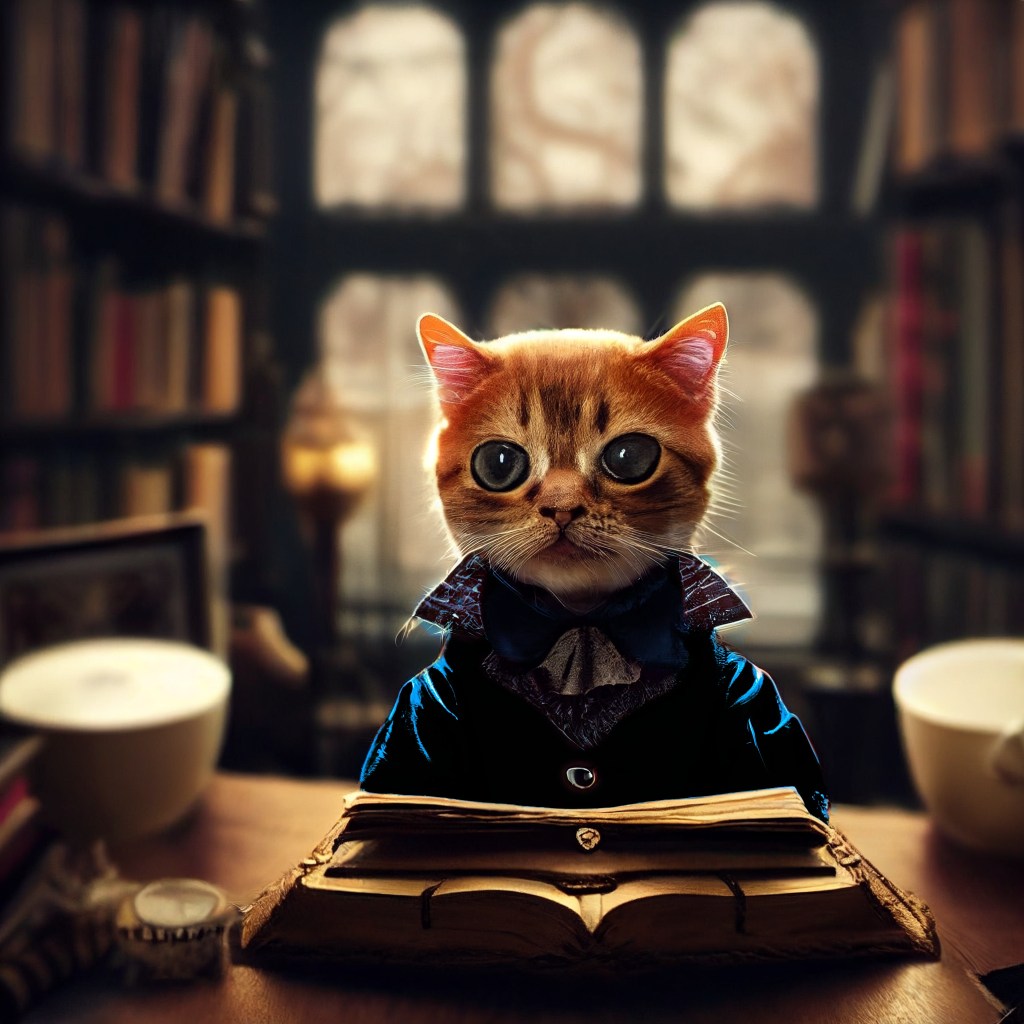
So, I’ve been doing more research reading recently (Day Job and otherwise), and reading some of the Japanese and Korean, well, cozy urban fantasy isn’t exactly right, but that sort of thing.
One of the non-fiction books I’ve been working through has two indices. One is for the main chapters. One is only for the bibliography. This is a summary history/archaeology book, with a huge bibliography, in multiple languages, with annotations (“excellent overview article … good overall guide to …”). When you go to the e-book index, the end has a sub-index for the bibliography. Each chapter has a link, so you can quickly find, oh, “Roman Contact” or “Arts and Culture” or “Religion and Philosophy” instantly and look at the sources. Is it useful for fiction? Probably not. Is it a great idea for semi-academic non-fiction? Oh yes, because it makes readers happy. If Cedar, say, or other illustrators and their publishers were to have an image index, or other writers have a map index for fiction (or hotlink the maps in their fiction) it would make things easier for readers. Happy readers buy books.
The regional Barnes & Noble has been stocking more and more Japanese and Korean … cozy magical realism? Cozy urban fantasy? I’m not entirely certain how to describe it, because it lacks the political aspect that is the hallmark of magical realism. Anyway, the books are set in the everyday world, but there is something different, a library that only opens one night a year, or a statue of a hippo in a park that grants a wish to people who sit on it, or a sweet shop open nights that caters to the restless dead, and so on. People come in with small problems, and find the perfect book, or gain the key to moving ahead in their lives, or a cat comes into their home and is the catalyst (pun fully intended) for positive change. The wish might not be fulfilled the way the person hopes or expects, but the change is always for the better.
Is this something to incorporate into my fiction? I’m not certain. Am I getting ideas from the books? Absolutely, and reading something different and fresh helps me out of mental ruts. I’m also thinking about what works with the stories, and if those elements can translate into a Western setting. Maaaaayyyybe? People are people, after all, and not all personal problems are best solved by the application of force (or high explosives). “Cozy” doesn’t have to mean small stakes for the character, after all. Getting a new career, breaking out of a relationship that has gone awry, leaving home for a new city, those are all big things in the MC’s life. A world is ending, even if it is a small-from-outside world.
In fact, Sunday night, I had an idea drift up. Vienna has a famous market called the Naschmarkt, “snack market” where people bought fresh food and produce, as well as snacks, which eventually gained more market space. Today it is a snack, produce, fish and sausage, bread, and other things market, still mostly open air, with some “stalls,” buildings from the 1800s and early 1900s. So, what about a Nachtmarkt, a night market, that appears in Vienna on foggy, full-moon nights? It is always in the Old City, but not always in the same place. People who find it can buy exactly what they need, but how that purchase helps them … isn’t always what they expect. And the market is old. So very old …


 Mad Genius Club
10 responses to “Learning From Nonfiction, and from Other Genres”
That nachtmarket sounds like Twilight Zone stuff, perhaps with a bit of Aesop mixed in. A place where what you buy is what you already have.
It’s a variation on “The Little Shop that Wasn’t There Yesterday” trope, but while TLStWTY usually sells you something harmful and/or charges you a price you didn’t want to pay, this one gives you exactly what you need.
Even if you don’t know it’s what you need, and you have to figure it out? That could lead to a lot of fun for the writer if not the character.
O yes. Exactly what you need should surprise the character. Otherwise it’s not really a story.
Non-western escapist fiction can be useful for knocking the cobwebs loose and helping one think outside the box, or at least that’s what I have found.
The underlying assumptions are rather different from Western fantasy and fiction. Sometimes.
I’d say some of the best work on presenting a setting drastically different from the reader’s that I’ve ever seen would have to be the Judge Dee mysteries by Robert van Gulik. They’re set in Imperial China, mostly from the viewpoint of a Confucian magistrate as he solves the crimes in the cities he’s posted to.
It’s all the better in that these stories move along swiftly, but at the same time van Gulik gives you incredible amounts of information on the society, culture, and technology of Ming China in particular.
I’m an enthusiastic fan of the Judge Dee mysteries – they are absolute classics. Characters are well drawn and I like the tradition of intertwining three different mysteries in each book.
I did not realize that there was a political aspect to magical realism, but that is likely because I’ve read very little of it. As a genre it really doesn’t appeal to me.
I love the Naschmarkt idea, though. And there is (or could be) a cozier aspect to that than to magical realism per se.
The vast majority of the magical realism authors prior to the late 1980s-1990s were leftists, from Latin America and Third World countries (Iran leaps to mind). They used magical realism as a coded way to critique the government, and church, and other institutions. For a while, some critics and authors argued that only Second and Third World authors could do magical realism, because leftist politics defined the genre as much as the fantasy element. That seems to be fading somewhat (see the movie Encanto for example), but the tendency is still there.