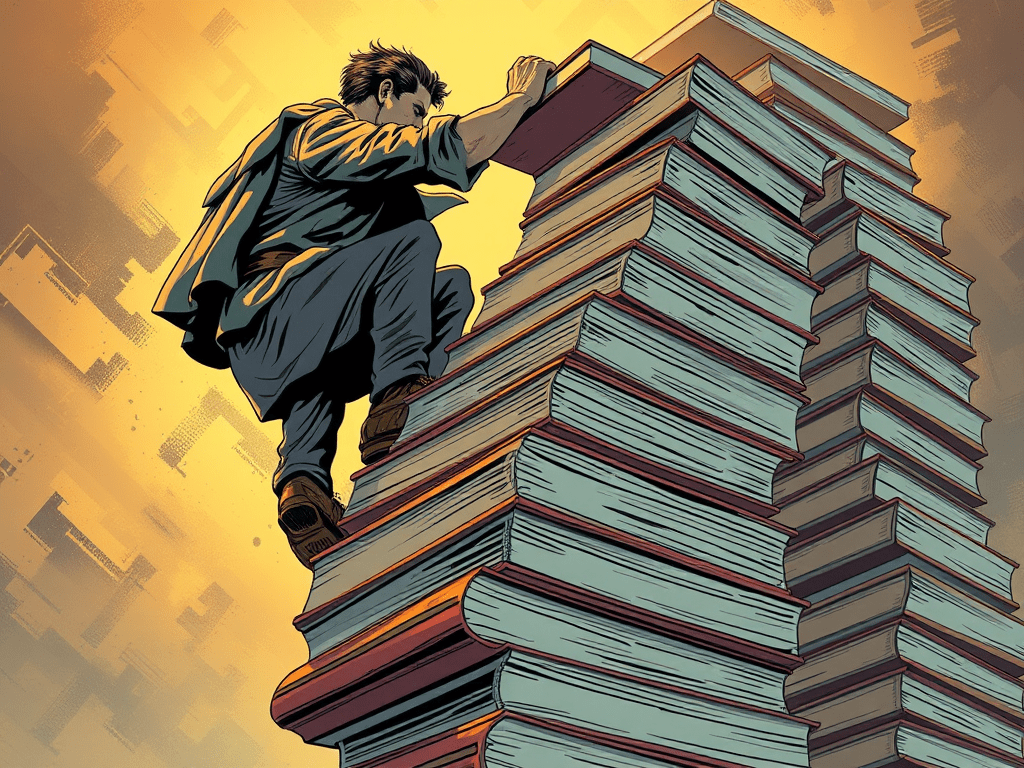
Sounds like the sort of thing I’ve been doing all my life… with limited success at times. Doing- or taking on too much. I laughed a great deal when reading THE WARLOCK IN SPITE OF HIMSELF when Tuan, the noble future king attempts to grab Big Tom, who retorts (I paraphrase) ‘A noble’s reach must always exceed his grasp.’ To which the hero, Rod, replies, “Careful, Big Tom. That’s sounding very much like a compliment.”
I don’t know about my nobility, but I’ve spent my life striving to reach far further than my ability – literally, on a few rock-climbs, while stretching and muttering ‘grow, baby, grow. Taking on far too much, mostly in blind ignorance, and sometimes in an inflated delusion of just how much I can do. Well, I might fail, but I do get a lot done.
That doesn’t always mean it has been a good idea – as some of the rock-climbs proved to me. Gravity doesn’t care how ambitious you are. And, um, it is true to say that readers don’t care either. If a book is ‘phoned-in’ because you’re over-committed, the readers are just as sympathetic as gravity.
There is, however, one other type of cramming that really, really truly does not work in books – and I am guilty. So, at times, was Sir Terry Pratchett. Yes, I’m with you: “If he’s guilty, make me guilty too.” Let me be blunt: you don’t have his ability, and neither do I. What I am talking about, of course, is the fact that his books so often had whole, brilliant untold stories, in one the many ideas that really had little to do with the story-line, but he threw out like chaff from pursued fighter-jet. You can do this and get away with it if you’re pushing a story-line so able to hold the reader, they don’t lose track – or if your style is to provide a ride of ideas and amusements and the story is merely a chain to hang them on. Both of these I would categorize as ‘skill-demanding, hard’. You may have that skill.
I am supposed to be judging a competition at the moment. The first story, the first page, I thought… ‘this one has probably won’. The writing was good, the hook well-placed… the pacing and story seemed promising. And then the writer crammed a novel into a 5K short. The story line got braided out into a lot of threads that didn’t move it forward and were effectively red-herrings with nothing much to do with it. There were still a few good scenes, but overall I was overwhelmed and not very interested.
In summary, there were lots of bits. The author wanted to use ALL of their ideas, and ended up with me following none of them. I also stopped caring. Perhaps some of the mysteries and other threads had character development, so I might have cared, but because they had so much to fit in a limited word-count… they soon went to tell, not show. A quarter of the story, none of the sub-threads, and it would have been good. There is such a thing as either being ruthless and cutting, or saying: ‘this is a novel, not a 5K competition entry.’
 Mad Genius Club
9 responses to “Ten pounds in a five-pound bag.”
To whom it may concern, I cannot unsubscribe this email myself since it takes the log-in of Holly Lisle to do it and I do not have that. Holly (my mom) died in August of ’24. Please unsubscribe this email from your content. I appreciate it. Rebecca Galardo On Mon, 24 November 2025 at 05:40 AM, Mad Genius Club
One thing that’s helpful here is Mary-Three-Names’s word count equation:
(Characters+Locations)*500*# of story threads/1.5
Admittedly, there’s a lot to criticize in the specific math of that equation. The basic idea, though, that every new character you add, and every new location you add, will add some number of words of description, and every new plot thread will increase the length by some percentage, is sound. If you don’t have a better idea, plugging your story into that equation might help. I don’t think it will necessarily tell you if your story is 4K or 6K—but if the word limit is 5K, and you’re getting 20K from the equation, that’s probably a hint that this story isn’t going to fit.
It also tell you what you need to cut. Far too many writers, when told to cut the length of their story, will chop descriptions to the bare minimum, maybe eliminate a few events, and remove direct quotes in favor of summarizing. Instead, what needs to be done is to eliminate characters, locations and plot threads while keeping the ones you have vivid and interesting.
Very true. Novel ideas are sticky. Short-short ideas are like ball bearings.
Apologies for the double comment, but something else occurred to me:
I suspect another part of the reason that your contest entrant is trying to cram so much story into so few words is that he may not be familiar with what is and isn’t a short story. When I first started trying to write short stories, I failed miserably, and I eventually realized that was because the only thing I was reading were the giant sci-fi and fantasy epics with dozens of plotlines that span multiple doorstoppers. No wonder I couldn’t figure out how to write something that was only a few thousand words! So I started reading the Father Brown stories and checked a few short story anthologies out of the library, and now I’m a short story writing machine!
(Whether my short stories are any good or not is admittedly a matter for debate, but I no longer have trouble with the format.)
So the moral of this story, as the moral of most writing-related stories is, is that you should read more, not only in the genre you’re trying to write but in the format and length!
Excellent points!
The point of my next post!
Ah A Diabolical Bargain.
I thought it was a novelette when I sat down, and kept throwing out things that would make it too long. Which only meant that after I gave it its head, and it plumped out to 25,000, I had to do two passes, revising, to put that stuff in and bring it up to 50,000.
Then I had to master a novel’s form to finish revision. But it was my first novel.
Exactly what I think happened here. The writer has considerable talent, just needs to actually put the story into the form it deserves.
‘this is a novel, not a 5K competition entry.’
Yeah, short stories are short. You’ve got room for a couple of characters and one or two clever things, and that’s it.
I’m not very good at them, honestly. Too much backstory to explain, suddenly you’re at 100K and you have a tome on your hands. ~:D