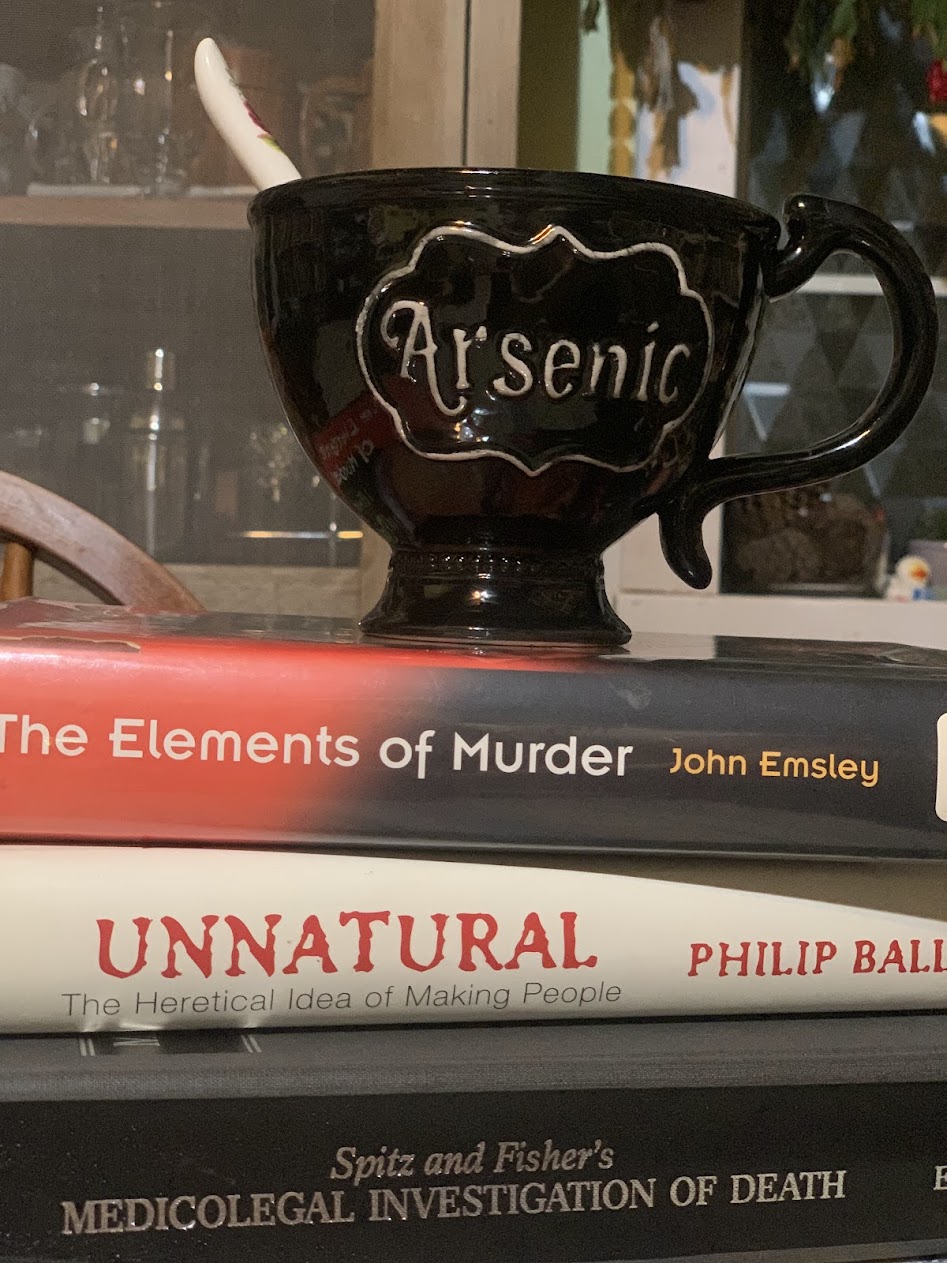
I’ve been reading, since I spent two weeks sick and then recovering (my husband would like me to say I’m still not recovered…) from what was likely a bout with the ‘flu. When I’m sick, I read. Furthermore, I have specific things I look for to read when I’m unwell and not wanting a challenge mentally. Since I read very fast, I want more than just one book. I want a cozy book – one that I can wrap around my brain like a warm blanket to echo the one around my shoulders while I sip warm tea. For me, I have a predilection for cozy mysteries, so it’s not that I’m looking to avoid drama – or, for that matter, pathos, since one of the series I’ve been reading made me a little, well, let’s just say the room got dusty. No, cozy is more a feeling of being comfortable with certain characters, the setting, and the friendships portrayed in the books.
First point, then: must have likeable characters. There can be villains, and characters who betray you, but the primary cast should be good people doing competent things, showing human emotions, and who draw you into thinking they could be friends. Kindred spirits, to use a phrase from a favorite girlhood author.
Second point: the plot doesn’t have to be a heavy one, but it shouldn’t be stupid. I get annoyed very quickly with many cozies, where the (usually female) MC is simply too stupid to live. Since cozy mysteries are generally being investigated by someone whose job is not to be an investigator, you really want to have a good reason for them to do this. Or at least, I do.
Third point: to be a bingeable series, there needs to be a reason to go from one book to the next… usually. Sometimes it’s enough to have characters the reader is really enjoying, and each mystery is standalone. Sometimes it is very helpful to have unresolved plot threads which the reader cares about and will keep reading to find out what happens in the next book. The series I’ve been most recently reading, the Homefront Sleuths, has a few of those, including one revealed in book five which was, in my opinion, unnecessary and a bit too pat. On the other hand, and I’m trying not to put spoilers here! there was an earlier is-she-isn’t-she? which had me on the edge of my seat rushing to the next book to find out. Which is exactly what you want to do to your binge readers.
Final point: know when to stop. This is perhaps the most difficult part for authors, and readers, and frankly there may not be a right point to give it up. I have finished up a series and wanted more. I have wandered off, bored, from a series and never bothered to go back to finish it, even though I loved the first several books (the Peter Shandy series, book 5 threw me out of the series so hard*, and even though I did read about to book 7) because the later plots became repetitious and I felt I knew what was going to happen. Long running series are difficult to pull off, the best of them, like Alma Boykin’s Familiars, or John Van Stry’s Valens, actually take a break to shift focus on a new cast characters. In both those series, from one generation to the next, but it can also be done in other ways. In all cases, there comes a point when the series goes stale. The author starts to phone it in, and you can tell. If you the author aren’t sure when that point is? Your sales numbers will tell you, I think. I can’t be alone in giving up and wandering off at certain books in a series. If the author is paying attention, this is a cue. Also, you won’t bring those readers back with the next book in the same series. It is time to find a new theme, new setting, new characters, and start over fresh, because this, I think with my reader hat on, will get the readers back again. I know I have authors I enjoyed well enough to go ‘oh, new books/series, will look at this!’ and picked up even when I’d been bored by end of the last series.
For comfort reads, I’m not looking too hard behind the curtain. As long as the historical accuracy is paid lip-service and doesn’t have an egregious howler, so long as the world hangs together well enough to set the story and give the characters their stage, I’m happy with it. Remember, I tend to read these when I’m sick and my brain is foggy. Given the difficulty of finding a decently-written cozy in the ever-widening stream of the Big River’s books, once I find a series I’m satisfied with, I’ll likely binge it. Which you, my dear authors, should think about as you write.
*The reason the Curse of the Giant Hogweed threw me so hard was that it was a weird fantasy/dream setting in the middle of what had been a slightly tongue-in-cheek small town mystery series. And it was a slog to get through, as the author was hung up on playing off the characters established quirks rather than a plot. It was just… no. Didn’t work for me.
 Mad Genius Club
13 responses to “Writing a Bingeable Series”
Oh yeah, I remember the Peter Shandy series – and the other series sent among blue-bloods in Boston by the same author. I think I have most of her books on my shelves.
Other series that I wandered away from – Nevada Barr’s national parks series. I mean, how many parks could her detective get stationed at? The one involving a woman stuck in a cave deep underground just icked me out.
I read the first of the Homefront sleuths – meh. I spotted a historical discrepancy that put me out entirely. But for a fun and engaging cozy series, try the Royal Spyness series, by Rhys Bowen – it hits all your required points for an undemanding, diverting read.
I faded out of my own continuing cozy series – Luna City. The first nine or ten were a breeze to write, but the last one seemed to become more a chore than a pleasure.
That last point about the becoming a chore to write is, I think, what I see as a reader in some series where there’s a book that just isn’t fun to read.
The Homefront Sleuths definitely has historical discrepancies, but they weren’t big enough to throw me out while I was reading sick. Might have bugged me more if my brain was wholly online, though.
I’ll definitely check out the Rhys Bowen series, thanks! The name sounds familiar…
Thank you so much for making the effort to finish the series. As a devoted reader, it’s appreciated.
You’re welcome. A major arc (the maturing of the sort-of-hero and he and his girlfriend finally getting married) was completed. and a couple of the real-life people who inspired certain characters had passed away … plus getting up to the year of the Covidiocy … and it was bad enough dealing with that in real life.
My library didn’t have the Hogweed one. Huh. Guess it’s just as well I never read it!
Back when Hastings was still in business, they had a row of westerns. Some of the series were up to #400 or so. Somehow I don’t think the same author was writing by then. 🙂
Back when I was reading the Horseclans books, the author had three intertwined series within the main series. One focused on the initial protagonist, and the others on people who became major drivers in the overall series. Plus he had short story sets that delved into different parts of the world, a bit like MZB did with the Darkover series. All the Horseclans books fit into the larger series in some way, but there was enough variety to keep readers interested.
With the Westerns I don’t think it mattered whether you’d read them all…
The intertwined series is a great way to do it. I’m fond of having side characters get their moments in the spotlight.
I know of one western series, The Gunsmith by J. R. Roberts, that ran to over 400 titles and was by one man: the late Robert J. Randisi. He did one of those every month from the mid-’80s to fairly recently. And also did several other books a year, and edited anthologies, and more. Since I discovered him (after his passing, alas), he’s become a bit of a hero to me for sheer productivity, since he was up there with the early pulps’ “million word a year” men, and he was consciously writing in a pulp mode.
I remember that I bounced off The Cat Who… books when they ceased to be mysteries. In the last one I read, we never even learned the name of the murder victim, that was how little both the authors and the characters cared about that plot point.
Both Wheel of Time and A Song of Ice and Fire, I bounced when the author put out a long book where basically nothing happened. We spent many hundreds of pages, but you’d be hard-pressed to say what was achieved. In both of those cases, I came to the conclusion that the author had lost whatever plot he’d once had and didn’t know how to end his series—in which case, I might as well make up my own ending.
There are others, though, where I have a hard time saying why I bounced. I couldn’t really point to anything specific and say, “That’s what went wrong. That’s why these books coming out now are inferior to those that went before.” The books are fine. I’m just…tired of it all.
Re: WoT. Learning that he was dying really helped Jordan tighten up his writing and get things moving, and Sanderson did a decent job of ending the series. YMMV, but you may want to finish the series.
By coincidence, I just finished number 50 in the “Murder, She Wrote” mystery series and found it to be excellent. However, there have been several ghost writers for that series (although the books are always shelved under F for Fletcher) and I think the quality varies depending on who is writing it. I think there are over 60 books in the series now; I don’t read them consistently, just if I happen to see one in the library.
Yeah the fantasy Peter Shandy book simultaneously charmed me at a meta level for what it seemed to say about the author’s tastes, and was a big NOPE in terms of execution. Would have been a fairly bad isekai type fantasy on its own terms, and as a side story in a cozy mystery series it was downright annoying.
Even if you do everything right to keep a perpetual series, you have to keep having novel ideas.