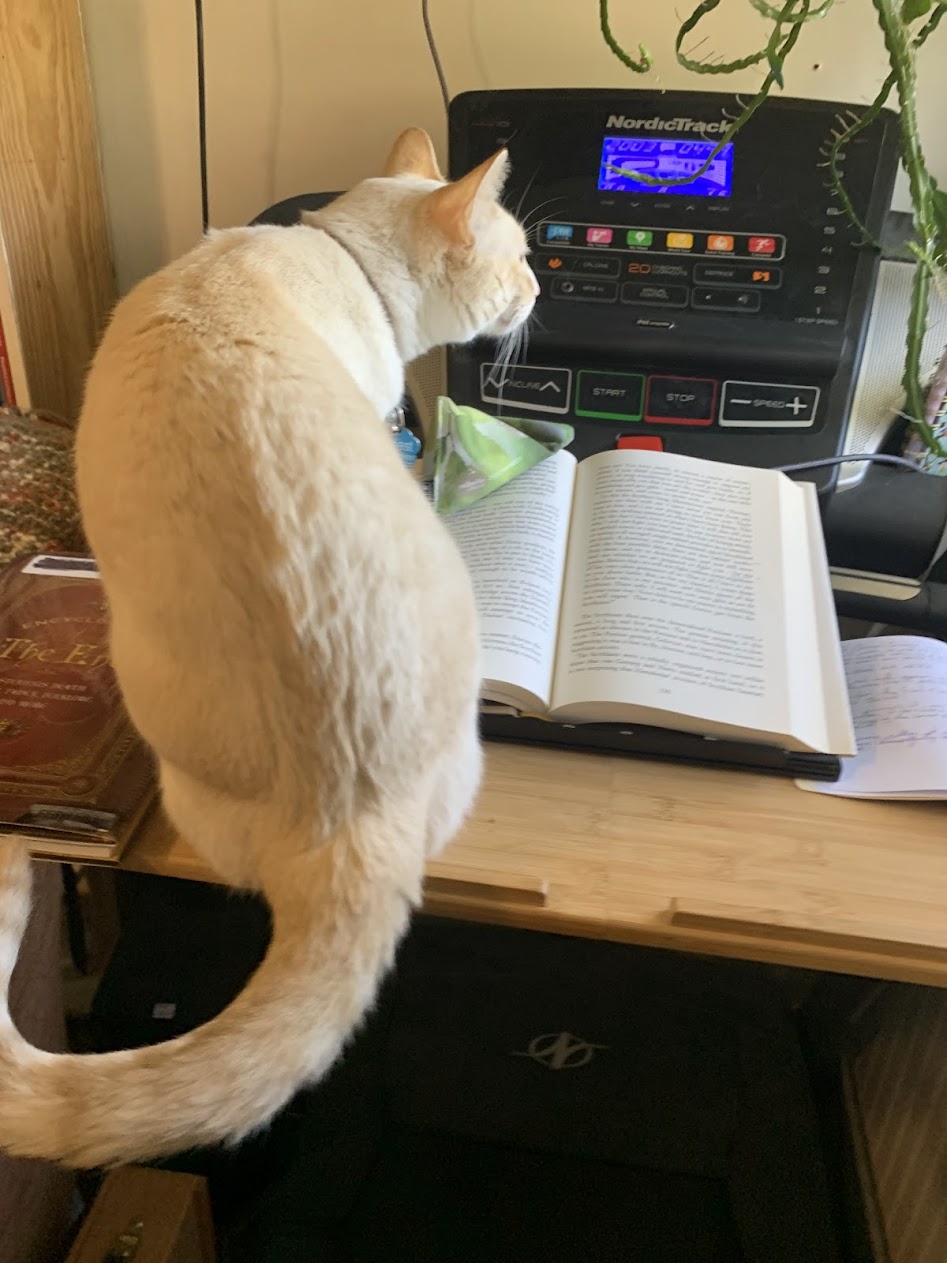
While I was working on the latest novel, I also was reading, or had read, a stack of books to give me support and ideas for what I was writing. As you do. In my case, I wanted some specific research books, so I hit Thriftbooks and picked up some that looked promising, and being used and fairly inexpensive, not a huge risk. Of the three, one was phenomenal and will stay in my library, one was meh and I’ll likely keep it for one reason only and one was…
Buying books online generally means you can look at the blurb, reviews, and get a decent idea of what you’re getting. This only works if you don’t skip past that part. In the case of Corpses, Coffins, and Crypts by Penny Colman, it was my ‘free book’ for the order so I tossed it in there and didn’t look very hard. And it’s not a bad book. It’s just intended for children (middle grades, to young teens) so it wasn’t very helpful for me. And for children who are interested in the topic, or struggling with the concept of what death brings to the human body, this is likely a useful book. It’s well illustrated, not at all morbid while being delightfully macabre and yes, I realize that’s a fine hair to split. It wasn’t helpful for my purposes as to my surprise, writing a series set in a cemetery already has me more than familiar with the highlights of death, as it were. I’ll be passing this on to someone.
The Encyclopedia of the End I’ll keep on hand because it is an easy alphabetical reference, and it’s got a solid bibliography in the back of it. The articles are likely more than in-depth enough for most purposes. I think it will continue to be more of a bouncing-off point for me, as I delve into Chloe’s new career, but that is fine. The mythology and folklore bookshelf is slowly growing as I add ever more esoteric books that are closer to original sources to it. Speaking of books not on that shelf, Mary Roach’s Stiff is a popular science take on what happens to the human body after death, and I shelve that with my medical books.
The book not on my shelves which came in handier for writing Have a Dead Night than I expected is the ebook version of Night Comes to the Cumberlands by Henry Caudill. I’m not linking to it, because I somehow managed to buy it twice, once years ago, and the other just recently while I was working on the book I was writing. I’m not sure what happened there, because it’s not in Public Domain to the best of my knowledge and I’m not clear on which copy I have is proper copyright. Still, if you can get your hands on a copy, and you are writing anything set in Appalachia, I recommend it. It’s bleak, in it’s portrayal of the hills and their inhabitants, but it resonates true with the stories I’ve been told by my mother-in-law and others who come from those hills. The holler in Have a Dead Night is based on a real place, which I visited with my husband and in-laws to look at a tiny cabin where Dan’l Boone and friends spent a winter. The bit with the owl in the holler is right out of Night Comes to the Cumberlands. Driving up the creekbed is based on where my husband’s family lived when he was a very small child, and where the family cemetery is. I try to insert what I know, or have learned, into my books when I can
Last, but certainly not least, is Timothy Taylor’s The Buried Soul, which was absolutely fascinating. Working forward from prehistory, and what the bones speak of about how the earliest people treated their dead, forward to the death of Lenin and how ritually coded the treatment of his body was, this book was thought-provoking. As a research book while writing fantasy, it was great for sparking my brain off into ‘ooo!’ moments. His discussion on bog bodies made me think of our own Alma Boykin’s tales, and I understand now why she treats bogs in her fiction the way she does. With great caution. From the viewpoint of someone who has spent a great deal of time reading fairy tales, The Buried Soul makes really interesting connections. I’ll be coming back to it with the future stories.
The thing is, Chloe lives surrounded by the dead, but has no real fear of them. Our modern American culture has a horror of the dead – and frankly, there are good reasons to be wary of death and dead bodies – but people all around the world know one thing: death and taxes are inevitable. To be born is to begin dying. I didn’t necessarily start writing the Groundskeeper Tales to say anything about the artificial distance we keep from death, but now that I’m here… writing a cozy fantasy set in a graveyard with a psychopomp, a ghoul, and several ghosts? Why not. In my world, death is not the end.
(Header image is Toast and my copy of The Buried Soul as she was ‘helping’ me with research)

 Mad Genius Club
11 responses to “The Books in a Book”
Oh, lord – the books within books …. I have shelves and shelves of Texiana – especially the books about the German settlements, for the writing of the Adelsverein Trilogy and the follow-ons. I believe I have just about every book there is in publication except for the wonderful, gossipy history of Comfort, Texas, by Guido Ranslaben, which was privately published and is a rare book costing over $100 when available. (Fortunately I got it briefly from the library…)
Then there is Wet Britches & Muddy Boots – about travel in the US in the 19th century – trains, flatboats, wagons and shanks’ mare… Appetite for America, about the history of the Fred Harvey Company, which was a nationwide hospitality chain (with restaurants, train dining cars, and resort hotels) about a hundred years before anyone else ever developed something like it. – That was for Sunset and Steel Rails, which had a young lady sign on with the company.
It really does save time, having that personal reference library…
Yes it does! I’ve been collecting some Texiana myself, and a local antique mall has proven itself terribly useful for that, I should head back over there soon to poke through certain booths again.
Although probably not very accurate, the musical The Harvey Girls, starring Judy Garland, is about, well, the Harvey Girls. https://en.wikipedia.org/wiki/The_Harvey_Girls
Apparently during the ’em robbing of Lenin, the sewers backed up in his mausoleum. One of the Russian Orthodox bishops is said to have remarked, as the relics flow the myrrh…
*entombing. Curse automangle.
Children’s books can be quite useful as research for subjects you are completely unfamiliar with. Though the tone can be a bit much.
This one isn’t twee at all, so it really isn’t bad, just not useful for me.
Something I found useful over the years were the WPA history books. One was a series on the various rivers, including Stanley Vestal’s The Missouri [dang, what I’d give to write like him!], and one on the great trails. There were other regional histories as well, several of which included dollops of folklore. They were written right on the edge of cultural shifts, and caught a lot of the now-lost local oral histories and traditions.
Yes, sometimes the tone is a bit condescending, but some of it is so straightforward that it chills the blood, like the one about the Deep South that describes a murder and mob attack. The author and his local associate disapprove, but the local’s tone of combined disapproval and acceptance that “very bad, but these things happen” … You won’t get that from modern histories.
I have a copy of Gumbo Ya-Ya, which is a book written for the WPA. It’s a massive collection of Louisiana history, culture, and folklore, and wildly entertaining. It covers everything from New Orleans history in French and Spanish times to the Creoles to voodoo to Mardi Gras to the rougaroo having their dances at Bayou Goula.
There are some parts in there that definitely wouldn’t pass muster today, but it’s far less condescending or racist towards blacks than you’d think. I was surprised by its chapter on the black churches with female leaders that combined Pentecostalism with spiritualism, and often had racially mixed congregations. This in the 1920’s and 30’s in the Deep South.
It really depends on the volume. Gumbo Ya-Ya is very even handed, as are most of the others. The one I was thinking of focused on Alabama and the central lower South. I wish I could recall the title and track it down, because I’d like to read it again now, 20 something years later, and see if I get the same sense as I did the first time I read it.
I just started re-reading my copy of Herbert Asbury’s The Barbary Coast, and in it he goes into detail about the San Francisco Vigilance Committees and how they cleaned the city out several times over. Basically, gangs of criminals were running amok, and since they were useful to the city politicians they got protection from the law. Finally local citizens had enough, got together under elected leaders, hanged the worst offenders and sent the rest on their way. At which point they set down their weapons and returned to their homes.
The unusual part by modern standards, at least to me, is how much Asbury approves of their reasoning: “When elected officials and the police refuse to enforce the laws they are paid to enforce, it has become the responsibility of the citizens to take matters into their own hands and put an end to the problem.” Not that I don’t agree, but I doubt many modern works would so approve of people who broke into the city armory, took out the guns, and then hunted down some very guilty men, put them on trial, and hanged some of them.