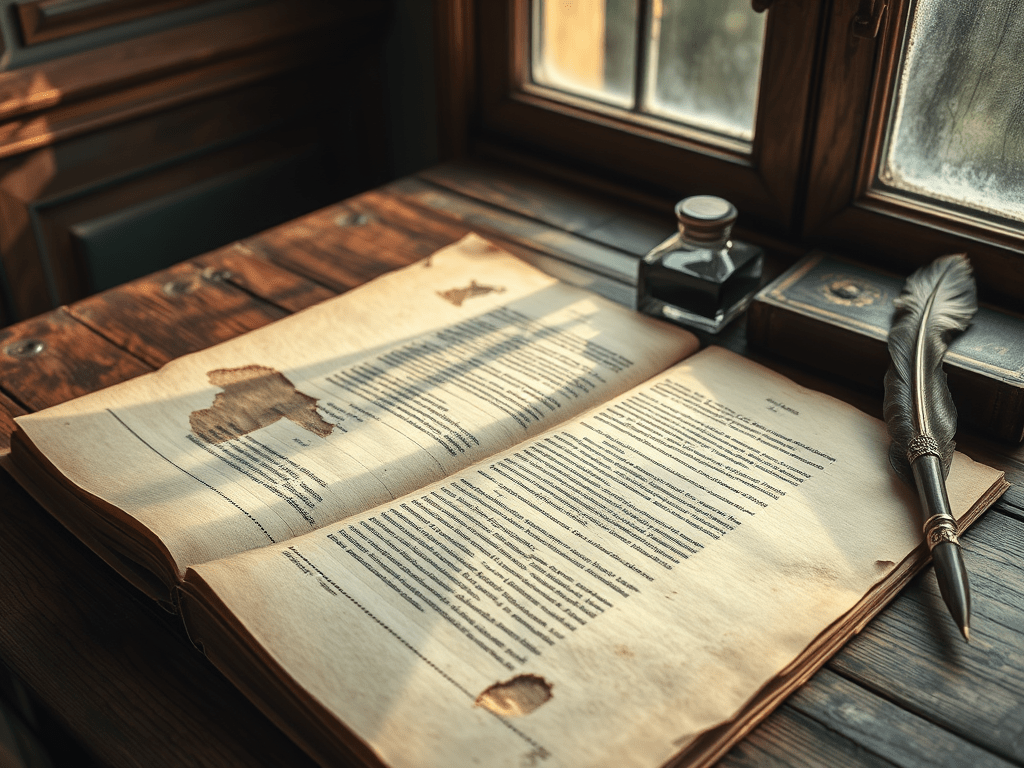
Palimpsest: One those words which has natural appeal for those with hippopotomonstrosesquippedaliophobia, being so short and in everyday use, ideal for slipping into conversations. When your wife tells you she is leaving you for the pool-boy, if you say in gelid tones: “My emotional reaction to your decision is something of a palimpsest,” will be both accurate and make her say: “And that is why!” before storming off to look it up.
Okay, beside such mundane usage, it’s also accurate to describe a lot of the writing process. A palimpsest is a page (often on vellum) that has been previously used, and then scraped or washed clean for re-use. It is sometimes possible to get to see the original text in it. Sometimes the original text is something you might wish to see. Sometimes not.
LLM are of course going to be this, on steroids, but with so many layers of text, it is likely that much of the original will no longer be visible (unless of course, you instruct the LLM to write the novel for you in the style of xyz author – might even be you). Still, this where technology meets the human norm, because we all do this, overwrite, re-write, re-use (I got involved in a project that involved an author physically re-using text, that I thought would have been better re-written).
A couple of authors I have met take this to the extreme of storing their cut out bits — a sort of ‘spare-part jar’ rather like the mysterious bottles of screws, bolts and springs that inevitably end up being part of a garage sale after the guy who was sure they’d be useful dies and his widow is trying empty the workshop. I’ve bought a few, as parts of job-lots, for my widow, one day to do the same.
For me, this doesn’t really work. There are style and language differences in each book. But I definitely DO echo earlier work – both of my own and of authors who influenced me, or that I am trying to imitate. It still comes out as a mix of that and me, but you can see the ghostly echoes there.
And you? Do you have the shadowy letters of earlier work there?
 Mad Genius Club
9 responses to “Palimpsest”
“Cut bits” is a section specific to each book in Scrivener, and it’s more about a) me wanting to see how much I have discarded in the process of writing and b) trying to see if maybe there’s a better place for a specific piece somewhere else in t he sam e novel. I don’t tend to get sidetracked by elaborate descriptions or colorful minor characters very much, and I can’t think of anything else that might be cuttable and recyclable.
Recyclable in a different work, I mean.
Not in my fiction, but in my non-fiction, I frequently find myself wanting to tell the same story to a different audience. Frequently, when confronted with such deja vu, I am able to do a search on my computer and find the previous essay, but sometimes I have to start from scratch, and, like Homer or some other ancient oral poet, attempt to recite it from memory. I often find what I consider the perfect phrasing for something and find myself repeating it to what I hope are different audiences, or at least audiences with poor memories. 🙂
What I really want to discuss is your first paragraph. The word “palimpsest” has always annoyed me, both for its obscurantism and because I always seem to misread it, skipping the last “s”. It seems to me the kind of word suitable only for describing some little-known disease in faux Latin. Speaking of which, then there’s hippopotomonstrosesquippedaliophobia, a deliberate redundancy, created only to serve as an example of itself. Now, as a lifelong writer, my vocabulary is apparently larger than the average person’s. I try not to use unusual words in my writing, but occasionally one slips by as when I was joshingly scolded by a friend for using the phrase, “my famously parsimonious grandmother”. I swear I thought everybody knew that word. It reminded me of William F. Buckley who was famous for his seemingly snobbish attitude and large vocabulary, who once defended himself by pointing out that he had to frequently consult a dictionary when reading John Updike.
Of course, I understand that your first paragraph is meant as an epitomization of itself, and is all in good fun, but it still triggered my rant. For a writer “trigger words” are nothing to be scared of, but rather are inspirations! 🙂
I have a bits and pieces folder. Some of the ideas don’t fit the current work or series, but might appear in a new form elsewhere. Some ideas won’t see print, but I need them as reminders about back story, or what has been hinted “on screen.” Others never find a place.
Ah, yes, TextSnips.rtf — 620K, or over 100,000 words of stuff that didn’t fit into the story. After going to all the trouble of writing it, I’m not just going to throw it away; it might come in handy some day! I’ve got another 550K associated with my current W-I-P too. A lot of that is going to get used…eventually.
Yeah, I do have containers of screws, nuts and hardware — what’s it to ya? 😛
I save, in a separate file. As a pantser I’ve written a scene that just does not fit, or the story decides is taking it in the wrong direction. More than half the time, a few chapters later, that cut scene fits in like a bug in a rug.
Re: obscure words. I try to keep the language simple, but some of my characters just love to hear the sound of their own voice speaking ten-bit words.
Since I write non-fiction, yes. Half my books are explorations of research I did for other books. A book on the US Pacific Fleet 1941 leading to a book about Japanese rikko bombers vs US warships (current work in progress). A book about US submarines vs Japanese aircraft carriers leading to a book about US WWII submarine tactics (to be written next year). And many, many others.
These follow-ups are easier to write (kind of like keeping a fiction series in the same universe with the same characters), but they also allow me to explore things I found interesting writing the previous book, but could not treat properly in that earlier book.
I keep all the old versions of a WIP backed up as I go forward. Any time there’s a revision of a title I keep the old ones and give the new one a new file name.
Because you never know if it might turn up useful later, right? This is the pack rat in me, saving everything in case Something Might Happen and I might need that some day.
Which leads me to a new Rule of the Universe I have formulated, known henceforth as The Phantom’s Rule of Things: If you bring it along, you probably won’t need it. If you don’t bring it along, you will need it for sure.
And so my hard drive is loaded up with old versions of everything I’ve written or that I’m writing. There’s a mountain of it. (On the other hand, storage is ridiculously cheap. 64 gig thumb drives are more storage than I can ever fill by writing in three lifetimes, and they are $15 for a nice Sandisk one, even here in the Demented Dominion of Canaduh.)
But having said all that, I don’t go back through old versions and try to reuse the cut-out bits. If I want to put it in a story it’s much easier to just type it again, custom to the story being written. This is more reasonable for a seat-of-the-pants guy like me. I’m literally making it up as I go along anyway, putting something in from memory is much more efficient than cutting/pasting/editing an old clipping.
I have a sub-folder in my writing folder called “Pigpen.” It’s where I put chapters, scenes, and random sentences I decided not to use, just in case I find a use for them later.