(For the French-impaired: The Right Word)
Vocabulary at the individual word level is a hugely important tool in our kit. Finding just the right term can distill more meaning with a single bang than the longest pedantic description of character or action. But be sure it can do the work! Your clever references are of no use if the reader can’t interpret them.
Some examples of words carrying weight follow.
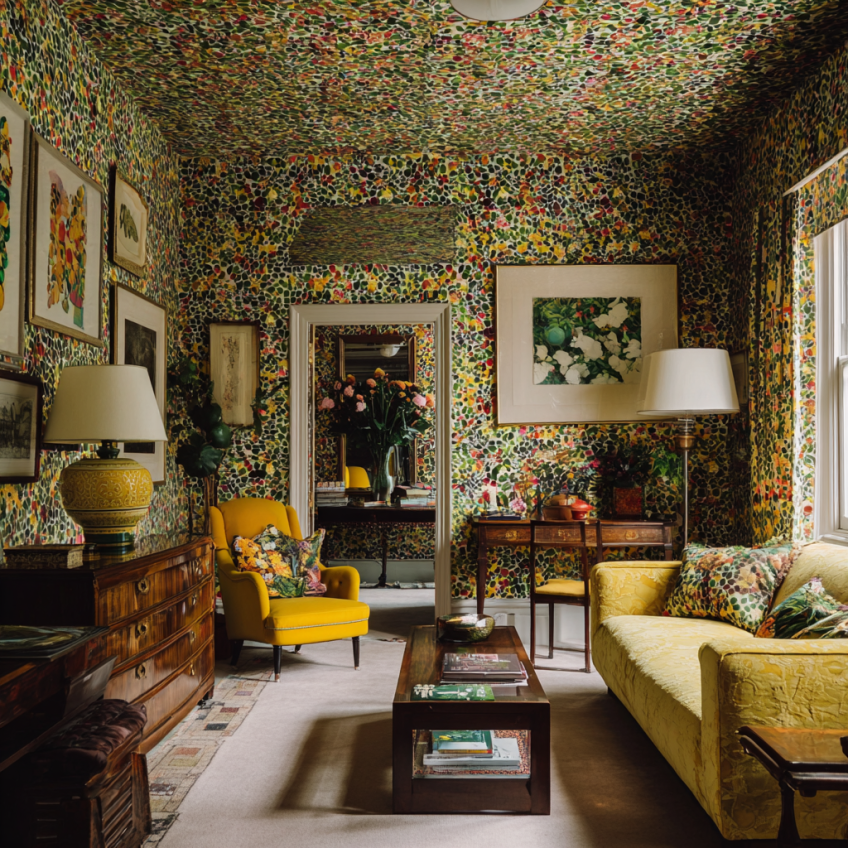
1. Single word example: “The walls were papered with a maddening design of interlocking rosebuds that simpered their way to the ceiling.”
To introduce the reader to the interior of a failed, lower-middle class apartment as a judgment from the ever-important British class status hierarchy, what could be more sneering in multiple directions than that choice of “simpered”? Think how much baggage that carries.
(Source: George, Elizabeth. A Great Deliverance (Inspector Lynley Book 1) (p. 76). Random House Publishing Group. Kindle Edition)
2. Shorthand referrals to a “well-known object” so that it can carry the descriptive communication weight that you don’t think you need to be detailed about.
Just mentioning, say, a saddled horse suggests entire surroundings re: smells, movement, interactions, clothing… all of it period- and culture-specific. It doesn’t take much to make the scene vivid because you don’t necessarily have to describe all the details.
But be careful — the thing referenced may not be common knowledge and your readers may not get it. I recently read a SciFi that referred to an alien goods transfer vehicle using a term for a US Navy military vehicle. I am sure of many things from this: the author has a military background, the comparison is presumably apt, and he meant to suggest subliminal things about power and capabilities by use of that comparison. But, alas, I don’t have that background and have no idea about the vehicle’s size or capabilities, so it failed to communicate to me as shorthand.
This sort of thing is a common pitfall for “knowledge expert” authors. But if you slip in a clue, you can at least give the reader what he needs without being wordy about it. I might want to use shorthand for what I think is a common-knowledge reference, as a shortcut for readers who can recognize it, but I can still provide clues.
Example: “He eyeball checked that the wheels on his side of the F-150 showed as still locked, before he hoisted himself in to start lumbering up the trail.”
Those who do not know that F-150 was the most popular truck in America (still is?) can still figure out that the referenced vehicle is probably a truck and has some significant height/size/weight. (And, of course, those who are familiar with it provide more of their own vivid detail about age and weight and stability.)
3 – You can always pause and provide explicit descriptive information. Some do this directly to the reader, but I prefer the 3rd party who needs to be told things preferably indirectly and in bits..
Example: “How does X work? Well, Joey, as you suspected….
4 – My favorite choice, where possible, is to have both my reference and my clue operating, addressed to different readers (casual and well-informed).
Example: “It was a civilizational battle, Jim”.
” Ah. A Siege of Vienna, eh?”
This takes the form of a shorthand clue, followed by a defining term (for those who can recognize it) after the clue has been given. Even if they don’t recognize the reference, well, they still understand that this is something important enough to be compared as a commonplace, even if it’s not in their background knowledge. And if they do recognize the reference, you’ve just conveyed a wide bandwidth for a vivid comparison.
There are thousands of ways to let just the right words carry all sorts of weight without bludgeoning the reader over the head in the process. If you’re skilled, you can even stun them with that “simpering” in the first example, which makes them rethink the whole description and milk it for more flavor.
Got any favorite or personal examples of this sort of thing?




 Mad Genius Club
16 responses to “Le Mot Juste”
I suspect the classic is Heinlein’s “The door irised open.”
One I read in a romance story set in upcountry Alabama described a place as “…a stretch of houses with sittin’ porches and slow swings, weighted down with sprawling oaks.” Yes, it is very, very descriptive and gives a sense of the culture [as the character saw it] and age of the neighborhood.
Lovely!
I couldn’t tell you the precise dictionary definition of “simpered” but I get a sense that is a kind of weak crawl or shuffle, possibly a contrast of “sauntered.” So the wallpaper pattern is kind of meandering upwards in a non-direct way.
The example of the F-150 is a bit less clear without any more context, maybe another sentence about the character or his intentions or location. “Tall ground vehicle” is about all I got until you clarified.
Simpering is originally a facial/vocal expression, which i always read as cutesy, fawning and insincere. The Elizabeth George description should probably be understood as charged with gender stereotypes (ie, too frilly and feminine for the POV character’s tastes) as well as class stereotypes (Those People and their bad taste).
Something something lightning bug and the lightning.
From Josh Billings (Henry Wheeler Shaw) via Mark Twain: …the difference between the almost right word and the right word is really a large matter—’tis the difference between the lightning-bug and the lightning.
https://quoteinvestigator.com/2019/09/02/lightning/
Thank you. I didn’t realize someone had said it before Mark Twain.
Neither did I, until I hit that website. Kudos to Twain for giving credit to the originator!
I just came across another Elizabeth George usage, in the use of a noun in verbal form to be expressive and an inanimate object with opinions.
“Although Stinhurst was in his seventies his face had lost none of the extraordinarily handsome, strong-jawed force of its youth, and his hair, shafted obliquely by the amiable low light of the room……”
(Elizabeth George, Payment in Blood)
This sort of extension of form (“shafted obliquely” , “amiable light”) can easily be overdone and satirized (it was almost a comic rhetorical form in the hip ’60s as I recall), but if used sparingly it is remarkably vivid and thick with information.
I don’t know about “simpering” – but if that is a real room, the interior decorator should be arrested for assault.
AI, of course, with prejudice.
I saw the wallpaper and almost fled screaming. Too busy!
My suggested caption: “After The IED In The Florist’s Shop”
I’m pretty sure i saw this room in one of James Lileks’s galleries satirizing 1970s decorating.
LOL!
In the opening of Witch Prince’s Ways, the heroine is in a winter forest, with all the trees as bare as a gallows pole.