
Recently I’ve been working at traveling with my husband. You must understand that this means driving around town on errands, most days. We simply can’t do the long road trips we used to use as dates, where we could talk uninterrupted and then find some out-of-the-way restaurant to enjoy a meal together. However, we can and do amble the back way into town, roam through unexplored side roads, and take our sweet time while we manage an errand or three (but no more than three, because anything more than two is exhausting). It is good. Getting to chat is very good, since we spend much of our time at home in the same room, on two different computers, often with headphones on.
The other day I took him along for the first time while visiting the Friends of the Library Warehouse. Hardbacks are a dollar, paperbacks (and their definition of paperback is loose) are fifty cents. It is, needless to tell you all, a dangerous place. Fantastic for acquiring reference books, cheap, like the Miss Manner’s Guide to Excruciatingly Correct Behavior, and Emily Post’s Etiquette which I picked up on a recent visit. When my husband and I walked in, it was a week or so after they had added more shelving and moved things around, so the Western books were no longer where they had been. This was, of course, what my husband wanted to look at! We were shown where they had been moved, and faced with many linear feet of books, he happily settled into pulling books off the shelf, showing them to me, and telling me where he’d been when he first read that author. Mostly, field exercises in the army, or during some hours-long wait while the military shuffled their men from place to place. He didn’t necessarily remember the books, but the author’s style stuck with him. He eventually picked up three JT Edson novels, telling me gleefully how bad they are, and I found a history of the Korean War and another book on Rasputin (and perhaps a couple of other books), before we paid up and headed for coffee and breakfast.
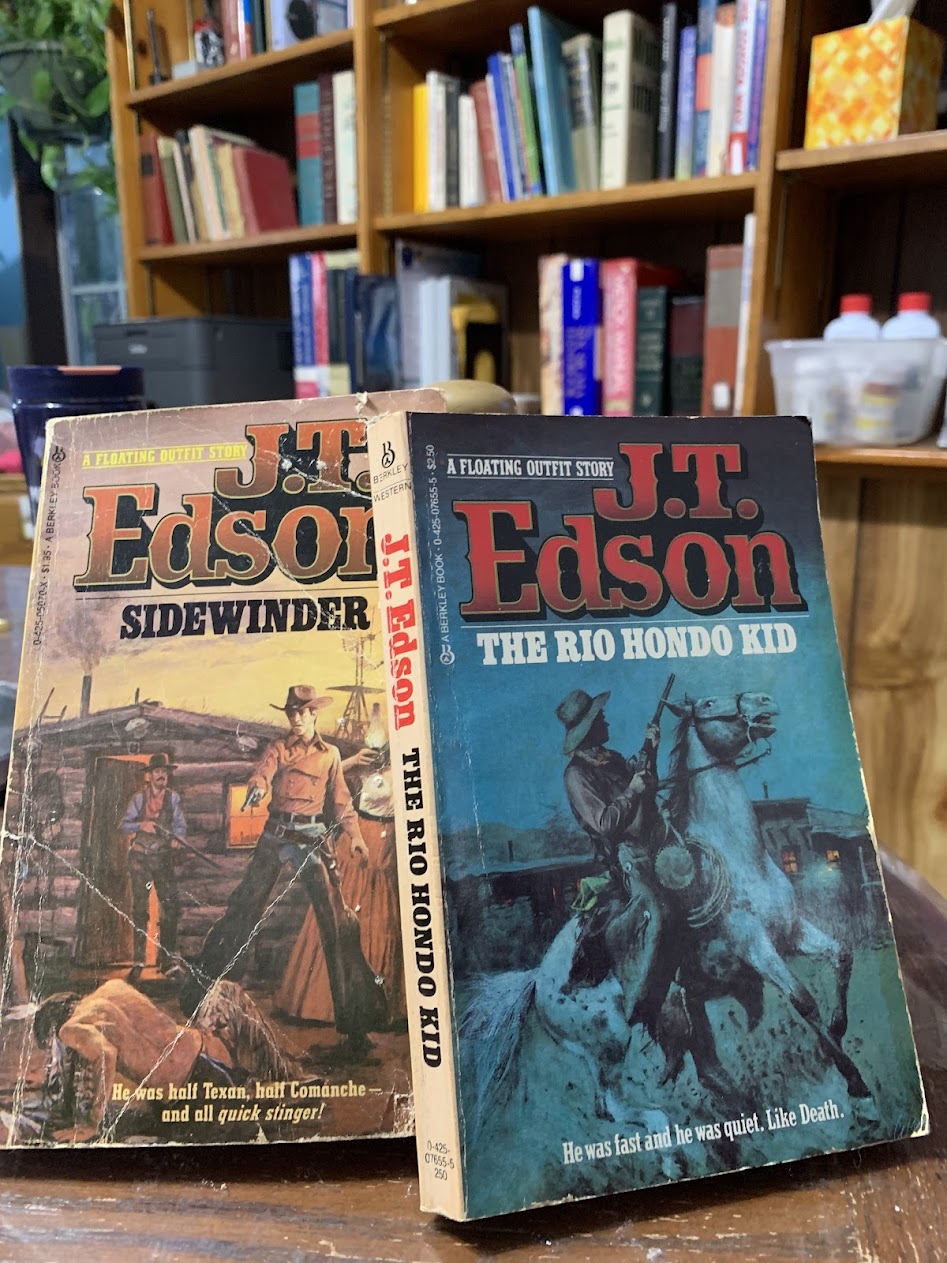
It got me thinking about the marks books leave with us. He remembers the very first book he ever read for pleasure, in second grade, a non-fiction book on sound waves. I… do not. I started reading at a very early age, around four, although Mom tells me she isn’t actually sure when I started reading. After that, I read voraciously. The only limits were running out of books at home or the library. I do have authors, or books, which shaped me. Louis L’Amour, an influence I share with my husband. Edgar Rice Burroughs, because when I ran through the tiny children’s section in remote Tok, Alaska, the library let me get into the storage room where all his books were lined up in a massive stack of hardcovers older than my parents. As a family, we read aloud to each other almost nightly, and these books were read more than once: Swiss Family Robinson, Little Women, The Borrowers, Five Little Peppers and How They Grew... as well as many others. I was given a set of LM Montgomery books for Christmas when I was 12 or 13 – the first brand new books I can remember owning all myself.
It isn’t just the books you read as a child, of course. Later reading leaves it’s marks, and in some ways these are more directed and chosen. Although I can’t say that I knew beforehand that Lois McMaster Bujold’s Komarr and A Civil Campaign would change my life, and save it. They simply introduced to me a concept I needed at that point. I suspect, and there really isn’t a way to collect the data on this, the books we read thinking they will influence us will have far less impact overall than the ones which surprise us. Besides which, the books we read later in life are building on the previous library we contain within us, making connections unique to us.
You are the only one in the world who has read the books you have read. Each one has made it’s mark, however faint and ephemeral. You have been shaped by those choices, the words in your mind echo back through the years at unexpected times to bring up a memory. And for those of us who write, we are what we’ve read, inescapably formed in the image of the books we’ve consumed. A synthesis of the past and the imagination, continuing in the tradition of setting words to paper in a story-form.


 Mad Genius Club
10 responses to “That’s Going to Leave a Mark”
I am grateful for the opportunities that benign neglect created for me. Our house had some seed material (my father brought few books to his marriage, but they included his own fairy-tale/trad childhood anthologies (good collections from the ’20s) as well as some of his college poetry books, and my war-bride mother practiced her English as an auditor of many literature classes at the local college (which I stole off the shelves whenever they seemed of interest (rarely, as a child).
Most importantly, my father’s Jewish background encouraged him to simply fund my book-buying requests without much inquiry, and once I found that out circa 4th grade… well, between Time-Life non-fiction collections, school book sales, random shopping mall outlets, downtown book stores with SciFi, etc., life became very good indeed.
I don’t have that material anymore (the marriage broke up while I was in college, and if I didn’t bring any of my personal possessions with me Freshman year, I no longer had them.) This sort of thing made me cling to books and reluctant to dispose of them, something which is now biting me. It would be much worse without ebook options, but the cost of storage has to be faced at this point. Sigh….
Still, my husband and I (met Freshman year in college) spent a great many expensive and gleeful hours booking, all over the literate Northeast, and gleaned the best of the collegiate and professional material of three generations. My horde is mostly self-indulgent or scholarly, but his also includes a serious Sporting (Hunting & Fishing & Equine) collection with monetary value (if I live long enough to package that for sale with him).
And it’s all grist for the writer’s mill, of course — the good, the bad, the boring, the transcendent. I’ve sampled thousands of lives, and only lived one. What a deal!
Not even if somebody else has read the exact same books, in the same order. No two people can ever read the same book, because the reader is part of the experience.
Exactly.
Golden Age sci-fi and fantasy, (Clark, Azimov, Anderson, Norton, McCaffrey) plus military histories of all kinds, often first hand accounts. Then toss in Susan Cooper’s Dark is Rising, which left an enormous impression on me. Rudyard Kipling and H. Rider Haggard – are they fantasy, science fiction, great adventure tales that happen to have something uncanny in them? I found the Heralds of Valdemar when I needed something like that, and Charles de Lint became my gateway to “grownup” urban fantasy. For a while I was very into Guy Gavriel Kay, and from him I stole the idea that you can take real events, and turn them into fantasy tales if you do it right.
No matter what combination, we all take something different from the books and authors, and what was going on in our worlds at the time. Some we can revisit and still enjoy (Haggard, Anderson, Norton, Cooper), some don’t age as well, or we see more of the work behind the surface. I cherish all of them, for different reasons.
There were so freaking many, even in the days when we were moving around a lot and shedding books like mad. What most human virtues look like (and also good prose looks like) I think I mostly learned from the Jungle Book, which I guess is slightly ironic. I Have No Mouth And I Must Scream was the obligatory “traumatized me when I read it too young” work. Tolkien’s probably responsible for my tendency to discover the backstory and family history behind a given set of characters once I start writing them. Emily of New Moon and its sequels was probably a bad influence in building up the Speshul Ah-tist self-image I had when I was young. Nearly everything I know about dialogue, I learned from Georgette Heyer and G. K. Chesterton.
One of the weirder things I learned from books is a contempt for the idea of rudeness as authenticity(1). Peter Wimsey calls it out in Murder Must Advertise as a kind of con job, which very few people “except St. Augustine” have ever seen through. I get why people are in full rebellion against fake nice right now, but it’s not an adequate excuse for being a bleephole, online or in person, and that applies to me as well as to everyone else.
(1) this is not to say that I am a polite or agreeable person, but I know it’s a character failing, not a virtue.
Copious amounts of history (including the historical books of the Bible, those were the exciting bits for me), Tolkien, H. Beam Piper, Jerry Pournelle, Clive Cussler, Eric Flint, David Drake, and the two C.S.es, Lewis and Forester, much of which I read when I was probably too young for it, but definitely helped give me a capacity to look at the big picture and be less trapped in the present.
Also, I don’t know if this is the place to ask about this, but would y’all be interested in a back-of-the-envelope book market analysis post that might encourage new authors who are wondering if low sales numbers mean that they’re not good at the whole writing thing?
TXRed as Mod: Absolutely yes!
I second this! Always happy to have more data.
Alright, cool, I’ll get to work on it then. Where should I send it once I’m done?
You can send it to cedarlila at gmail dot com. Thanks!