
I am in Dallas at FenCon this weekend, and yesterday was the first day of the con. It was a day of friends, old and new, conversations, and somewhat random food. I started the con off slowly with one panel, “Facts Behind Urban Legends and Folklore.”
It was a good panel discussion. One of the panelists was sitting at her very first experience on the side of the table facing the audience, and she did a wonderful job. Something she said caught my attention, about cooking with dutch ovens being a skill she’d given her main character. Later, during the question time of the panel, an audience member asked the panel a question, about showing something in use, rather than telling about it. I made an offhand comment that show, don’t tell, being one of those cast-iron rules of writing, and then added, with a glance over at the other panel member who would understand, that like cast iron it is brittle and can be broken.
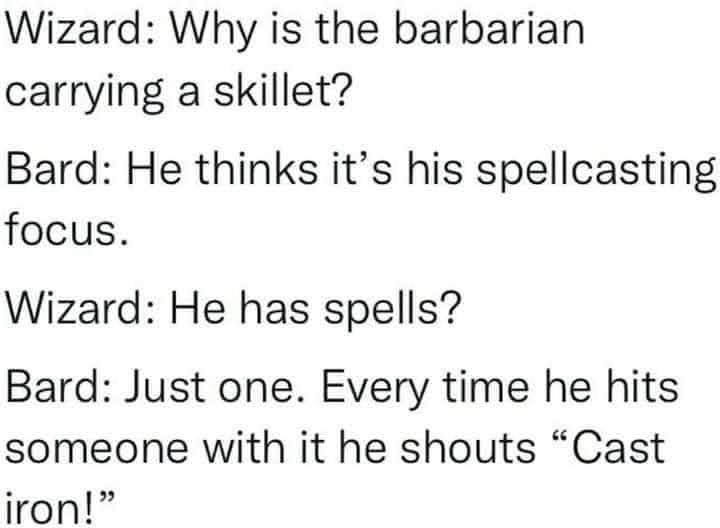
If you’ve ever dropped a cast iron skillet onto a hard surface, you know what I mean. If you haven’t, try not to. Most kitchen floors won’t lead to calamity, but from a height onto stones around a campfire, or onto a concrete floor… You know what I mean, and I didn’t have to describe the whole scene for you to flinch a little and if you love your cookware, feel the emotions I did thinking about it while I wrote that passage. While it can be very good to show in storytelling, there are times where you don’t want or need to do that.
If the story is short, telling in a few words or a sentence can allow the plot to drive on without being hung up in the weeds of writing out the ‘show’ of an object, an emotion, an interaction. If the ‘show’ is important to the plot, by all means, weave it in there. If it isn’t, and you think your readers will follow you, don’t bother with the ‘showing’ but simply introduce it and carry on. Unless you are writing a mystery and want them to be misled by the red herrings you keep tossing along the path, in which case, ‘show’ things that later turn out to have been unimportant, or downright misleading. Don’t do that too often, though. If you do you’ll have a confused, frustrated reader.
On the other hand, if you withhold the ‘showing’ of something (or someone) from the reader, you can pull off some deft misdirection that allows you to pull a rabbit out of a hat later in the plot. Don’t do this without foreshadowing, but that can be some small ‘tells’ tucked in that gave the reader hints but didn’t dwell on writing out the whole ‘show’ and, er, giving the show away.
In short, ‘show don’t tell’ is a solid rule of writing, a workhorse, even, that stands you in good stead. However, there are times that it can be broken, and probably should. Knowing the rules in order to break them is important, as this way you’ll know why the rule was there, before you circumvent it. And listen to your reader’s feedback. They may be telling you the story is broken, but it might not be in the way they are saying it is. The audience member asking about showing and telling was more interested in the idea, exploring a concept, than in moving the story forward. You have to decide what’s right for your story, for the length you want it to be, the plot it should have, and the style of digressions your readers will enjoy, and stopping to smell the roses while exploring just what chemical compounds make up their fragrance may not be it.



 Mad Genius Club
8 responses to “Cast Iron Rules”
I believe there are two sources of “show, don’t tell”, both of them eminently defensible in their own way (though, yes, of course it should be broken when the situation calls for it).
First, screenwriting. According to a probably apocryphal story, F. Scott Fitzgerald was on a studio lot when a producer was driven by in a car. The producer yelled out the window at him “We can’t photograph adjectives!” The screenwriting form has more rules than a sonnett, and for good reasons. And working writers were getting extra money in Hollywood since the silent era. So “show, don’t tell” very likely seeped back into fiction through simple osmosis.
Second, using it as a general rule is a good way to get writers to avoid relying on Informed Attributes. An Informed Attribute is a quality that a character is said to have, but which he never really demonstrates. “Show, don’t tell” subconsciously urges the writer to demonstrate the attribute, rather than having characters talk about it.
(The term comes from bad movie reviewer Ken Begg, who once described showing Zontar: Thing from Venus to someone for the first time, and that person said in frustration “What’s going on in this scene?” “It’s a comedy relief scene.” “But how can you TELL?” “It’s easy, listen to the music.” “…oh!” The music was informing the audience that what was on screen was supposed to be funny, even though it obviously was not.)
It’s older than the term. The oldest formulation of it comes from Aristotle: “The poet should speak as little as possible in his own voice.”
Wayne C, Booth’s The Rhetoric of Fiction is useful on the uses and abuses of show, don’t tell.
If a thing is not older than the term identifying it, then it is likely a marketing scam to begin with. 🙂 First things exist, then we name them.
Remember C.J. Cherryh’s great rule on writing.
“Never follow any rule off a cliff.”
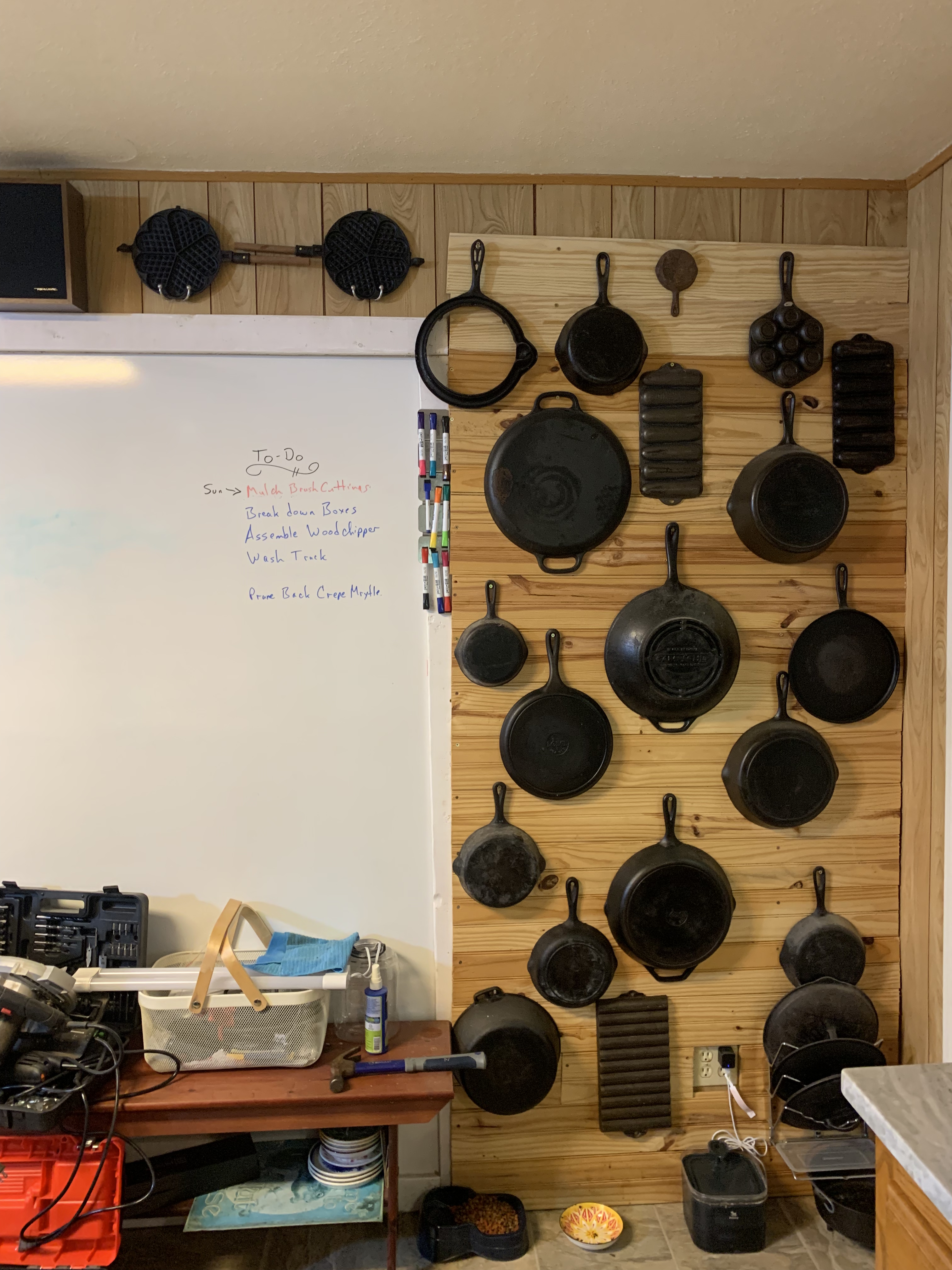
*Looks at pans in photo* Someone does not have a glass-topped stove.
Tell, don’t show works when you need to compress something that either the readers or the characters already know, like an event in a pervious story, or one that happens off stage.
For example: “Yeah, Big Bob was at the bar last night and had one too many. We had to get him home.” Jake pointed to his bruised cheek with his bandaged hand. “Tripped over the ottoman and hit the coffee table. His wife rearranged the furniture this week.”
I do have a glass-topped stove. Some of the pieces on the wall are heirlooms, not currently in use. Can’t have a gas stove here, sadly.
Last place had a glass top stove. I hated it – it was so unresponsive.
Current place is gas (first time for me). I like 👍. Induction does come close, though.
BTW, we use cast iron or carbon steel pans for non-stick use, such as frying eggs.
Properly maintained cast iron is non-stick.
Speaking of rule-breaking, though – I cook dishes with TOMATOES in mine. Wash as soon as it cools enough, and I’ve never had a problem.
Maybe I just had crappy ones in the places that we rented – but I hate gas stoves. For me, they always had just two settings – “Off” and “Incinerate.” Much happier with my glass top; never have a problem with response on it. (Like Cedar, no way to have gas in any case. Nearest line is nearly two miles away.)