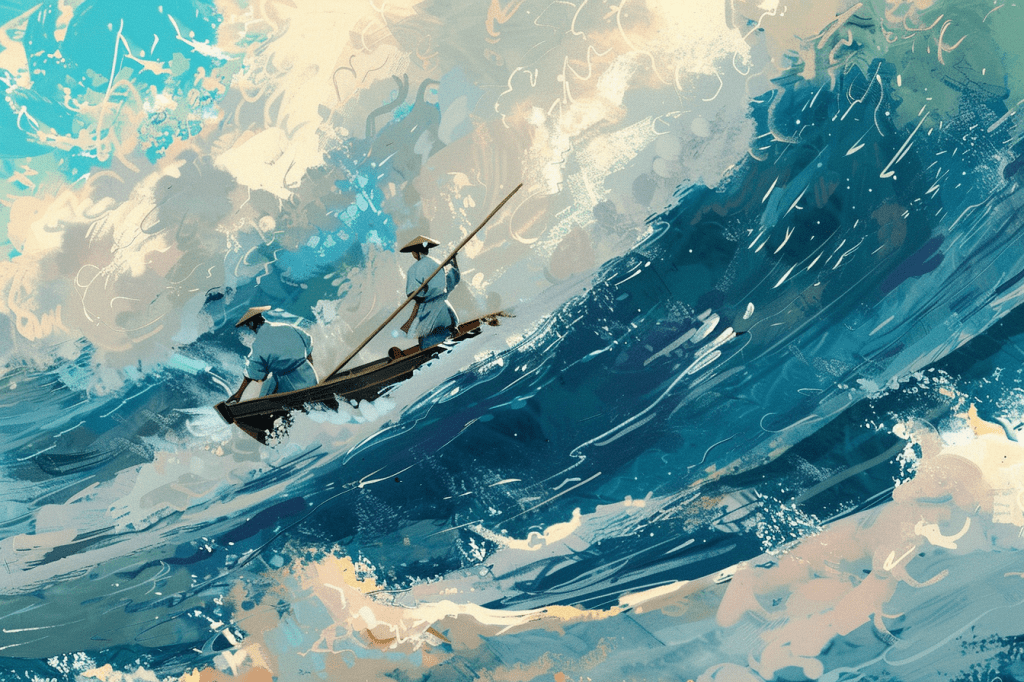
I have been reading, off an on, books about the South Seas trades, voyages, and specifically the trading routes, for several years now. Originally they were part of my research for the world of the Tanager, a trading ship whose route of planets was made possible by the space opera handwavium of jumpspace, folding the perceptual distance between stars and cutting a journey of many lightyears into mere weeks.

I’ve come to realize that some of my choices here were affected more or less unconsciously by early reading and a childhood listening to my father talk about Hawaii, where he grew into his teens and launched into an adulthood precipitated by my arrival when he was 20 and my mother 19, a mere ten months after their marriage. He met my mother on Sitka, another Pacific island, and later on I would come to live on the Pacific Rim in various places myself – although never past the wall of the sea crashing against a solid continental beach. At some point – I must have been ten or eleven – I found a battered copy of Kon Tiki, one of Thor Heyerdahl’s books, it’s dust jacket long lost, and devoured it. Then, I wondered how he could bring himself to leave what sounded like a paradise to a little girl. Now, I think I understand the fearful risks that life held.
Which brings me back around to the research reading. Most of the books I’ve found have been more focused on the sensational, like the one recording the shipboard mutiny of the whaler Globe, Demon on the Waters. I’ve poked around looking for accounts focused more on the trading, hoping to find one that would be more useful to me, and ran across Sea People: The Puzzle of Polynesia. I haven’t quite finished reading it, no time! but I’ve gotten enough out of it to recommend it as I did last week’s book, for world-building a far-flung science fiction world.
Unusually in this day and age, the author seems to be making an effort to portray both sides of the equation fairly. I really enjoyed that – while the Europeans were no angels, they were taking on voyages of almost unimaginable duration and difficulty to explore their world. The Polynesian peoples were, at that point, settled into their separate spaces, having for some inexplicable reason given up the long seafaring tradition that had brought them there in the first place.
My mind began to buzz with the thought of explorers reaching, as it were, an archipelago of stars, each with habitable planets, possibly even more than one (let’s not say science proves this impossible, as the science at the time of Cook and his predecessors proved that there was a continental mass which balanced those of Europe and Africa, keeping the world from spinning out of balance and wildly off into deep space). An ocean spangled with stars, and a people scattered amongst them, with a shared history, and no starcraft. Just how did they get there?
They might have, as the Tahitian Tupaia did, a staggering knowledge of places they could never have traveled to on their own. Lost civilizations, like the heads of Easter Island, might lay there on planets habited by peoples who could not explain how they got there, or how they had accomplished what the evidence so clearly showed they had.
“The way a star compass works is this: You begin by envisioning the horizon as a circle marking the meeting point of the earth and the sky—which, of course, is exactly how it looks from a boat on the ocean or the high point of a small island. In the mind of an experienced navigator, this circle is dotted with points marking the rising and setting positions of particular stars. When the navigator imagines himself at the center of this circle and his destination as a point on the horizon, the star compass becomes a plotting diagram, giving the bearing of his target island in terms of the rising and setting points of particular stars. A “star path” is a course defined by the series of stars that rise over the course of a night in a particular direction.”
— Sea People: The Puzzle of Polynesia by Christina Thompson
https://a.co/aukslaE
The discrepancies between Cook’s charts, and Tupaia’s can be seen as how they saw – or didn’t see – the stars. Like our star-voyagers to planets unseen, the canoes of the Polynesians set out into empty water for lands they didn’t know existed. It is breath-takingly foolish, from one perspective, or brave from another. Wouldn’t that be a story to tell?
I love this sort of research, where I am springboarding off the past into the pure pool of speculation, where there is no single axis of possibility. The glimpses of human nature, or the nature of exploration itself, are here, and can be extrapolated into a story readily, serving as a foundation to build on.
Hopefully I find the time to finish the book soon, and it stays so consistently good – I can already recommend it, and it’s in Kindle Unlimited so an easy risk to take if you use that service. Even if it takes a turn, though, I’ve already gotten enough story fodder to add into my work to make it worth the time.



 Mad Genius Club
14 responses to “Ocean Spangled with Stars”
I’ve read in other sources that they read the wave-patterns and migrations of birds to figure out where there ought to be other land-masses before they ever ventured out. How would that translate in space, I wonder….
Look at the techniques used to find probable exoplanets. Most of them were found by observing a particular star long-term so you could detect the variation of light intensity pattern as the planet crosses the star.
If you haven’t already read it, I strongly recommend reading the sequence in Nevil Shute’s “Trustee from the Toolroom” where the object of the search is in the islands, and the hero takes on a native navigator to find it.
And if you don’t already know the book, you’re likely to enjoy it anyway.
Almost anything by Shute is a great read, but that is absolutely one of his best.
It has been on my TBR for a long time – I’ve read and enjoyed several others of his, just somehow not this one.
That section of it has a use case for what you have in mind that you might find interesting or suggestive. And that part starts in Hawaii.
Brian Fagan’s Beyond the Blue Horizon is an anthropology/history of the transition from coastal sailing to deep-water sailing, looking at very early navigation and technology. Like all of his books, it’s quite readable. (Fish on Fridays about the social, environmental, and economic side of medieval fasting practices is also fascinating.)
Thank you! This looks like another I’ll enjoy – but I usually do like the ones you recommend.
Ms. Sanderson,
Kudos on this piece as I look forward to release of your forthcoming book; hopefully “real soon now” (with apologies to the late Jerry Pournell). I’ve downloaded on your recommendation “Sea People: The Puzzle of Polynesia” by Christina Thompson. Implicit in the voyages of ancient peoples is memory, and as we all know too well, memory is perishable.
Tolkien reminds us that “History became legend. Legend became myth.” Patrick Nunn’s “The Edge of Memory” suggests memory lasts up to 10,000 years. This of course suggests the span of human memory extends past the advent of the written word with events poorly recalled in what was written after the events themselves. Witness the manner of the Trojan War as recounted by Homer many years after the reality of events spawning the story. Already when put to paper, the world described by Home had ceased to exist, as exemplified by the manner of individual combat by heros instead of that of the Greek hoplites arrayed in depth for combat en mass.
I’m fair to sure there was linguistic analysis done of fairy tales, including but not limited to Grimms’ collection, that concluded some portion of them were older than written language, and definitely older than the languages in which they were first written down.
In fact, yes, at least some fairy tales are more than 6,000 years old. Written language is a bit more than 4,000 years old.
https://phys.org/news/2016-01-phylogenetic-analyses-fairy-tales-older.html
Yeah, well, I would recommend treating all such claims as high suspect.
There has been a LONG history of making improbable claims about the antiquity of fairy tales. My personal favorite was the analysis of tales on the assumption that a certain plot device stemmed from the era when human beings deduced paternity.
Memory is also mutable, which is how legends morph into mythos. It’s fascinating to read folklore and fairytales from around the world and see the threads that connect them all woven in.
There are also more recent influences. For instance, the publication of the Brothers Grimm resulted in a noticeable shift in folktales in Japan.