
It’s rare that I pick up a research book and read it almost in a sitting. I’m far more likely to absorb bits that I need, or to take weeks dipping in and out while I read other things for pleasure in between. I’d picked this book up at an antique mall last year, and it’s been sitting in the general history section of my home library since. I’d been toying with setting stories in my adopted state of Texas, and acquiring research books toward that idea, as well as doing some traveling about the state. I want to do more of the latter, in particular to museums, but I digress.
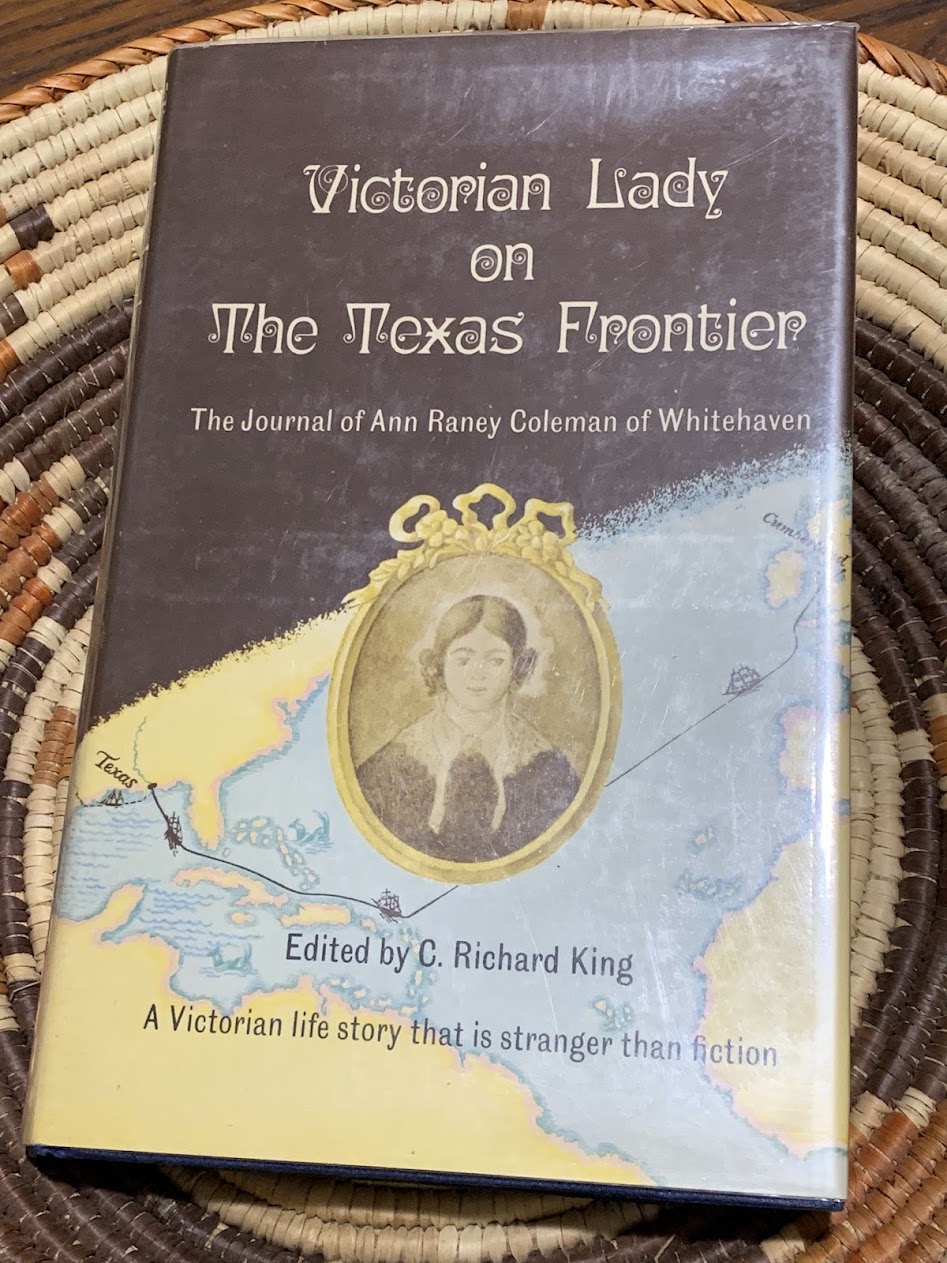
I’d seen this book on the shelf at the antique store, given it a cursory glance, and then went on as it was more than I wanted to pay at the time. It stuck with me, though, and finally when I returned a month or more later and saw that it was still on the same shelf, I brought it home with me.
This is a book that has everything. Ann Raney was born in the Regency era of England, and the story starts there, where her life of privilege could easily be used for a writer researching the ubiquitous romances of the era. However, her father’s bankruptcy precipitates a family crisis. First her father and brother travel to distant Texas – which was not part of the United States at the time, and was, in fact considered a province of Mexico until 4 years after Ann arrived herself – and then she with her mother and sister followed.
Her story is told plainly, and while I reminded myself to keep a grain of salt handy, there are many parts which ring true. Her doomed relationship in England, although perhaps not it’s dramatic ending. The encounter with pirates as they sailed to Texas, which is where you get an idea of Ann’s insistence on looking at her enemy, something that she would do over and over with life, saving only her own husbands where she seems deliberately obtuse.
It is very much a look at a history modern women are, by and large, going to find incomprehensible. Ann resents her mistreatments, but doesn’t attempt to fight them in any real way. In reading between the lines, this is a woman who put up with some horrific infidelities and abuses. She was also a heroine. She fought, more than once over her life, for her home and her adopted country – the Republic of Texas. She fought, in a feminine way, during the Civil War, when she was fifty years old, and a great age in that era.
She was a teacher, many times, over her life. Sometimes for a single family’s children, some times for an entire school which might have been as many as forty students. The map of her life traces over much of early Texas and into Louisiana. It’s a fascinating read, with undercurrents that pass between the lines. She wrote the journal for her niece, and I can’t help but get the feeling this is the much-expurgated version kept polite for the ears of a young woman.
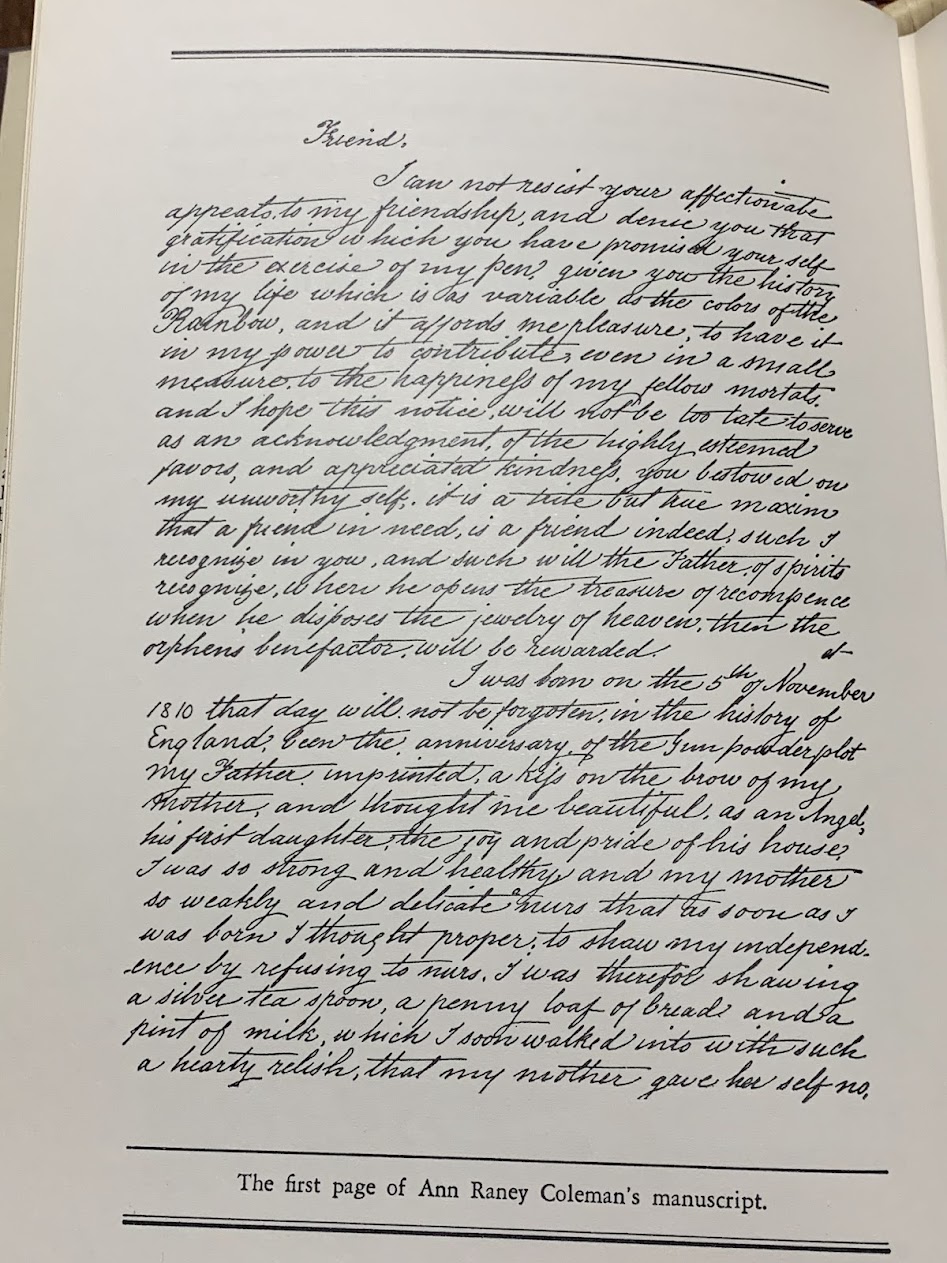
Would I recommend it? Well, yes. However, it is a very specific and single-minded story. One that will give you an idea of what it was like to be a young woman dragged off to colonize a distant and hostile world, peopled by those who were friends or wanted to exploit her – and sometimes both. Writing colonial science fiction? This may be useful. It is not available in ebook, but I was pleased to see that a paperback edition is still in print – I have the original 1971 hardback.
Would I take everything in the book as fact? I think I’ve made it clear that no, I don’t. I will say that I appreciate the professor who turned this into a book, as he included clear and copious footnotes on the people she lightly mentions, and the places she was, with their history, which solidly grounds Ann’s own tale. However, books like this are a window into a different era, different cultures, and well worth reading. They can help give modern fiction a flavor and basis in a way that a more, ah, filtered take on the past would not. Ann’s perspective is not a modern one, even if she herself considered her outlook more enlightened and sophisticated than the peoples she lived and worked with, while never being overly patronizing (especially towards the end of the book when she was in dire straits).
I do very much recommend books like this, obscure journals or autobiographies, if you are writing historical fiction and for things you might not have considered while writing genres as far-flung as science fiction and fantasy. Ann’s voyage across the ocean might well have been to a distant star. Her life in log cabins and during the Civil War, her teamwork with the other women to scavenge lumber for firewood (they lived where there were no trees, and a church that came down in a gale was the source of much wood, and an amusing account of a man set to keep them away from it utterly foiled and teased by a pack of mothers who would keep their children warm with it) could easily serve as inspiration for fantasy set in eras with no electricity and modern conveniences. Look around you next time you’re in an antique mall or used book store, for the tell-tale signs of the book that was published by a family, or a small university as this one was, which may be long out of print, and you’ll soon discover treasures for your research, world-building, and character studies.

 Mad Genius Club
11 responses to “Book Review: A Victorian Lady on the Texas Frontier”
The Betsy-Tacy books and the Anne of Green Gables books might be twee but I think they do a similar thing about setting you back in history. Of course those series don’t mention some of the biological things that must have been, well let’s not go there. I bet the nineteenth century was…aromatic.
I don’t think Anne is twee, but haven’t read Betsy-Tacy.
I will rephrase then. I absolutely adore the Anne series and I’m glad you do also. I laid a preemptive twee charge out there and will gladly withdraw it. Betsy-Tacy stories. Twee. But there’s a cool part where the family moves into a modern house with, gasp! Gas lamps to see by and IIRC a place you can bathe where you don’t have to bring buckets of water to it.
Both Betsy-Tacy and Anne were at the turn of the century, Some of the modern inconveniences (as a wit in the Anne book put it) were coming in.
Besides, what goes without saying doesn’t get mentioned. Your nose gets inured anyway.
Thanks for the recommendation. I picked up a copy.
I’ve been thinking about the parallels between the past and future colonization efforts a lot lately, too, but looking more to the musical realm for inspiration. Nathan Evans’ Wellerman is great.
That is an interesting approach!
I’ve got notes, and characters in my head, for a mystery series set against a vaudeville background, could be set in the 1880s or up through the 1910s or so. Even have a couple of good research books. But. I’ve been trying to find a journal or a memoir by an actor recounting, more than anything, the day to day details of moving by rail from town to town, getting laundry done, and things like that. A daily journal simply recording expenses would even work. But I’ve not come across anything quite like what I need yet (and I checked libraries in the Los Angeles area, which seemed like a good place, since so many vaudevilleans ended up in Hollywood, but, alas, nothing).
Granted, given my schedule for writing, editing, and publishing in the next year or ten, I don’t see how I could squeeze in a project like this that would have an audience of possibly just me. But still, I’d like to find something anyway, since that world fascinates.
Although… come to think of it… the plan for the books would set it squarely in “kids’ adventure”…
The comedian Fred Allen wrote a memoir that gives details about his start in vaudeville. Title is “Much Ado About Me.” It might be worth reading other works by comedians to see whether they contain info as well (the Marx Brothers?) – if you haven’t already looked into that.
I never realized Allen started in vaudeville. The Marx Brothers bios gloss over vaudeville, as it was seen as disrespectable burlesque, and focus on their success on Broadway. Not a lot of useful workaday detail in them.
Something I found fascinating was reading letters from the Old Country to people in Texas. How did the people back home, who had never been to Texas or the US, understand events and places? What worried them about the frontier and edge of civilization?
One letter advised that father was sending younger sister to live with her brothers in order to find a husband. Would two saddles, habits for hunting as well as everyday riding, and one formal gown in addition to her usual wardrobe be sufficient? And did they have a cannon for mounting on the wall of their ranche in case the wild Indians attacked? Father imagined a ranche to look rather like a small English castle, and the Indians to use tactics similar to the Zulu.
Alas, I don’t know what answers the brothers give their father. He obviously cared for them, and was sincerely concerned for their safety and that their sister would make a good showing in the local Season. But I sort of imagine the gents reading the latest missive and chuckling at how different their world was from what he guessed it to be.
Letters written by Rachel Henning to her family as she moved back and forth between Australia and England in the 1850’s are full of details of a completely different life. https://gutenberg.net.au/ebooks06/0607821.txt You have to go to the Australian Gutenberg because the book was published in 1951 or 2 so it’s out of copyright there but not elsewhere.