thump, thump thump… skitter skitter slide… thud
If you guessed that was a cat, running through the house, loosing traction on hardwood floors, extending claws in a failed bid for traction, and ultimately careening into a doorframe, then congratulations.
If not, don’t feel bad. I gave you no context. No setting of the scene, characters, no description from any sense besides sounds. I heard it in the dark, but then again I was familiar with the stage and the players on it, as I was heading for the cream with coffee mug in hand in my own home. I had set up the scene twenty minutes earlier when I fed them their gushy fud, and this was the morning zoomies sesh.
I was thinking, as I watched one of the miscreants jog past me, tink tink tink of her bell, innocent glance upwards from big blue eyes, that you could use this sort of thing in fiction. I know Toast was one of the guilty parties despite her ploy of ‘walk casual, act like nothing happened’ as her tail was poofed to twice again it’s normal sleek size. Using sounds, made-up words, these can introduce an element of whimsy into the work. Even a serious dramatic story can use a little whim here and there. Heather Strickler’s substack post on whimsy caught my eye this morning as I was sipping that coffee and contemplating awake and awareness from a suitable distance. It’s unpleasant to have awakening sneak up on you all of a sudden-like. I prefer to approach it slowly, with suitable blandishments.
Whimsy, and it’s companion humor (like Toast and her tiny companion Kittieboo) can lift a book from dark and dire to greater heights of emotion. You don’t want to overdo it (had there been the crash of breaking glass in the opening sequence I wrote above, this may have been a very different post) but the tension of crises will build better if you break it unexpectedly with a little ray of sunshine. As Heather points out in her post, it’s chiaroscuro for fiction.

The depths of failure, tragedy, and pathos that fiction can evoke in the reader’s emotions will seem even more abysmal if they are pushed further into the shadows by shining a light on Our Hero(es) in the form of hope, joy, and keeping the faith. If all there is, is darkness in the story? It’s flat and dull and lifeless. There is no hope, so why even bother? The main character (definitely not a hero in this story) may as well lie down and die, and the readers do something better with their time. Lift up the character with a touch of whimsy, give them hope of a sunbeam breaking through the clouds, and suddenly they may find within them that which defines a Hero.
It’s important to set the scene, though. Just splashing it in there willy-nilly can dampen the reader and turn pathos to bathos. Like my mysterious sequence of onomatopoeia above, you’ve got to lay the groundwork before hand. Give the reader what they need to know, but only when they need it. Like telling a joke, it’s all about the timing. And yes, I do realize this is vague at best. It’s something you’ll know when you see it, and then you should study it to see how it was done. Like looking at the brushstrokes of a master, then stepping back a few paces to let the whole picture snap into focus and brilliance.
Recently I had the pleasure of introducing my son to Terry Pratchett, who was a grand master of the whimsical. His are not shoes most of us can step into, but we can find ideas there, of whimsy and lurking in the deeps, there are dark Things with Teeth. His books skew more to the light, with abysmal shadows that catch you off-guard and are so camouflaged you may miss them entirely on the first reading.
Read, so you can write. What are your favorite moments of whimsy in an otherwise serious book?


 Mad Genius Club
7 responses to “Setting up for Whimsy”
‘Master Meriadoc,’ said Aragorn, ‘if you think that I have passed through the mountains and the realm of Gondor with fire and sword to bring herbs to a careless soldier who throws away his gear, you are mistaken. If your pack has not been found, then you must send for the herb-master of this House. And he will tell you that he did not know that the herb you desire had any virtues, but that it is called westmansweed by the vulgar, and galenas by the noble, and other names in other tongues more learned, and after adding a few half-forgotten rhymes that he does not understand, he will regretfully inform you that there is none in the House, and he will leave you to reflect on the history of tongues. And so now must I. For I have not slept in such a bed as this, since I rode from Dunharrow, nor eaten since the dark before dawn.’
[…]
Pippin remained behind. ‘Was there ever any one like him?’ he said. ‘Except Gandalf, of course. I think they must be related. My dear ass, your pack is lying by your bed, and you had it on your back when I met you. He saw it all the time, of course. And anyway I have some stuff of my own. Come on now! Longbottom Leaf it is. Fill up while I run and see about some food. And then let’s be easy for a bit. Dear me! We Tooks and Brandybucks, we can’t live long on the heights.’
The Council of Elrond contained quite a bit of vista to it. Rohan, for instance.
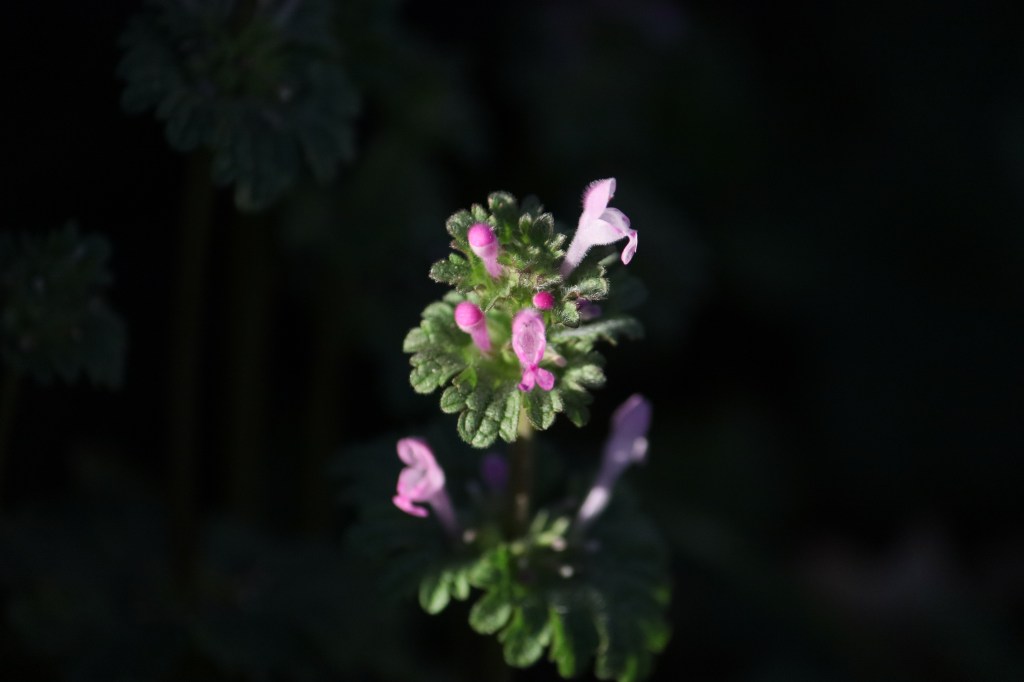
Gill-over-the-ground!
…Ah, no, that’s a close relative, Glechoma hederacea. Edible lookalike, though….
yes! There are three spring plants, all in the mint family, all looking similar, that I know and love. This is the one that thrives here in Texas.
I … have read so little fiction recently that I nothing springs to mind.
GiganCat was a sweet, enormous, not brilliant red tabby who never remembered that he had no stopping power of parquet floors. You’d hear him thundering across the den, see him try to stop, and then read over his head, “No braaaaaake—” Thud. I’m sort of surprised he didn’t have a flat face after so many years of sliding into the bar/counter between the den and the kitchen.
….I know I’ve seen it, but dang if I can think of one right now.
Of course, lately I’ve been trying to read light stuff, because dang do I feel down, so….
Servant of War, the final exam, the one with the Commissar. That one.
If you’ve read it, you know.